
24/7 Customer Support

Free returns

Same-day & Next-day Delivery

Quality Guaranteed

Unlock Your Welcome Offers: FREE Delivery | Up to 80% OFF | Free 30-day JoyPlus trial
Download the APP
Replacing dim halogen lamps with T10 W5W 194 LED bulbs can brighten your car’s interior, number plate area or side-marker lighting without complicated wiring. However, choosing by brightness alone often leads to poor fitment, dashboard warnings or bulbs that overheat.
UK motorists commonly search for 168 501 2825 LED bulbs, but these numbers can represent cross-reference sizes rather than a guarantee of compatibility. Before ordering, check the original bulb, the vehicle handbook and the light’s intended position.
T10, W5W, 194, 168, 501 and 2825 are widely used reference numbers, but housings can vary. A bulb may have the correct electrical code yet be too long, too wide or incorrectly positioned for a particular fitting.
Compare the replacement bulb’s length and diameter with the original. The KATUR 24-SMD models listed here measure 26.1mm by 11.4mm, while other T10 designs may differ.
Canbus error-free LED bulbs include an integrated circuit intended to reduce warning messages, flickering or bulb-out alerts. Vehicle electrical systems are not identical, though. Some cars may still need a decoder, resistor or a different bulb design.
Product descriptions may state compatibility percentages, but these are not a guarantee for every UK vehicle. If your car monitors individual lamps, keep the original bulb available and test the new one before refitting the trim.
“Super bright car LED bulbs” can be useful for a boot or cargo area, but excessive glare may be unsuitable for a courtesy lamp or number plate fitting. Colour also matters. Cool white can create a crisp appearance, amber suits indicator or warm styling applications and red or blue options may be restricted depending on their external position and vehicle use.
For exterior lighting, confirm that the colour and lamp type are permitted for your vehicle and do not compromise road visibility or compliance. These replacement bulbs are generally more appropriate for car interior LED bulbs, dome, map, courtesy and compatible number plate applications than for headlamp conversions.
Look for a listing that clearly includes your original code, such as T10, W5W, 194, 168, 501 or 2825. Cross-reference lists can be helpful, but visual comparison remains important. Check whether the bulb is a standard axial design or an offset version, particularly where the LED chip direction affects light distribution.
A plug-and-play car bulb should connect directly to the factory socket. Even so, LED bulbs are polarity-sensitive in many designs. If the lamp does not illuminate, switch it around rather than forcing the fitting.
Many interior lamps use a nominal 12V system, but a vehicle’s running voltage can be higher. Some options are specified for 12V, while others accept 12-24V automotive LED bulbs and may suit a wider range of vehicles.
Do not assume that a 12V-only listing is suitable for a 24V commercial vehicle. Check the stated operating range before purchasing, especially for vans, coaches or other heavy-duty applications.
LEDs use less power than traditional incandescent lamps in comparable applications, but they still produce heat at the chipset and driver. Aluminium bodies, ventilation and sensible power ratings can assist heat dissipation.
Published lumen figures should be treated as a comparison point rather than a promise of identical brightness inside every housing. Reflector shape, lens tint and lamp position all affect the result. A 360-degree design may help distribute light more evenly in a dome or map fitting.
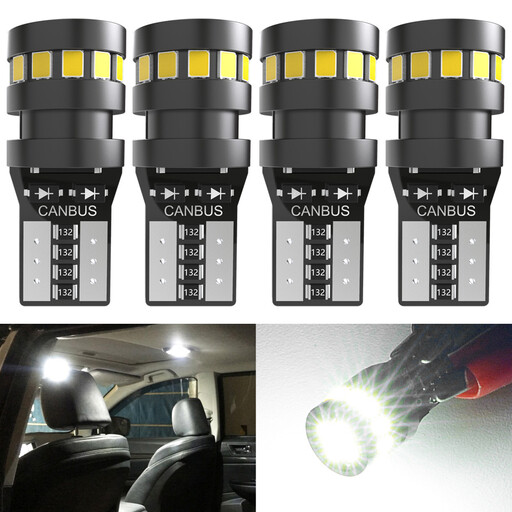
Why This Fits Their Persona: A practical pack for drivers replacing several interior, dome, map, door or courtesy bulbs in one job.
The listing identifies several cross-reference numbers and includes an integrated Canbus design, while still advising buyers to verify their original bulb.
12V operation, 2.5W per bulb, 300 lumens per bulb and a four-bulb pack.
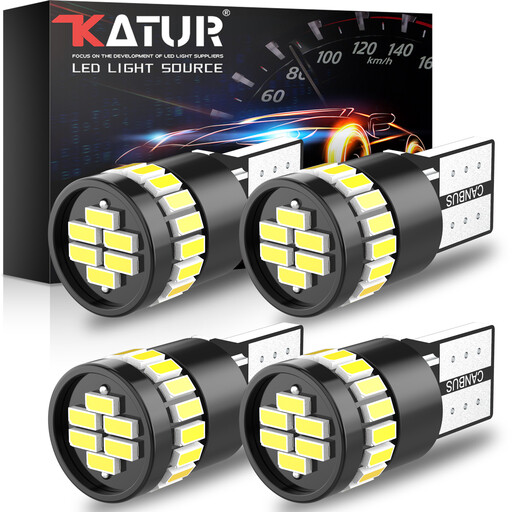
Why This Fits Their Persona: Suitable for owners seeking a consistent cool-white appearance across several interior or compatible external fittings.
Its stated dimensions, 24-SMD layout and cross-reference list make the fitment decision more transparent than relying on a brightness slogan alone.
The listing specifies 280 lumens, 12V operation, aluminium construction and a stated 60,000-hour rated life.
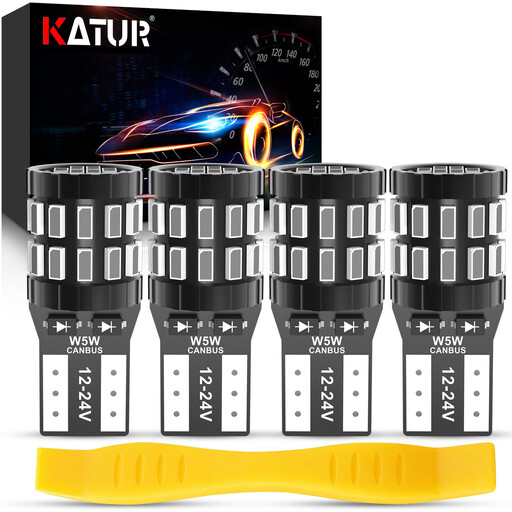
Why This Fits Their Persona: A higher-output option for compatible 12-24V applications, including some parking, marker, tail, dome and licence plate positions.
The 12-24V specification reduces uncertainty for wider-voltage vehicles, while the stated 360-degree viewing angle addresses uneven illumination concerns.
The listing specifies 30 3014 SMD chips, 3W power, 450 lumens and an aluminium body.
Before removing a bulb, switch off the lights and allow hot halogen lamps to cool. Avoid touching delicate LED components with greasy hands and do not force a bulb into a socket.
Use this checklist:
A pack of four LED bulbs can be convenient when replacing matching lamps, but buying more than you need is wasteful if your car uses different bulb types in different locations.
We have compiled a complete, real-time list of products that fully satisfy these strict selection criteria and UK safety regulations.
They are commonly used as cross-reference names, but interchangeability is not guaranteed. Check the original bulb marking, socket shape and physical measurements before ordering.
No. They are designed to reduce errors, but vehicle monitoring systems differ. A warning, flicker or rapid flashing may still occur, so test compatibility before completing the installation.
An LED replacement may use less electrical power for a similar application. Actual savings depend on the number of lamps, usage time and the product’s stated wattage. For example, some listed T10 options specify 2.5W or 3W per bulb, but brightness and suitability still depend on the housing.