Who these robots may suit

Home players fitting a shared space

If you already have access to a table, plan where the feeder, any collection net and your playing position will fit. Table Tennis England’s recreational playing-area guidance can help with space planning, but it is not a required clearance for a domestic robot.

Solo players practising longer drills

If you want to spend less of a session gathering and reloading balls, check whether the setup only catches balls or returns them to the feeder.

Club players building varied sequences

If you practise structured drills, match the robot’s placement, spin and sequence controls to the shots you want to repeat. Also consider how you will move the equipment and arrange support between sessions.

What to prioritise when buying

Check the table and playing space first, then decide how you will manage balls between shots and which drill controls you need. A consumer may care about several factors, but the rows below distinguish the primary need that matters most to each scenario.

Concern What to check when buying Who this matters to
Table attachment and usable room Check whether the model sits on, attaches to or stands behind the table; measure the mount, net clamps and space for your playing position. If you need the feeder and your movement area to fit around an existing table, that fit comes first. Around 29% of consumers prioritise table and space fit.
Ball recovery and session interruptions Distinguish manual collection, a catch-only net and a system that returns balls to the hopper; check the exact model and bundle. If repeated drills would be interrupted by collecting and reloading balls, you may want a compatible return-to-hopper arrangement. Around 22% of consumers put fewer collection and reload stops first.
Shot variety and drill control Check whether spin, speed and placement can change within a drill, and how the model creates or stores sequences. If you want changing shots or repeatable sequences rather than one basic feed, match the controls to that practice goal. Around 21% of consumers prioritise varied drills.
Straightforward setup and equipment needs Check the exact bundle for balls, collection accessories and power supply instead of assuming they are included. If basic feeding and a clear picture of the complete setup matter more than advanced controls, compare what comes with the particular variant. Around 14% of consumers prioritise a simple feeder and setup.
UK service, parts and electrical setup Ask who handles model-specific repairs and replacements, and check the supplied plug and applicable information for your UK destination. If you rely on the robot for shared or regular practice, you may want a clear support route and suitable electrical equipment. Around 14% of consumers put support and electrical setup first.

For recreational play, practice and coaching, Table Tennis England recommends a playing area of 8 m × 4 m with 3 m of clear height. Treat this as playing-space guidance, not a compulsory domestic robot clearance; check the actual robot and net footprint as well as room for your strokes.

Buying pitfalls to avoid

  • Assuming every net automatically recycles balls

    A catch net and a return-to-hopper system serve different purposes. A catch-only setup can still leave you collecting and reloading balls during a longer session.

    Check the exact model and bundle for the collector, side nets and return path before comparing setups.

    A compatible return-to-hopper conversion may be a separate purchase.

  • Checking table length but not installation fit

    A floor stand needs space behind the table, while a mount or collection-net clamp may not fit the table edge. Table Tennis England’s playing-area guidance is not a substitute for checking the robot’s mounting hardware.

    Measure the particular mount and collection equipment, as well as the area you need to move and play. The Practice Partner 80 listing specifies a maximum net-clamp opening of 90 mm; that measurement applies to that setup, not to robots generally.

  • Treating feed frequency as proof of varied drills

    A feed-rate figure does not tell you whether shot settings can change from ball to ball.

    Match the documented controls to your practice plan, whether that means fixed repetition, alternating placement or individually programmed balls.

  • Assuming a listing or warranty applies to every UK purchase

    UK listings differ on the Robo-Pong 1055’s current availability, and the Amicus Prime manual’s stated manufacturer-plus-distributor warranty applies to North and South America only.

    Before ordering, confirm the current UK seller’s written warranty, repair route and accessory availability for the exact model.

Relevant brands to consider

Practice Partner

The PP20 represents a table-mounted option for home or school practice; the PP80 is an example of a wheeled floor-standing setup.

  • The PP20 listing describes adjustable frequency, spin and oscillation, with an optional net.
  • The PP80 listing gives a 90 mm maximum net-clamp opening and marks that model discontinued. Check current availability and table-edge fit before considering it.

Newgy

The Robo-Pong 1055 represents a bucket-fed robot with preset drills and a separately offered recycling conversion.

  • A product listing describes a 200-ball bucket, and a compatible recycling upgrade is listed for specified Robo-Pong models.
  • UK listings differ on the 1055’s availability. Confirm the seller, compatible upgrade and repair route for the exact model.

Butterfly

Amicus Prime is a UK-listed option for players seeking programmed sequences with ball-by-ball changes.

  • The Butterfly Amicus Prime manual documents variation in spin, speed, placement and trajectory within exercises.
  • The manual’s stated manufacturer-plus-distributor warranty applies to North and South America only; check the UK seller’s terms.

Power Pong

The Alpha Plus, Delta and Omega are presented as programmable options with recycling systems.

  • Power Pong UK’s product comparison says these models include recycling and describes different control methods and drill capacities.
  • These are supplier descriptions and terms, not independent performance findings. Confirm the chosen model’s terms and power supply with the seller.

JOOLA

The Buddy V300 is a compact tabletop option described for relatively simple spin and oscillation practice.

  • The UK listing describes adjustable topspin, chop and oscillation, with the robot positioned at one end of the table.
  • The robot-only listing says balls are not included. Check the exact bundle rather than assuming a separately offered set is part of it.

SmartPong

The TJ3000A is offered by a Leicestershire-based specialist advertising nationwide sales and service.

  • The supplier describes programmable shot settings and offers a separate tripod accessory for positioning the feeder away from the table.
  • Confirm the exact net, tripod and repair arrangements for the model you are considering; supplier comparisons are not independent evaluations.

Joybuy product options for solo table-tennis practice

These Joybuy product choices relate to solo table-tennis practice and ball collection.
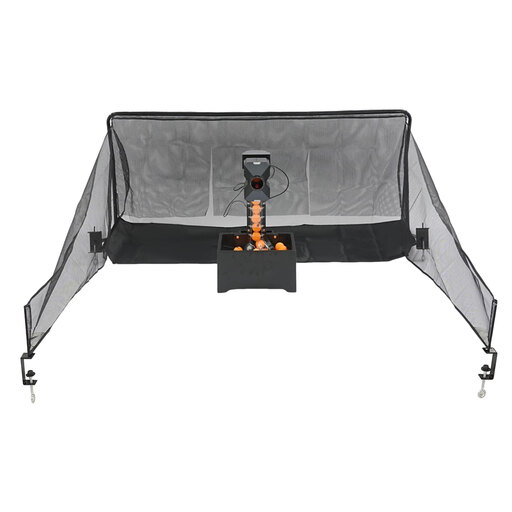
Table tennis ball pitching machine with 10 training modes, wireless remote and catch net

Table Tennis Ball Pitching Machine, 10 Training Modes

Its listed catch net and retractable ball picker may suit practice where collecting balls is part of the setup; check whether the net catches balls only or returns them to the machine.

Listed features include 10 training modes, a wireless remote, a catch net, a retractable ball picker, 100 × 40 mm table-tennis balls and a UK plug.

Joybuy

Frequently asked questions

How much room should I leave around my table?

Measure the table, the space you need for strokes and movement, and the footprint of the particular robot and net. Table Tennis England recommends 8 m × 4 m with 3 m clear height for recreational play, practice and coaching; this is guidance, not a compulsory domestic robot clearance.

Does a collection net feed balls back into the robot?

Not necessarily: check whether the net only catches balls or returns them to the hopper. The Robo-Pong 1055 listing describes a separately offered catch-only net and a separate recycling upgrade, so check the exact model and bundle.

How can I tell whether a robot will run varied drills?

Check whether the model can vary the shots within a drill, not just how frequently it feeds balls. The Butterfly Amicus Prime manual documents changes in spin, speed, placement and trajectory within exercises; other models may offer different controls, so check their exact specifications and control method.

Who can help if a robot or its power supply needs attention in the UK?

Ask the UK seller who handles repairs and whether the specific spare or power supply is available for your model. Table Tennis Robot UK advertises SmartPong sales and service, while Power Pong UK provides setup support; confirm the repair route, warranty terms and any charges with the supplier.

How should I look after a table-tennis robot?

Follow the instructions for the specific model and keep clear of moving throwing wheels while the robot is operating. The Amicus Prime manual specifies enclosed, dry-room use; check the chosen model’s manual for its own operating and care conditions.