A table-top freezer is a proportionate choice if you keep only a small rotation of individual soup portions and space is tight. An undercounter freezer gives regular batch-cooking and other frozen food more room, but needs a substantially larger installation space. Whichever format you consider, measure your containers and the available space, and check the exact model’s placement and defrosting requirements.
Who each format suits
Solo portion-freezers with limited space
If you freeze one or two servings at a time, a table-top freezer may fit a measured kitchen or utility-room space. Russell Hobbs lists a 31 L example; check whether your filled containers fit inside it and whether you are comfortable defrosting it manually.
Regular solo batch-cookers
If several labelled portions must share space with other frozen food, undercounter storage may be easier to organise. Beko and Bosch list 95 L and 83 L examples respectively, though the number of containers that fit depends on their shape and the internal layout.
Garage or outbuilding freezer users
If the freezer will stand outside the heated kitchen, match its stated operating conditions to that location. Beko specifies FreezerGuard operation down to −15 °C for the UFS4584; that claim does not extend to other models.
What to check before buying
Decide how many portions you want to keep at once, then measure both the containers and the installation space before comparing freezer features.
| Concern |
What to check |
Who this matters to |
| Space and container fit |
Measure the proposed location, door-opening space and filled containers; check the model’s ventilation clearances and internal layout. |
I only need a small rotation of soup portions, but the freezer and my containers must both fit. Around 45% of consumers put this space-and-fit need first. |
| Capacity and organisation |
Count the portions you would freeze in a batch and check shelves or drawers as well as stated litres. |
When I cook several portions and keep other frozen food, I need to separate and retrieve labelled containers. This is the main concern for around 33% of consumers. |
| Upkeep and placement |
Check the exact model’s defrost method, operating-temperature limits and installation instructions. The Food Standards Agency recommends −18 °C for domestic freezers. |
If I cannot place the freezer in a heated kitchen, or want to avoid manual defrosting, day-to-day operation shapes my choice. Around 22% of consumers prioritise these conditions. |
Buying pitfalls
-
Choosing by litres alone
A stated capacity does not tell you whether your soup containers will sit level inside. The Russell Hobbs table-top example is 31 L and measures 49.2 × 47.2 × 45 cm externally; the cited Beko and Bosch undercounter models offer 95 L and 83 L but need more space.
Measure the filled containers, the available location and the route through which the appliance must be moved. Check the internal shelf or drawer layout before settling on a format.
-
Assuming any freezer can go in an outbuilding
Beko states that its UFS4584 with FreezerGuard operates in ambient temperatures down to −15 °C. That model-specific statement does not establish suitability for another table-top or undercounter freezer.
For a garage or outbuilding, compare the exact model’s ambient-temperature and installation instructions with conditions at the intended location.
-
Keeping a batch in one deep container
A large container is awkward when you need a single serving. NHS guidance on cooling children’s food recommends cooling it quickly and gives smaller portions and shallow containers as practical methods.
Divide the soup into labelled, shallow, freezer-safe portions and cool it promptly before freezing. Leave room in each container for the liquid to expand.
-
Judging energy use by the class letter alone
An energy-class letter does not, by itself, compare the practical choice between appliances of different sizes and formats.
Read the energy label and product information sheet for each exact model, then compare appliances that would meet the same storage need.
Relevant brands to consider
Russell Hobbs
The RHTTFZ0E1B is a table-top option when a compact external footprint matters more than holding a large batch.
- Russell Hobbs lists 31 L capacity, a reversible door, manual temperature control and external dimensions of 49.2 × 47.2 × 45 cm.
- This model is not frost-free, so allow for manual defrosting.
Beko
The freestanding UFS4584 offers undercounter storage for several portions alongside other frozen food.
- Beko lists 95 L capacity, a reversible door and FreezerGuard operation down to −15 °C for this model.
- At 84 × 54 × 59 cm, it needs substantially more dedicated space than the cited table-top model; the low-ambient claim is specific to the UFS4584.
Bosch
The GTV15NWEBG is an undercounter option for someone who values a stated power-failure storage period.
- Bosch lists 83 L capacity and 16 hours of storage during a power failure for this model.
- Its 850 × 560 × 580 mm external dimensions still require a full undercounter location. The stated power-failure period should not be assumed for other Bosch models.
Joybuy products for fitted kitchens
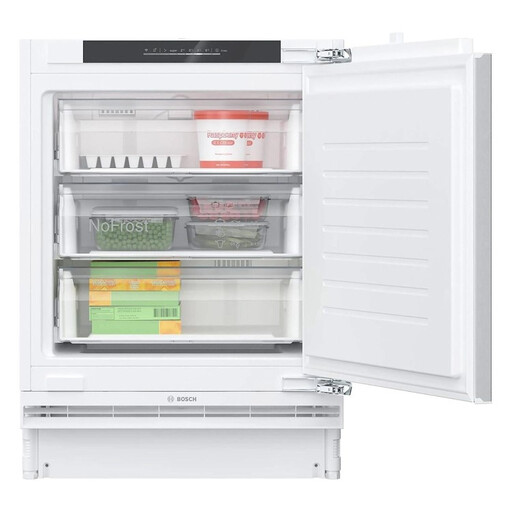
This built-under freezer is a choice to consider if your soup portions will be stored in a fitted kitchen with suitable space beneath a worktop. Check the cabinet and ventilation requirements before choosing it in place of a freestanding model.
 No image available
Bosch GUN21VFE0G Series 4 No Frost Built-Under Freezer, White
Consider this model for portioned soup storage if a built-under installation suits your fitted kitchen.
No Frost design; white finish; E energy rating. Check the required cabinet and ventilation arrangement, and measure your containers against the internal storage space before ordering.
Joybuy
Questions about freezing soup
What freezer size makes sense for one person’s vegetable soup?
Choose by the number and dimensions of portions you intend to keep, rather than by a litres-per-person rule. Russell Hobbs lists a 31 L table-top model for a small rotation; the cited Bosch and Beko undercounter examples offer 83 L and 95 L for larger batches and other frozen food. Measure your containers and installation space before deciding.
Can cooled soup go straight into the freezer?
Yes, once the soup has cooled promptly and is divided into suitable portions. NHS guidance on children’s food recommends cooling food as quickly as possible, ideally within one to two hours, and describes smaller portions and shallow containers as ways to help it cool. Follow any more specific recipe or packaging instructions that apply.
What temperature should I check when freezing soup?
The Food Standards Agency recommends −18 °C for domestic freezers. Follow the appliance’s instructions when setting it up and use a suitable freezer thermometer if you need to check its operating temperature.
What should I compare on a freezer’s energy information?
Compare the energy label and product information sheet for the exact models you are considering, alongside their capacity and format. UK government guidance says products within the relevant energy-labelling rules must display a label at the point of sale, including online; an energy-class letter alone does not settle which size meets your storage needs.


