Full-page script readers
A larger display is worth considering if you want to see more dialogue and stage directions without frequent zooming, and usually read at a desk or with a stand.


Choose a larger conventional tablet if seeing more of a script page and using other apps matter most, provided you are comfortable carrying and positioning it. A smaller conventional tablet suits readers who prioritise portability and PDF markup; a paper-style tablet suits a mainly document-focused workflow, provided your scripts and transfer method work with it. Whichever route you take, try an authorised copy of your actual script at a readable zoom level.
A larger display is worth considering if you want to see more dialogue and stage directions without frequent zooming, and usually read at a desk or with a stand.
If you mark cues, cuts or blocking on authorised PDFs, check the compatible pen and the app you will use to save and share your marked script.
If reading and handwriting matter more than general tablet apps, a paper-style device may suit your routine. Confirm how you will get each script onto it.
Choose it when: You want a larger view of a script or need to work across conventional tablet apps.
Trade-off: Plan where the device will rest during a long read. Apple lists its 13-inch iPad Air Wi-Fi model at 616 g, and Samsung lists the 13.1-inch Galaxy Tab S10 FE+ Wi-Fi model at 664 g.
Choose it when: You carry scripts between the library and rehearsals and want PDF markup alongside general tablet apps.
Trade-off: You may need to zoom or turn pages more often than on a larger screen; check pen compatibility and what comes with the model you choose.
Choose it when: Your main task is reading and handwriting on permitted documents rather than using a broad range of apps.
Trade-off: File formats and transfer methods become central to the choice; check them with your own script before relying on this route.
| Concern | What to check | Who this matters to |
|---|---|---|
| Page visibility | Open your script at a comfortable zoom level; compare how much dialogue, directions and margins remain visible. | If I need to follow dialogue and stage directions together, losing my place to repeated zooming is disruptive. Around 33% of consumers put page visibility first. |
| PDF annotation | Check pen compatibility and whether your chosen app can save and export a marked PDF. | When I prepare cues or blocking notes, I need those marks to remain usable in the script I share. For around 33% of consumers, annotation is the primary concern. |
| Focused reading | Confirm that authorised files open without a connection and that the transfer method fits your routine. | I want to settle into a quiet reading session without depending on a file download at the library. Focused document access comes first for around 20% of consumers. |
| Portability | Consider the device together with the case, pen or stand you would carry. | If I travel between home, the library and rehearsal, I need the whole setup to be manageable in my bag. Around 14% of consumers prioritise portability. |
A larger screen does not guarantee that your particular PDF will be comfortable to read; its text, margins and viewer settings also matter. Larger devices can be harder to hold for a long session.
Open a representative script at your usual zoom level and try the seated position you expect to use. If the tablet will rest on a desk, consider a stable case or stand.
Pen support and pen inclusion are different questions. Samsung lists an S Pen in the box for the Galaxy Tab S10 FE and FE+; Apple lists compatible Apple Pencil options for iPad Air separately.
Before choosing an annotation setup, confirm the exact pen supported by your tablet variant and what comes with the selected package.
Importing, marking and exporting are separate steps. For example, reMarkable sets a 100 MB maximum for web and USB file transfers, while Samsung Notes and Apple Preview provide their own PDF-markup workflows.
Try an authorised copy of a long script: import it, add a note, then open the saved or exported file where you need to use it next.
The UK Intellectual Property Office states that copyright protects dramatic works and that most uses of copyright material require permission. Borrowing a printed script does not itself settle whether you may scan or share it.
Use an authorised digital copy where available. Before scanning, uploading or sharing a script, check the permission covering that title and your intended use with the rights holder or relevant library or licence administrator.
The iPad Air range is a conventional-tablet option for readers who want PDF viewing and markup alongside other iPad apps.
The Galaxy Tab S10 FE range offers two screen sizes for readers considering Samsung's PDF-markup workflow.
Paper Pro is a document-focused alternative for reading and handwriting on permitted scripts.
This paper-style option is relevant if you are considering an E-Ink device for library reading. Check its PDF workflow against your own script, especially if you need to annotate and move marked files.
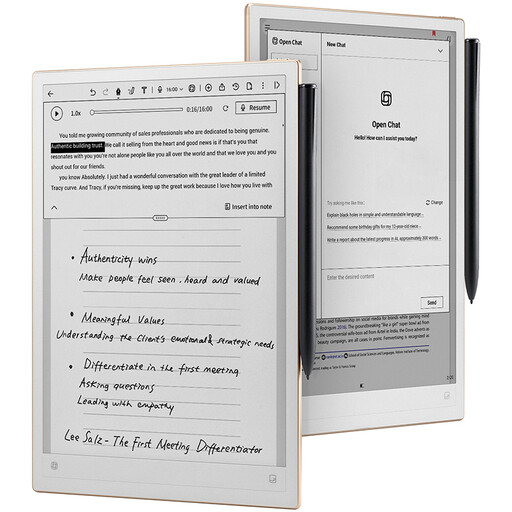 Image unavailable
Consider this paper-style device if document reading is your main library task. Its product title specifies a 10.65-inch E-Ink screen and 4.2 mm thickness. Before relying on it for rehearsal notes, confirm PDF import, annotation and export with your actual script.
Borrowing a printed script does not by itself establish permission to scan or share a digital copy. The UK Intellectual Property Office says copyright protects dramatic works and most uses require permission; check what is permitted for the particular title and intended use with the rights holder, library or relevant licence administrator.
reMarkable lists PDF and EPUB import for Paper Pro. It says USB transfer also accepts rmdoc files and sets a 100 MB maximum file size for web and USB transfers, so check your script file and preferred transfer method before choosing it.
No stylus is needed simply to read a script, but one matters if you intend to handwrite cues or rehearsal notes. Samsung lists an S Pen in the box for the Galaxy Tab S10 FE and FE+; for iPad Air, check which compatible Apple Pencil and package suit your planned markup workflow.
A Wi-Fi-only tablet can serve a reading routine if you download authorised scripts and confirm they open offline before visiting. If you need to retrieve files while away from Wi-Fi, consider how you would connect and check the requirements of the device and service you choose.
Silence notification and keyboard sounds before reading. Check that library's rules for device use, charging, photography and Wi-Fi rather than assuming the same arrangements apply at every venue.