
24/7 Customer Support

Free returns

Same-day & Next-day Delivery

Quality Guaranteed

Unlock Your Welcome Offers: FREE Delivery | Up to 80% OFF | Free 30-day JoyPlus trial
Download the APP
Buying table tennis equipment in the UK can seem straightforward until product descriptions start using terms such as “professional”, “competition”, “high-speed” and “premium”. These labels do not always tell you whether an item suits a child learning basic strokes, a family playing at home or a club running frequent drills.
The most useful approach is to compare the construction, intended use and quantity of each item before looking at appearance or star ratings. This guide explains the details that matter when choosing table tennis bats, table tennis balls, portable table tennis sets and training accessories.
Star ratings can help distinguish product ranges, but they do not replace practical specifications. A beginner table tennis racket with a forgiving all-wood blade may be easier to handle than a carbon-reinforced racket designed for fast attacking play. More speed can make control harder for someone still learning timing and placement.
Check the blade construction, grip shape, rubber type and intended player level. A penhold grip, for example, is a different choice from a shakehand grip and should match the player’s established technique.
A small box of professional table tennis balls may be appropriate for competitions, but it can be uneconomical for repeated multi-ball drills. Clubs, schools and coaches often need table tennis training balls in larger quantities because balls can be misplaced or damaged during high-frequency practice.
Look for the material, seam design, pack quantity and stated grade. A ball described as competition-grade is not automatically the most suitable option for everyday coaching.
Loose balls quickly become a nuisance in a garage, sports hall or spare room. Without a table tennis ball storage box or collection tool, players may spend more time gathering equipment than practising.
For regular sessions, consider whether the kit includes a carry case, storage solution or a standing table tennis ball collector. These features are particularly useful for clubs and training facilities where many balls are used at once.
For casual play, a multi-ply or solid wood blade can provide a familiar feel and straightforward handling. The Double Fish Diamond Series 1-Star model uses a 7-ply solid wood construction, double-sided rubber and a non-slip, sweat-absorbing grip. This type of configuration is suitable for someone building basic consistency.
Players moving into more demanding training may prefer additional stiffness or spin response. Carbon-reinforced blades, such as the Double Fish Diamond Series 6-Star shakehand racket, are designed with a high-modulus carbon fibre layer and offensive inverted rubber. These features may suit an advancing player, but beginners should not assume that a faster racket will automatically improve performance.
Also check the handle profile. A flared or concave handle can feel more secure for shakehand play, while a penhold racket is shaped for a different grip and stroke pattern.
Modern table tennis balls are commonly made from ABS polymer. The material alone does not determine suitability, so also check whether the ball is seamed or seamless, its stated star grade and the intended setting.
The Double Fish 3-Star V40+ competition ABS seamed ball is listed as ITTF Professional Certified and WTT Certified. Buyers should still check the current rules of their specific league or event, as competition requirements can vary.
For routine practice, bulk packs can be more practical. The Double Fish B40+ No Star Training ABS Seamed balls are supplied in a pack of 100, while the B40+ 1-Star Professional Training balls are also supplied in a 100-ball pack. Larger quantities can support feeding drills, serve practice and group sessions without requiring frequent replacement orders.
A table tennis bat and ball set is convenient for families and occasional players, but check exactly what is included. Some sets contain bats and balls only, while others include a net and carry case.
The HY-PRO portable set with net includes two bats, three balls, a net and a carry case. The HY-PRO bat and ball set includes two bats, three balls and a case, but no net is listed. This distinction matters if you plan to play on a standard dining or office table rather than a dedicated table tennis table.
For children, consider handle size, overall weight and the playing environment. A children's table tennis racket should be comfortable to hold and easy to control, rather than selected solely for advanced rubber technology.
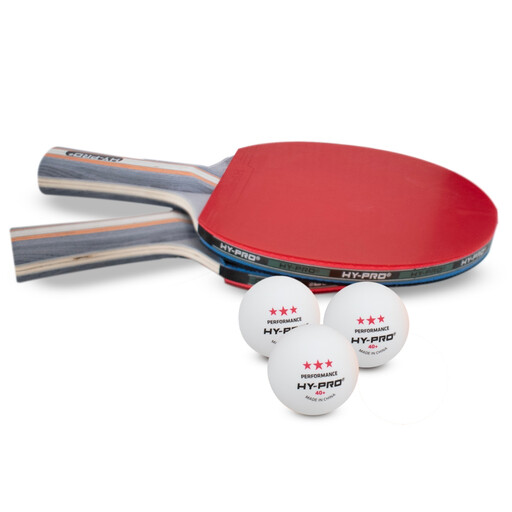
Why This Fits Their Persona: A practical starting point for households wanting ready-to-play equipment for games at home, in the garden or while travelling.
The listing clearly identifies the bats, three balls and carry case, avoiding uncertainty about what is supplied.
Two bats, three balls and a zippered carry case; no professional installation is required.
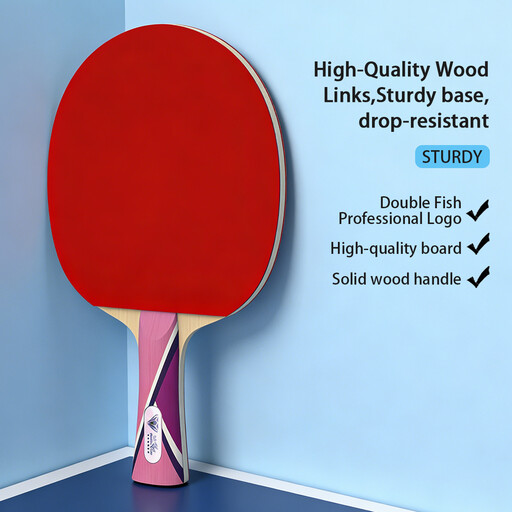
Why This Fits Their Persona: Suited to advanced shakehand players who already understand their preferred grip and want a carbon-reinforced racket for intensive practice.
The construction and intended user are specified, so buyers can distinguish an advanced racket from a general beginner model.
High-modulus carbon fibre layer, enlarged hitting area and double-sided offensive inverted rubber.
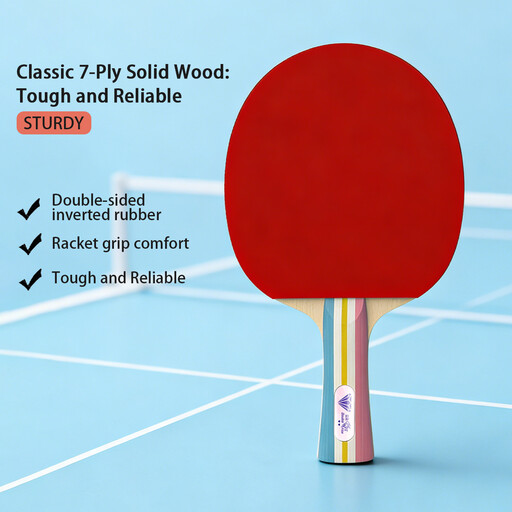
Why This Fits Their Persona: A youth-focused option for children learning shakehand technique at home, school or a local club.
Its product description identifies children, beginners and the intended shakehand grip rather than presenting it as a universal competition racket.
7-ply solid wood blade, flared non-slip handle and double-sided inverted rubber.
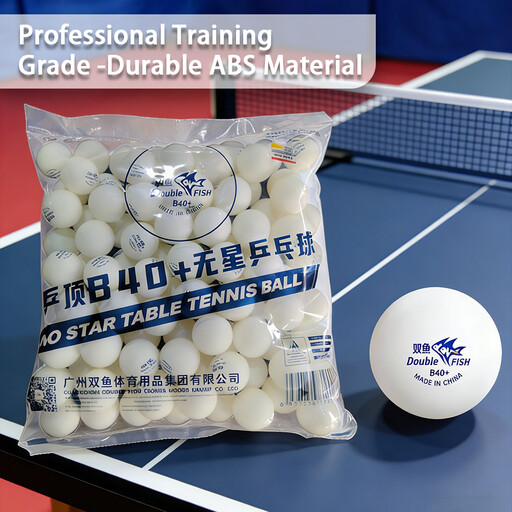
Why This Fits Their Persona: A bulk-pack choice for coaches, academies, schools and clubs that run frequent drills or multi-ball sessions.
The pack quantity is stated as 100 balls, making it easier to compare ongoing training costs with smaller competition packs.
ABS construction, seamed design and a high-capacity 100-ball pack for regular practice.
Wipe bats and balls with a soft, dry cloth after use. Keep them away from direct sunlight, high temperatures, open flames and sharp objects. Rubber surfaces can lose their useful playing characteristics if stored carelessly, while balls may deform after excessive impact or prolonged heat exposure.
A carry case helps protect a portable table tennis set during transport. For larger sessions, a standing collector can reduce collection time. The Double Fish Champion X1 Standing Ping Pong Ball Collector has a telescopic stainless steel handle, non-slip grip and large-capacity mesh pocket. Its adjustable design allows balls to be collected without repeatedly bending down. Store the collector dry and inspect the mesh and handle before use.
If you need a wider selection of competition table tennis equipment, beginner rackets, storage accessories or table tennis balls, browse the full category.
We have compiled a complete, real-time list of products that fully satisfy these strict selection criteria and UK safety regulations.
For occasional family play, three to six balls may be sufficient. A club, coach or school running serve and movement drills may find a 100-ball pack more practical, particularly when several balls are in play at once.
Lifespan depends on frequency of use, impact, storage and surface condition. Keep bats dry, avoid dropping them and clean the rubber gently. Replace balls when they become visibly cracked, dented or misshapen, as irregular balls can bounce unpredictably.
Choose a portable table tennis set if you need bats, balls, a net and a case for occasional play on standard tables. Individual table tennis rackets and balls are more suitable when you already have a net or table, or when you need a specific grip, rubber type or bulk quantity for structured training.