Solo renter with little worktop space
A compact tank-fed format may suit you if counter space is the main constraint. Check that its basket fits your usual plates and that you have a workable drain route.


For very small loads and limited worktop space, consider a compact tank-fed dishwasher if its plate limit and drainage arrangement suit your kitchen. If you regularly collect more dishes and have room for a water connection, a six-place-setting tabletop model may be more useful; check the exact dimensions, plate clearance and operating figures before choosing.
A compact tank-fed format may suit you if counter space is the main constraint. Check that its basket fits your usual plates and that you have a workable drain route.
If plates, bowls, cups and cutlery accumulate over a day or two, compare six-place-setting models with your actual load rather than choosing by exterior size alone.
If you have space and a suitable water connection, compare the exact models' energy-label figures, water use and stated noise alongside capacity.
For one-person loads, establish where the dishwasher can go and how it will connect before comparing basket capacity and operating figures.
| Concern | What to check | Who this matters to |
|---|---|---|
| Worktop and plate fit | Measure the available width, depth, height and door clearance; check the limit for your largest everyday plate. | If my worktop is tight, the machine must fit without leaving my usual plates outside the basket. Around 28% of consumers put usable space first. |
| Water and drainage | Check whether the exact model uses a tank, a tap or fixed water supply, and where its drain hose and plug must go. | I need an installation arrangement that works in my kitchen, not just a machine labelled tabletop. For around 28% of consumers, connection practicality is the primary concern. |
| Daily-load capacity | Compare place settings with the rack layout and the plates, pans and serving dishes you actually use. | If I want to clear a fuller day's dishes together, basket space matters more than the smallest footprint. Around 28% of consumers prioritise load capacity. |
| Operating figures | Compare energy use per 100 cycles, water per cycle, programme duration and stated noise for the exact models. | Once a dishwasher fits and connects, I want its published running figures to help me decide. Operating information is the main priority for around 16% of consumers. |
Cookology lists a kitchen-tap or fixed-supply connection for its CTTD6BK, while the HOMCOM compact example has a built-in 6 L tank. The format alone does not tell you how a machine takes in water.
Check the exact model's inlet, drain route, tap compatibility and installation instructions before ordering.
The four-place-setting HOMCOM example specifies a maximum plate diameter of 20 cm. A place-setting figure does not establish whether your larger dishes or pans will fit.
Measure the tableware you use most and compare it with the model's plate limit and rack layout.
Candy lists 6.5 L per cycle and 51 dB for the CP 6E51LS-80; SIA lists 7.3 L per cycle, 49 dBA and a 240-minute Eco cycle for the TTD6WH. Both manufacturers state an E energy class for these models.
Compare the full label and product sheet for each exact model, including energy use, water use, capacity, programme duration and noise.
Candy's CP 6E51LS-80 is a six-place-setting tabletop model measuring 550 × 501 × 443 mm, according to Candy Home UK.
Cookology lists its six-place-setting CTTD6BK at 550 × 500 × 438 mm.
Toshiba Lifestyle UK lists the DW-06T2 (W)-GB as a six-place-setting tabletop dishwasher.
SIA lists the TTD6WH as a six-place-setting tabletop model with eight programmes.
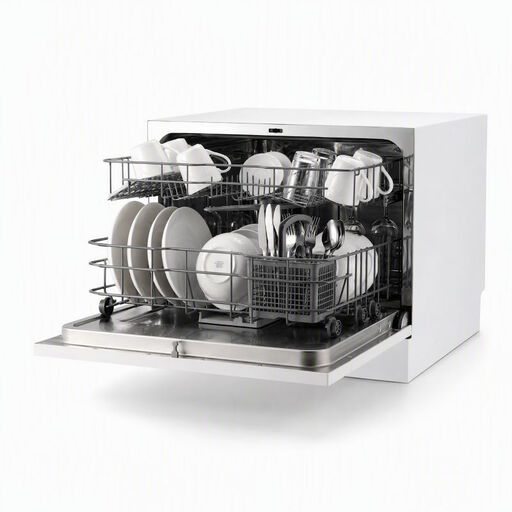
This six-place-setting tabletop option is relevant if you want to wash a fuller one-person load together. Check its dimensions and water-connection instructions against your kitchen before deciding whether it fits.
 No image available
Consider this model if you want capacity for a collected one-person load rather than the smallest tank-fed format.
Its listing states six standard place settings, a 30-minute quick wash and a 24-hour delayed start. Check the exact model's worktop clearance, water supply, drainage and energy-label figures before ordering.
Allow for the appliance itself, its open door, hoses and plug. Cookology lists the six-place-setting CTTD6BK at 550 × 500 × 438 mm, while the four-place-setting HOMCOM tank example measures 45 × 44 × 45.8 cm; check the clearances required by the exact model.
A tank-fed model may avoid a kitchen-tap inlet connection: the HOMCOM example has a built-in 6 L tank. Cookology lists tap and fixed-supply connections for its CTTD6BK. In either case, check the exact model's drainage, power and installation instructions.
Follow the instructions for your exact model. Candy lists salt and rinse-aid indicators for the CP 6E51LS-80, and the Cookology CTTD6 manual covers loading salt into its softener; do not assume every tabletop dishwasher has the same requirements.
Compare the exact models' energy class, energy use per 100 cycles, water use per cycle, programme duration and noise alongside their capacity. The Department for Energy Security and Net Zero and the Office for Product Safety and Standards state that products within the UK energy-labelling rules must be supplied with an accurate printed energy label.