
24/7 Customer Support

Free returns

Same-day & Next-day Delivery

Quality Guaranteed

Unlock Your Welcome Offers: FREE Delivery | Up to 80% OFF | Free 30-day JoyPlus trial
Download the APP
A tall display cabinet can add vertical storage without taking up much floor space, but attractive product photography does not always reveal the practical details. UK homeowners, renters and interior design-conscious shoppers should look beyond colour and styling before ordering.
Common pitfalls include:
The right choice depends on whether you want a glass display cabinet for ornaments, a metal display cabinet for everyday storage, or a dedicated jewellery storage cabinet for smaller items.
Record the available height, width and depth, then leave clearance for skirting boards, doors and assembly. A narrow storage cabinet may save floor space, but its doors still need room to open fully.
Also consider the route into your home. A cabinet measuring 150 cm or more in height may fit its final position but be difficult to move through a stairwell, hallway or lift. Check the packaged dimensions where available, rather than relying only on the assembled measurements.
For compact bedrooms or dressing areas, a 38 cm square footprint can be easier to accommodate than a wider cabinet. For living rooms and home offices, a unit around 75 cm wide may offer more practical display capacity.
A metal display cabinet with a powder-coated finish can suit industrial, contemporary or utility-inspired interiors. Metal surfaces are generally straightforward to wipe clean, but check the construction, shelf layout and whether the cabinet includes an open lower shelf.
An MDF or wood-based cabinet can work well for bedrooms and dressing areas, especially when combined with fabric or suede lining. However, it may not be the right choice for heavy books, large ornaments or damp areas.
For any display cabinet with shelves, check:
Tempered glass is designed for improved resistance compared with ordinary glass, but it can still break under impact. Place glass-fronted furniture away from children’s play areas and avoid striking doors when loading items.
Look for supplied anti-tip hardware and follow the assembly instructions carefully. UK buyers should also ask the retailer for applicable product safety and furniture compliance information, including whether relevant furniture stability standards have been considered. Do not assume that a tall or heavy unit is stable without wall fixing.
For jewellery, a mirrored jewellery armoire with a key lock and lined compartments can be more suitable than a general display cabinet. A lock may deter casual access, but it should not be treated as a high-security safe.
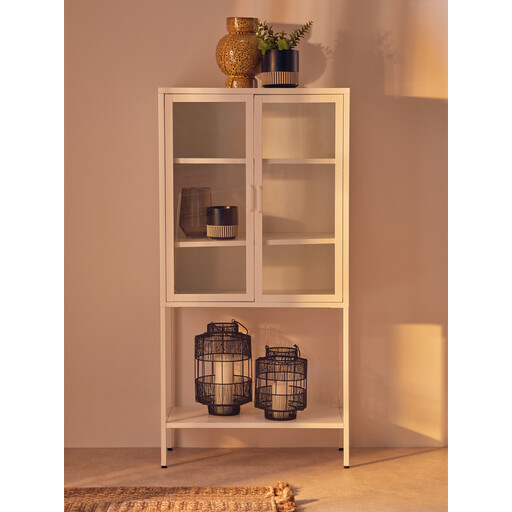
Why This Fits Their Persona: A practical option for shoppers furnishing a bedroom, rented flat, living room or home office who want visible storage in a light-coloured finish. Its supplied dimensions are H150 x L35 x W75cm.
The listed specification clearly identifies the metal construction, tempered glass and assembly requirement, helping buyers avoid assuming that a narrow cabinet arrives ready to use.
Powder-coated metal body, two glass doors and an open lower shelf. The 25 kg unit is designed for freestanding use with anti-tip wall fixing.
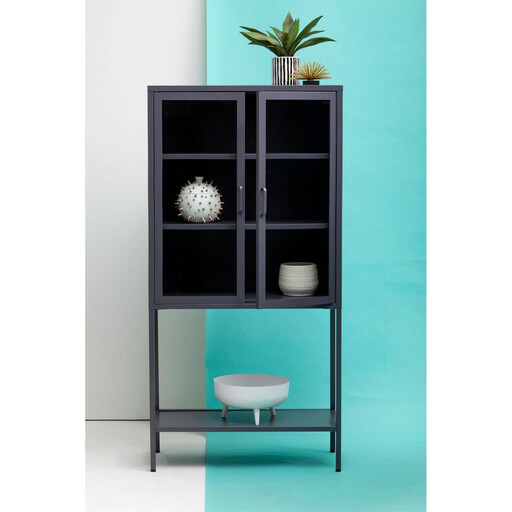
Why This Fits Their Persona: Suitable for shoppers prioritising a structured industrial look and a robust metal-and-glass format for a living room, office or display area.
Its product information gives the assembled size, 25 kg weight, tempered glass and powder-coated finish, making it easier to compare with similarly styled cabinets.
Two glass doors, one open shelf and a powder-coated metal frame. Confirm the listed grey colour against the product images before ordering.
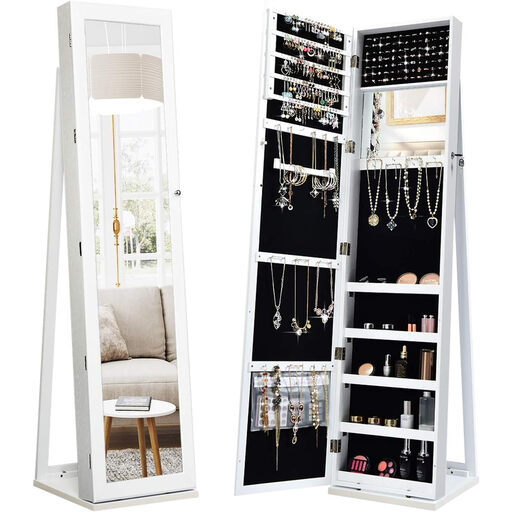
Why This Fits Their Persona: Designed for dressing areas and bedrooms where a full-length mirror, organised jewellery storage and a compact freestanding form are more useful than large open shelves.
The internal layout is specified rather than described only as “spacious”: it includes 100+ earring slots, 91 ring slots, 30 necklace hooks, a bracelet bar and lined pockets.
Full-length mirror, 360-degree rotation, key-lockable door and hidden rear display shelf. Dimensions are D38 x W38 x H157cm, with an anti-tipping device supplied.
We have compiled a complete, real-time list of products that fully satisfy these strict selection criteria and UK safety regulations.
Assemble it on a level surface, check that doors open without shifting the unit, and use the supplied anti-tip hardware to fix it to a suitable wall. Follow the manufacturer’s instructions and check that the wall and fixings are appropriate for the cabinet’s weight.
Yes, provided the shelves and doors match the items being stored. Use it for ornaments, books, collectables or household accessories within the stated load limits. Avoid placing heavy objects on open shelves or storing items where they press against glass doors.
Most require occasional dusting and wiping with a soft, dry cloth. Avoid abrasive cleaners on powder-coated metal, painted MDF and glass. Jewellery cabinets may need additional care around suede, velvet or fabric-lined compartments; keep these areas dry and free from loose debris.