
24/7 Customer Support

Free returns

Same-day & Next-day Delivery

Quality Guaranteed

Unlock Your Welcome Offers: FREE Delivery | Up to 80% OFF | Free 30-day JoyPlus trial
Download the APP
A circular saw is only as good as the blade you fit to it. Yet, choosing the right replacement can feel like navigating a minefield of marketing claims and confusing technical jargon. A poor choice doesn’t just result in a rough finish; it can lead to burnt wood, chipped laminates and a blade that’s blunt after only a handful of cuts. For tradespeople and serious DIYers, that means wasted time and money.
As the Joybuy Product Recommendation Officer, my role is to help you sidestep these common issues. Before you add another blade to your basket, let’s look at the frequent pitfalls that catch out even experienced users.
To ensure you get a blade that performs reliably, focus on these three non-negotiable parameters. Getting these right is the foundation of a clean, safe and efficient cut.
These are the first numbers you must check. They are not suggestions; they are safety and compatibility requirements.
The number of teeth dictates the speed and finish of the cut. There is no single "do-it-all" tooth count; the right choice depends entirely on the job.
When you see TCT circular saw blades, it stands for Tungsten Carbide Tipped. This is the industry standard for a reason. The body of the blade is made from hardened steel for stability, but the cutting tips are made from tungsten carbide, an extremely hard and heat-resistant material. These tungsten carbide saw blades stay sharp significantly longer than basic steel blades, especially when cutting abrasive man-made boards or dense hardwoods.
Instead of a generic list, we've matched specific products to the practical needs of UK users.
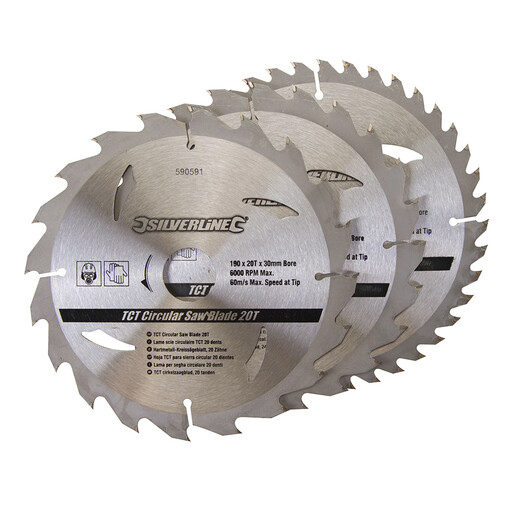
Why This Fits Their Persona: A tradesperson needs to be prepared for any task. This circular saw blade set provides immediate options for fast ripping (20/24T) and clean finishing (40T) in the common 190mm circular saw blade size, reducing downtime spent searching for the right blade.
It directly counters the "Tooth Count Trap" by providing a range of blades in one pack. The hardened and strengthened construction with TCT tips avoids the durability deception, offering a longer service life on demanding job sites.
Cost-effective versatility. The inclusion of 25mm and 20mm reduction rings ensures compatibility with a wide range of professional saws, solving the "universal fit" problem.
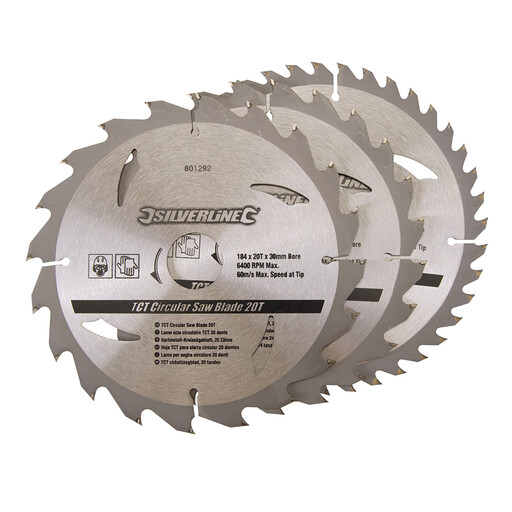
Why This Fits Their Persona: Perfect for the home workshop owner with a popular 184mm circular saw. This pack provides the right tools for varied projects, from building garden planters with the 24T blade to fitting skirting boards with the 40T for a clean finish.
This set provides a practical solution for multiple tasks, preventing the user from buying a single, expensive blade that is wrong for half their projects. The included reduction rings ensure a proper fit, avoiding the "universal fit" myth.
This is a complete kit of replacement circular saw blades for the most common DIY woodworking tasks. The hardened steel and TCT tips offer performance that surpasses cheap, unbranded alternatives.
We have compiled a complete, real-time list of products that fully satisfy these strict selection criteria and UK safety regulations.
The lifespan of a TCT blade depends heavily on the materials you cut. When used primarily on softwood, a quality blade can last for months of regular work. However, cutting abrasive materials like MDF, chipboard or reclaimed wood with hidden nails will dull it much faster. It’s time for a replacement or sharpening when you notice burn marks on the wood, feel increased resistance during cutting or see the quality of your finish decline with more chipping and tear-out.
Yes, TCT wood cutting saw blades are suitable for composite materials like MDF and chipboard. In fact, their hardness is essential, as the resins and glues in these boards are highly abrasive and will quickly destroy a plain steel blade. For the cleanest cut with minimal chipping on these materials, a blade with a medium-to-high tooth count (40T or more) is recommended.
The only functional difference is the 6mm in diameter. It is critical to use the blade size specified by your saw’s manufacturer. Attempting to fit a 190mm circular saw blade to a saw designed for a 184mm circular saw blade is extremely dangerous, as the blade will not fit correctly under the safety guard. Conversely, using a smaller blade than specified will work, but it will reduce your saw's maximum depth of cut. Always check your tool's manual.