Groups serving many cups
A labelled 240-bag box makes stock planning straightforward if you expect to use one bag per cup. Loose tea calls for a dose calculation and brewing equipment.


For a camping group planning around 240 cups, a box explicitly labelled as 240 tea bags gives you a count to plan with, provided you use one bag per cup; it is not loose leaf tea. Choose loose leaf tea if you want that format and can bring brewing and cleaning equipment, but check the suggested dose before estimating how many cups a pack will make.
A labelled 240-bag box makes stock planning straightforward if you expect to use one bag per cup. Loose tea calls for a dose calculation and brewing equipment.
Consider how you will keep the tea dry and separate from other food once the pack is opened. The Food Standards Agency notes that temperature and humidity in tents and vehicles can differ from conditions at home and recommends sealed containers to help protect food.
Loose tea gives you a weight-based pack rather than a fixed bag count. It suits a set-up with an infuser or teapot, a way to clean it and somewhere to put wet leaves.
Start with the format and the number of cups you expect to make, then check what the pack and your campsite set-up require.
| Priority | What to check | Your needs |
|---|---|---|
| Portion count | Check the stated bag count as well as net weight. Yorkshire Tea, Tesco and Tetley listings identify 240-bag, 750g packs; for loose tea, use the maker’s suggested dose to estimate cups. | I need to plan tea for a group without measuring leaves for every cup. With one bag per cup, a 240-bag box provides 240 bag portions. |
| Brewing equipment | Standard tea bags do not need an infuser. Loose tea needs a suitable infuser, strainer or teapot, plus a plan for cleaning it and disposing of wet leaves. | I would choose loose tea for its format and blend choice only if I can carry and clean the equipment at camp. |
| Pack format | Check whether bags are individually wrapped if separate portions matter. Twinings lists loose-leaf pyramid bags in 15- and 40-bag packs, rather than a single 240-bag pack in those examples. | For a shorter trip, I may prefer smaller packs; for a large group, I need to count how many packs will cover the planned cups. |
| Storage | Read the product’s storage directions and plan a clean, dry, sealed container if the opened pack needs protection. The Food Standards Agency advises sealed food containers for camping conditions. | I need to keep the tea away from damp, pests and other food while it is stored in a tent or vehicle. |
A 240-bag box contains counted tea-bag portions. Loose tea is sold by weight, so the pack weight alone does not establish how many cups it will make.
For one-bag-per-cup planning, check the stated bag count. For loose tea, check the suggested brew dose and take the equipment needed to prepare it.
Loose tea also means carrying an infuser, strainer or teapot and allowing time to clean it.
The Food Standards Agency notes that storage conditions in a tent or vehicle differ from home and recommends sealed containers to help protect food. Yorkshire Tea’s listed instructions call for cool, dry storage away from direct sunlight.
Keep the tea in intact inner packaging or a clean, dry, sealable food container, away from other food and sources of moisture.
GOV.UK’s Food Standards Agency guidance says running a food business requires registration with the local authority and includes businesses operating from mobile units or temporary premises. That does not, by itself, establish whether a particular camp event is a food business.
If tea is supplied as part of an organised operation, ask the relevant local authority how the guidance applies to that arrangement.
These brand ranges illustrate different pack formats; a loose-tea pack or a smaller bag pack should not be treated as an exact 240-bag box.
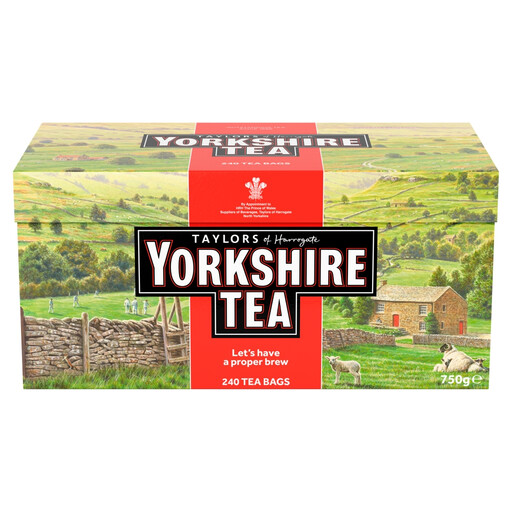
Morrisons lists Taylors of Harrogate Yorkshire Tea as 240 black-tea bags in a 750g box.
Twinings lists 500g loose-tea catering packs and loose-leaf pyramid bags in smaller pack sizes.
Whittard lists both loose tea and traditional tea bags, including 50-bag products.
Fortnum & Mason lists loose leaf tea, including a 125g bag and a 250g caddy, alongside tea-bag selections such as a 60-bag pack.
Bettys lists loose teas in formats including 500g and 1kg, as well as counted tea-bag packs.
Ringtons lists tea-bag bundles in 200- and 400-bag sizes, including decaf options.
These tea-bag boxes suit a camping group planning portions with one bag per cup. Neither is a loose leaf tea pack.
 No image available
The stated 240-bag count helps plan group servings when using one bag per cup. This 750g black-tea pack is a tea-bag product, not loose tea; its storage directions specify a cool, dry place away from direct sunlight. Check how you will protect the bags from damp and odours after opening.
 No image available
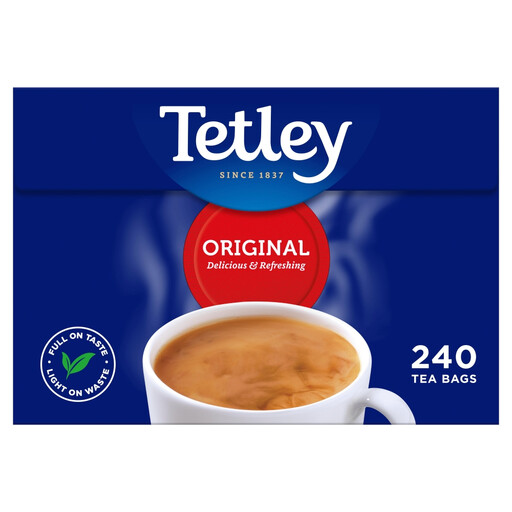
The stated 240-bag count helps plan group servings when using one bag per cup. This 750g black-tea pack contains tea bags rather than loose tea; its storage directions specify a cool, dry place. Check how you will keep the supply dry after opening.
No. A box labelled 240 tea bags contains counted bag portions. Loose tea is sold by weight: Twinings lists 500g catering packs, for example, so check the suggested brew dose to estimate servings.
Follow the pack’s storage directions and keep tea dry and separated from other food. The Food Standards Agency recommends sealed containers for camping food because storage conditions in tents and vehicles can differ from home; Yorkshire Tea’s listed directions also specify cool, dry storage away from direct sunlight.
Divide 240 by the number of bags you expect to use each day: at one bag per cup and 12 cups a day, that is 20 days. It is a portion-planning calculation, not a storage-life estimate, so also check the pack’s date and storage directions.
Registration depends on whether the arrangement is a food business, not simply on serving tea outdoors. GOV.UK’s Food Standards Agency guidance says food businesses must register with their local authority and includes mobile units and temporary premises; ask the relevant authority if an organised event’s position is unclear.