Hosts offering self-serve drinks
A counted box of tea bags makes it straightforward to set out individual portions beside the coffee. Check that guests want the tea in the box: a 240-bag black tea does not provide decaf or other varieties.


Choose a 240-count box if friends will make individual cups: the count-matching Yorkshire Tea product listed by Paperstone contains tea bags, not loose leaves. Choose loose leaf if you want to brew a shared pot and can measure the tea and provide suitable brewing equipment. If guests prefer different teas, consider a small selection alongside either main format rather than assuming one black tea will suit everyone.
The useful distinction is whether guests will make their own cups or you plan to brew tea for the group.
A counted box of tea bags makes it straightforward to set out individual portions beside the coffee. Check that guests want the tea in the box: a 240-bag black tea does not provide decaf or other varieties.
Loose leaf suits a planned pot of tea when you have a teapot, infuser or strainer and time to measure and brew it. The UK Tea & Infusions Association advises one rounded teaspoon of loose tea per cup, subject to the tea’s pack instructions.
If coffee is the main drink, a smaller assortment may be more useful than several large boxes of one blend. Twinings’ trade range, for example, includes a selection of individually enveloped teas and infusions; check the contents of a particular pack before choosing it.
Choose when: Friends will make separate cups, particularly at a self-serve drinks table.
Trade-off: The bags avoid measuring leaves, but a 240-bag box does not meet a loose-leaf requirement.
Choose when: You want to prepare and pour a pot for several friends.
Trade-off: You need to measure the leaves and provide brewing equipment; a pack’s weight is not a fixed count of individual portions.
| Priority | What to check | Your needs |
|---|---|---|
| Tea format | Read the exact listing for “tea bags” or “loose leaf”. Paperstone describes its Yorkshire Tea box as 240 tea bags; loose-tea packs such as those in the Twinings catering range are described by weight. | I want guests to make individual cups without measuring tea, or I have the equipment and time to serve a pot. |
| Brewing | Check the pack’s portion and brewing instructions. The UK Tea & Infusions Association advises one tea bag or one rounded teaspoon of loose tea per cup; loose leaves also need a suitable brewing method. | If I choose loose leaf, I can measure it for the number of cups I plan to pour. |
| Tea choices | Check the tea type and the contents of any assortment. A large box of one black tea and a mixed selection serve different purposes. | Some friends may prefer decaf or an infusion even if others want standard black tea. |
| Sourcing information | If sourcing affects your choice, look for information and any certification on the exact product listing rather than assuming it applies across a brand’s range. | I want to be able to assess the sourcing information for the tea I buy. |
The 240-count Yorkshire Tea box listed by Paperstone contains individual tea bags. A loose-tea pack described by weight calls for a different way of preparing and serving it.
Decide whether you need separate bags or leaves for a pot, then check both the format and quantity on the exact listing.
A bulk box can cover the standard black-tea option, but it will not give a guest a decaf tea or herbal infusion.
Consider which alternatives your guests are likely to want, and check the contents of a smaller mixed selection before adding one.
Loose leaves need measuring and a way to separate them from the drink. That changes how readily guests can make their own cups.
Set out a suitable infuser or plan to serve a pot. Follow the tea’s pack instructions; the UK Tea & Infusions Association gives one rounded teaspoon of loose tea per cup as general portion guidance.
These brand ranges illustrate different formats; check the exact product rather than treating a brand’s entire range as a 240-count or loose-leaf option.
Yorkshire Tea lists loose tea in its range, while Paperstone lists a separate 240-tea-bag box.
Twinings lists loose-tea catering packs and, separately, trade selection packs of enveloped teas and infusions.
Whittard’s tea range includes loose leaf, tea bags and brewing equipment.
Fortnum & Mason lists loose-leaf teas by weight, including a 250g Royal Blend caddy.
Bettys lists loose tea, including a 1kg Tea Room Blend leaf-tea option.
Ringtons lists loose leaf and separate tea-bag bundles, including 200- and 400-count options.
These are black tea-bag boxes for individually portioned cups alongside coffee. Neither is loose leaf; choose a weight-labelled loose tea and suitable brewing equipment if serving a pot is your priority.
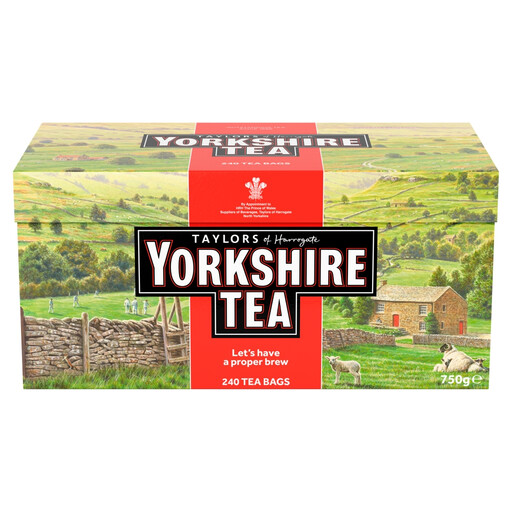 No image available
Individual bags suit a self-serve drinks area. This is black tea in a 240-bag, 750g pack, not loose leaf; offer another option if guests want decaf or an infusion. Store the pack in a cool, dry place.
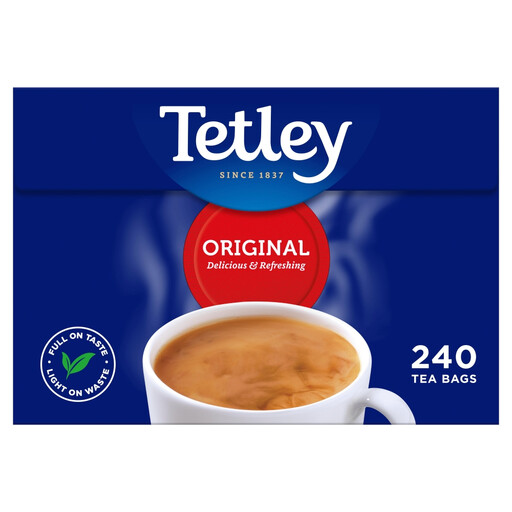 No image available
The individual bags let guests prepare separate cups. The pack contains 240 black tea bags and weighs 750g; it is not loose leaf and does not replace a decaf or herbal choice. Store it in a cool, dry place.
Not in the count-matching Yorkshire Tea example: Paperstone describes it as a box of 240 tea bags. If you want loose leaves for a pot, check that the exact product says “loose leaf” and gives its quantity by weight.
The UK Tea & Infusions Association advises one rounded teaspoon of loose tea per cup. Count the cups you intend to serve, then follow the chosen tea’s pack instructions if its recommended measure differs.
The listings for the two Joybuy 240-bag options specify cool, dry storage. Check the instructions on the pack you buy and protect the tea from kitchen moisture after opening.