Frequent tea makers with little counter space
An instant-hot countertop RO unit can filter and heat water without plumbing, but measure its footprint, tank access and distance from a socket before choosing one.


Choose an instant-hot countertop reverse osmosis (RO) purifier if you make tea frequently and want filtered water heated at the appliance, provided you have room for its tanks and accept refilling and reject water. A compact non-heated RO unit still needs a kettle; if taste or kettle limescale is your main concern, a suitable filter jug and your existing kettle may be the simpler route.
An instant-hot countertop RO unit can filter and heat water without plumbing, but measure its footprint, tank access and distance from a socket before choosing one.
If taste and limescale matter more to you than RO filtration or dispensing hot water, a jug cartridge designed for hard water may be worth considering. BRITA positions its MAXTRA PRO Limescale Expert cartridge for water used in kettles.
If you want an RO system for its stated filtration features, check the claims for the exact model alongside filter replacement, refilling and reject-water arrangements. For public supplies in England and Wales, the Drinking Water Inspectorate says water companies must supply wholesome water suitable for domestic use; a suspected supply or plumbing fault needs investigating rather than simply adding a filter.
Choose when: You want to dispense heated, filtered water for tea without using a separate kettle.
Allow for: A powered appliance, tank refilling, replacement filters and RO reject water.
Choose when: A compact, installation-free RO format matters more than dispensing hot water.
Allow for: Heating the filtered water separately for tea.
Choose when: Your main aim is to address taste or kettle limescale without another powered countertop appliance.
Allow for: A cartridge matched to your jug and water conditions; this route does not provide RO filtration or instant-hot dispensing.
| Concern | What to check | Who this matters to |
|---|---|---|
| Tea-ready water | Check the model's maximum and selectable temperatures and dispensing volumes; hot-water models do not necessarily boil water. | When I make tea several times a day, I want heated, filtered water at a temperature that suits what I brew. Roughly 29% of consumers put tea-ready temperature and speed first. |
| Counter space | Measure width, depth, height and clearance for filling or removing tanks; check whether plumbing is required. | If counter space is tight, I need to fill and use the unit without blocking the space around it. For roughly 29% of consumers, practical fit is the primary concern. |
| Filtration and upkeep | Check model-specific filtration claims, replacement filters and the RO reject-water arrangement; a TDS display alone does not establish water safety. | I would accept a refill and maintenance routine to get the RO features I am looking for, but I want to understand the exact model's claims. Broader filtration and upkeep come first for roughly 24% of consumers. |
| Taste and limescale | Check local water hardness and whether the cartridge suits both that condition and your jug. | If kettle scale or the taste of my tea is the issue, I would rather address that than add an electric RO appliance. Around 18% of consumers make this simpler route their primary concern. |
For public supplies in England and Wales, the Drinking Water Inspectorate says water companies must supply wholesome water suitable for drinking and cooking. A filter can still address a preference, but it is not a substitute for investigating a suspected supply or property-plumbing problem.
If water is discoloured or has a persistent unusual odour, contact your water company and investigate any property-plumbing fault rather than relying on a purifier as the fix.
A countertop unit may fit between cupboards yet leave too little clearance to lift out a tank or replace a filter. AquaTru lists its Carafe as 33 cm high × 35.5 cm deep × 19 cm wide, but those dimensions alone cannot establish whether it will work in your kitchen.
Measure usable counter space and clearance above and around the appliance, including the route for removing and refilling its vessels.
Waterdrop states a 3:1 pure-to-drain ratio for the C1H. An installation-free RO unit can therefore still involve managing reject water.
Check the exact model's ratio, reject-water container and instructions before deciding whether its filling and emptying routine suits you.
Countertop RO models use model-specific cartridges that need replacing to maintain the system as instructed by the manufacturer.
Identify the exact cartridge and its stated replacement interval, then check that you can obtain the correct replacement before choosing the appliance.
Countertop RO models in its UK range include the instant-hot C1H and K19.
Its installation-free Carafe offers a countertop RO route for people who will keep using a kettle.
The WB99-H is a countertop RO option for tea drinkers comparing adjustable hot-water dispensing.
The ADD6921DG/10 combines countertop RO filtration with hot and chilled dispensing.
A jug-and-cartridge alternative for tea drinkers focusing on taste and kettle limescale rather than powered RO filtration.
These countertop RO models are choices for filtering and dispensing hot water at the appliance. Compare their temperature options, counter clearance and maintenance requirements with your tea-making routine before choosing.
 No image available
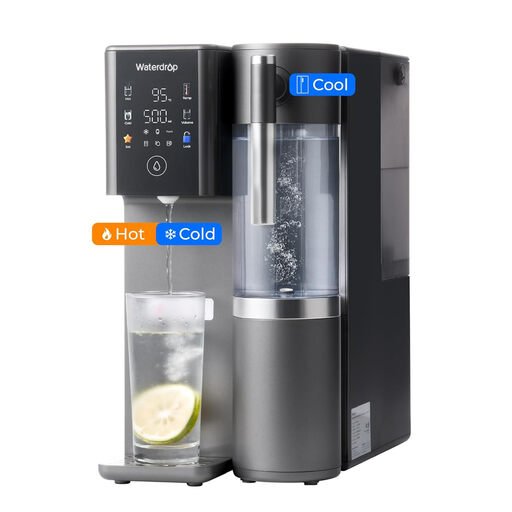
Consider this model if you want filtered hot water for tea without a plumbed-in setup. Its listed configuration includes six temperature settings and a 3:1 pure-to-drain ratio. Check that the actual temperature and dispensing-volume choices suit your tea and cups, and leave room to access the tanks.
 No image available
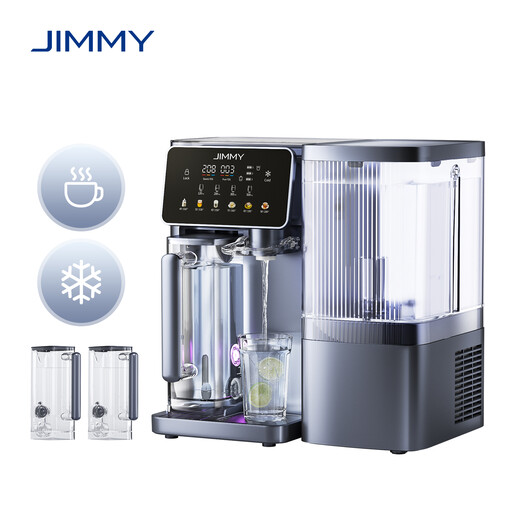
Consider this hot-and-cold model if you would use both dispensing options. Its listed configuration includes seven-stage filtration, a 5.5 L tank and two 1 L pitchers. Confirm the hot-water temperatures, cup volumes and counter clearance for your kitchen; keep children under adult guidance when operating the hot-water function.
For public supplies in England and Wales, a home purifier is not generally needed as a health-protection measure: the Drinking Water Inspectorate says water companies must supply wholesome water suitable for drinking and cooking. That does not settle a concern about a private supply or a specific supply or property-plumbing fault, which should be investigated directly.
It can handle tea preparation without a kettle if its dispensing temperatures and volumes suit what you make. Waterdrop lists the K19 at up to 95°C, while Frizzlife lists a 45°C–100°C range for the WB99-H; check the exact model rather than assuming every hot-water purifier boils water.
Some countertop RO models do not: Waterdrop describes the C1H and K19 as plug-and-play or installation-free, and AquaTru lists the Carafe as requiring no installation. These arrangements still involve filling the appliance and providing a suitable power connection.
Check the exact cartridge required by the model and the manufacturer's replacement guidance before choosing an appliance. Waterdrop states a life of up to 12 months or 1,100 gallons for the C1H and K19 replacement filters; actual replacement needs can vary with water quality and use.
No. A total dissolved solids (TDS) reading does not measure every potential contaminant or establish water safety on its own. If you suspect a genuine supply or property-plumbing problem, seek advice from your water company or an appropriate plumbing professional.