
24/7 全天候客户支持

免费退货

当日/次日达

品质保障

开启新人专享福利: 全场免邮 | 低至 2 折 | 免费试用 30 天 JoyPlus 会员
下载 Joybuy
A confined space can turn a straightforward inspection into a costly strip-down. Whether you are checking an engine cylinder, brake system, HVAC duct, pipe or wall cavity, the right borescope can help you view the problem before removing surrounding components.
The Teslong TD450S articulating inspection camera is aimed at users who need more control than a fixed, phone-connected endoscope can provide. However, buyers should look beyond screen size and phrases such as “HD” before choosing an inspection camera. Probe diameter, articulation control, lighting and recording functions have a greater effect on day-to-day usability.
An 8.5mm probe may suit larger access points, but it will not pass through every vehicle opening or narrow pipe. For example, a spark plug hole or injector access point may require a much slimmer camera. Always measure the opening first and leave clearance for the probe to move.
A camera advertised as an 8.5mm borescope camera may need an access hole of at least around 9mm, while a 3.9mm probe can be suitable for openings from approximately 4.5mm, according to the supplied product specifications.
A larger display does not automatically mean a more detailed image. Check the camera pixel count, image capture resolution and video resolution separately. A screen may show a live image at one resolution while saved photos and videos use different settings.
For practical work, image stability, adjustable lighting and the ability to move the camera tip can be more useful than a high-sounding resolution figure.
A flexible probe can be shaped before insertion, but that does not mean the camera tip can be controlled once inside. If you need to look behind an obstruction or around a corner, choose a genuine two-way inspection camera or articulated probe camera with a mechanical control.
Also check the stated movement range. The products below specify up to 210° of articulation, but the usable result depends on how far the probe has been inserted and whether surrounding surfaces restrict movement.
For vehicle technicians and DIY car owners, probe diameter is often the first practical limit. The Teslong TD450S uses an 8.5mm probe and has a 1.55m, approximately five-foot, semi-rigid cable. This can be useful for engine inspection, brake system checks and larger wall or duct access points.
If you work around narrow openings, a 3.9mm or 5.5mm design may provide more flexibility. Confirm the required hole diameter rather than relying on general terms such as “slim” or “ultra-thin”.
The cable should be flexible enough to form a route but sufficiently firm to retain its shape. Avoid forcing it around sharp bends, as repeated kinking can affect both movement and service life.
A control lever, wheel or thumb control can reduce the need to twist the entire cable. This is particularly useful for an automotive endoscope camera used around cylinder walls, behind dashboards or within brake assemblies.
Two-way articulation is not the same as full rotation. It normally moves the camera tip in two opposing directions, so you may still need to reposition the probe to inspect other angles.
A flexible inspection camera with light should offer enough illumination for dark cavities without washing out reflective metal. Adjustable LEDs are useful when moving between black plastic, painted surfaces and shiny engine components.
For documentation, check whether the unit supports photo and video recording, where files are stored and whether a memory card is included. The TD450S records photos at 1920×1080 and supports 1280×720 or 1920×1080 video recording, with a 32GB TF card listed in the supplied information.
A rechargeable borescope with screen avoids relying on a mobile phone connection. Battery capacity is only one consideration, however. Charge the unit fully before use and check the charging connection and storage instructions. The TD450S has a stated 3500mAh lithium battery.
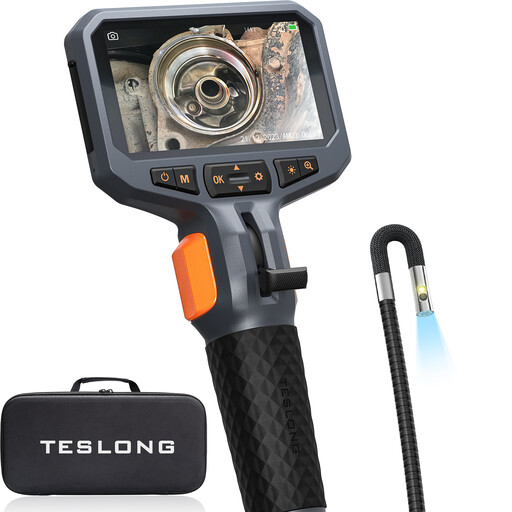
Why This Fits Their Persona: A practical choice for home garages, vehicle maintenance and general property checks where a built-in 4.5-inch display and straightforward controls are preferred.
It provides a mechanical articulation control rather than relying only on a bendable cable. Buyers can also save inspection images and videos for later reference.
4.5-inch colour display, 1.55m probe, stated 210° movement, 3500mAh battery and TF card support.
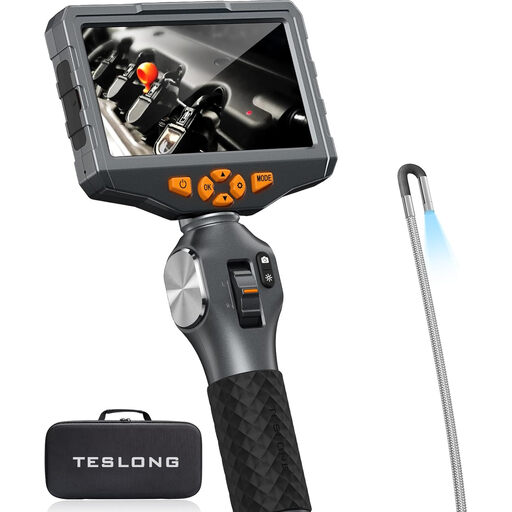
Why This Fits Their Persona: Suited to users who prioritise access through smaller openings and want a larger display with higher stated camera and recording specifications.
The 3.9mm probe addresses the common mistake of buying a camera that cannot enter the intended access point. Its 210° two-way control supports corner viewing.
5-inch display, 2-megapixel camera, 1920×1080 photo and video resolution, 3000mAh battery and included 32GB TF card.
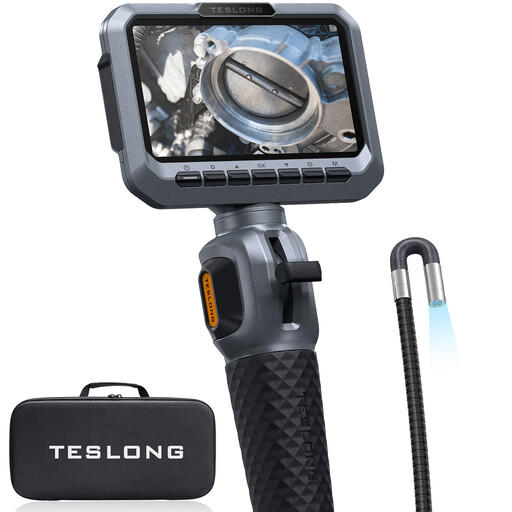
Why This Fits Their Persona: Useful for HVAC, plumbing, aircraft, automotive and building inspection tasks where adjustable illumination and a narrow 5.5mm probe are important.
Its six adjustable LED lights address the risk of a poorly illuminated cavity, while the articulated probe avoids the limitations of a fixed-view endoscope.
5-inch IPS display, 5.5mm probe, stated 210° bi-directional control, 3000mAh battery and storage case.
Before use, isolate machinery where necessary, avoid inserting the probe into live electrical equipment and follow the manufacturer’s cleaning and storage instructions. These cameras are inspection tools, not substitutes for safe isolation or formal diagnosis.
It is designed for vehicle component inspection and does not depend on a specific vehicle electronic protocol. Its 8.5mm probe requires a sufficiently large access point, so measure spark plug holes, pipes or other openings before ordering.
Yes. The TD450S supports photo and video recording, with stated photo capture at 1920×1080 and video options of 1280×720 or 1920×1080. Confirm the memory card is inserted and has available capacity before starting a job.
Service life depends on cable handling, lens cleaning, battery care and the environments in which it is used. Do not sharply bend or drag the probe, keep the lens clean and store the unit dry. Battery runtime can also vary with screen brightness, LED use and recording activity, so charge it before time-sensitive inspections.