
24/7 Customer Support

Free returns

Same-day & Next-day Delivery

Quality Guaranteed

Unlock Your Welcome Offers: FREE Delivery | Up to 80% OFF | Free 30-day JoyPlus trial
Download the APP
A good workout starts from the ground up. Whether you're flowing through a yoga sequence, holding a plank, or performing floor exercises, the surface beneath you can make all the difference. A thin, flimsy mat on a hard floor can lead to sore knees, an aching back and a constant struggle to maintain your grip.
As a Joybuy Product Recommendation Officer, my role is to help you find practical solutions for your everyday needs. This guide is designed to cut through the clutter and focus on what truly matters when selecting a thick exercise mat. We will explore key features to look for and highlight a few options that deliver on comfort, stability and portability.
Finding the right mat isn't just about picking the thickest one. Consider these factors to ensure your choice supports your specific fitness routine.
The material of your mat directly impacts its feel, durability and grip. The two most common materials for thicker mats are NBR and TPE.
The primary reason for seeking a thick exercise mat is joint protection. However, the ideal thickness depends on your activities.
A mat is only as good as its grip. A slippery surface is not only frustrating but can also be unsafe. Look for mats with textured surfaces designed to provide traction against both your body and the floor. A non-slip yoga mat is essential for holding poses with confidence.
Additionally, consider how you'll transport and store your mat. Many options come with a pilates mat with strap, which makes it simple to roll up and carry to the gym, a park or store neatly at home.
Based on features that prioritise comfort and stability, here are our recommendations.
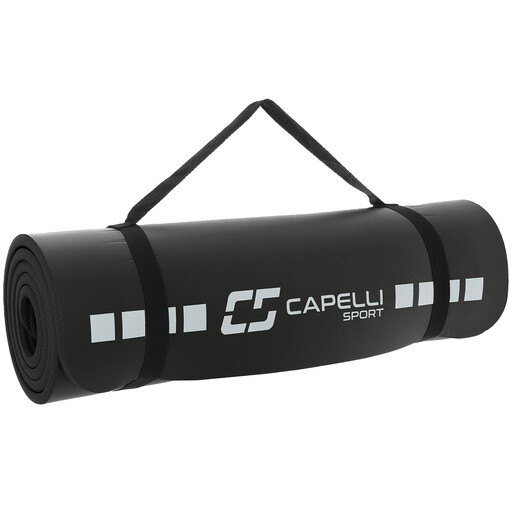
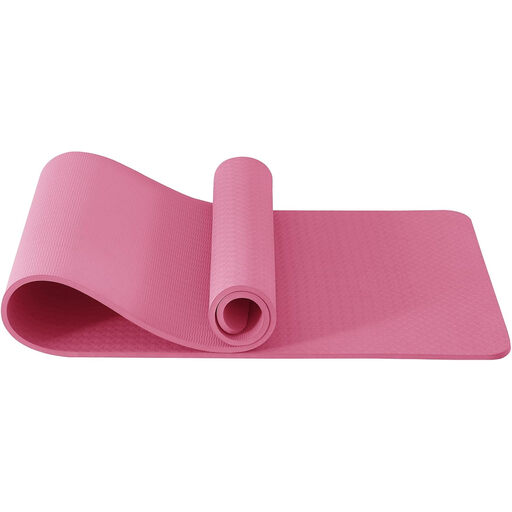
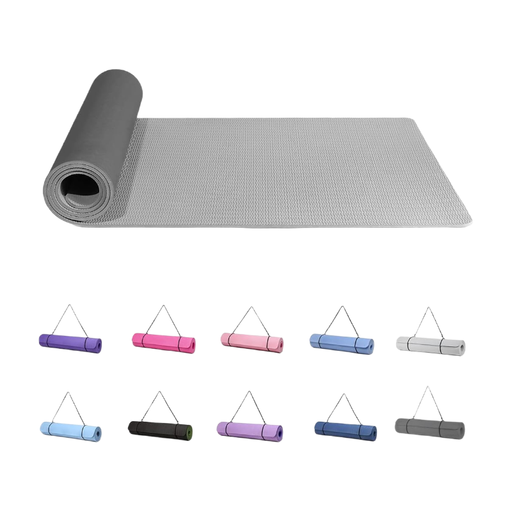
A quality mat is the foundation of a great workout. If you are also looking to enhance your routine with other equipment, such as aids for strength training or stretching, you may find what you need in our broader fitness collections.
For example, you can explore our range of gym straps to support your lifting and resistance training.
For general floor exercises, Pilates and workouts involving significant time on your knees or back, a thickness of 10mm to 12mm provides excellent cushioning and joint protection. For yoga practices that include many standing and balancing poses, a slightly thinner mat of 6mm to 8mm can offer better stability while still providing comfort.
To prevent slipping, choose a mat made from a material with natural grip, such as TPE. Also, look for mats with a dual-textured surface. These often feature different patterns on each side—one to grip the floor and one to provide traction for your hands and feet. Keeping your mat clean from dust and oils also helps maintain its grip.
The main difference lies in density and feel. NBR mats are generally softer, lighter and more 'spongy', offering great cushioning. TPE mats are denser, often providing better durability and a firmer, more stable surface with excellent non-slip properties. TPE is also widely considered a more eco-conscious material choice.