Renters cleaning a confined alcove
You need to work inside a tiled recess without losing control of the brush near grout or adjacent finishes. Surface care and safe handling matter when you may need to show the alcove’s condition at check-out.


Choose a compact cordless scrubber if the alcove is narrow and you need control around grout, taps and corners; choose a telescopic model if reaching low, high or recessed tiles is the main difficulty. Check that the head suits the surfaces, the handle fits the space and the model’s water-use instructions cover your intended cleaning. An interchangeable-battery tool makes more sense if you already have a compatible battery and have other recurring cleaning jobs.
You need to work inside a tiled recess without losing control of the brush near grout or adjacent finishes. Surface care and safe handling matter when you may need to show the alcove’s condition at check-out.
Your main difficulty is reaching low, high or deep tiles without kneeling or stretching. A longer handle may help, provided its weight and working angle remain manageable in the alcove.
You are tackling joints, edges and internal corners rather than a broad tiled wall. Brush size, attachment compatibility and close control are more useful starting points than handle length alone.
Decide whether reach or close control is the harder part of cleaning your alcove, then check surface suitability and safe wet-area use for the exact tool.
Choose it when: The recess is narrow and you need to guide a suitable head around joints, taps and corners.
Trade-off: A small head covers less tile per pass, while a short tool may still require you to bend or reach.
Choose it when: Low, high or recessed tiles are uncomfortable to reach with a handheld tool.
Trade-off: The shaft may be harder to position precisely in a tight recess and needs somewhere to be stored.
| Concern | Buying checks | Who this matters to |
|---|---|---|
| Reach and comfort | Measure the alcove’s height and depth; check usable handle length, tool weight and the angle needed to keep the head against the tile. | If reaching the back or bottom means kneeling or stretching, I need a tool I can still guide comfortably. Around 40% of consumers put reach and body comfort first. |
| Grout and corner control | Check head diameter, included detail attachments and the maker’s guidance for the tile, grout and neighbouring finishes. | When dirt sits along joints and internal corners, I want an attachment I can position without scrubbing the wrong surface. For around 30% of consumers, precise detail cleaning is the primary need. |
| Safe use and upkeep | Check the exact model’s water-use instructions, electrical documentation and availability of compatible replacement heads; keep charging equipment away from water. | In a rented bathroom, I want to avoid damage or an electrical hazard and keep the tool usable beyond one clean. Those ownership and safety needs come first for around 30% of consumers. |
Extra reach helps only if there is room to angle the shaft and place the brush accurately. Lakeland specifies 112 cm reach for its Turbo Scrubber, but that figure alone cannot tell you whether it will fit your recess.
Measure the depth, height and access angle before choosing a telescopic model. If reach is not the problem, compare compact heads instead.
Water-use limits differ between models: Bosch describes its UniversalBrush as IPX5 splash-water resistant and instructs users not to immerse it. A scrubber’s rating does not describe the safety of its charger, plug or socket.
Follow the exact model manual, charge in a dry place and inspect the charging equipment before use.
Bosch’s attachment guidance distinguishes uses by material, so a pad suitable for one area should not be assumed suitable for every tile, joint or nearby surface.
Identify the surfaces first, use an attachment approved for them and try the least aggressive suitable option in an inconspicuous spot.
For applicable England tenancies, the Tenancy Deposit Scheme says a landlord cannot require a professional cleaning service. It assesses cleaning disputes against evidence of the property’s cleanliness at the start and end of the tenancy, rather than whether a particular service was used.
Check the inventory and tenancy documents, clean to the documented starting standard and keep dated photographs. Seek locally applicable guidance for a tenancy elsewhere in the UK.
Compact and long-reach cordless options for different alcove layouts.
Compact UniversalBrush option for tile, joint and corner work with the appropriate attachment.
Compact detail tools and 18V ONE+ scrubbers for people considering an existing battery system.
Interchangeable-head power scrubbers described by the manufacturer for household surfaces including tile and grout.
Small-head oscillating cleaning tools for detail work around joints, taps and edges.
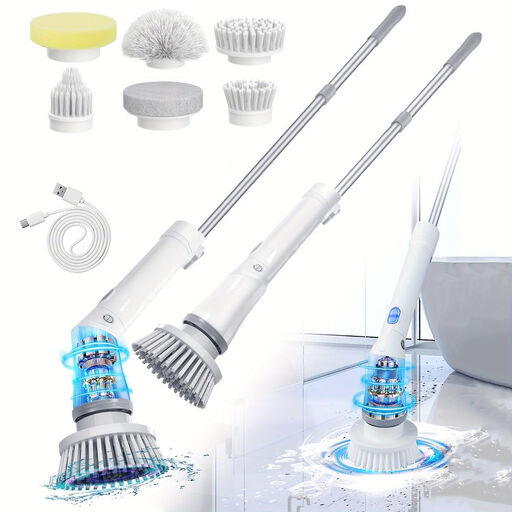
These cordless scrubbers are choices to assess for tiled-alcove cleaning. The two Leebein listings have extendable handles for reach-led tasks; assess the Iagreea tool against your required head shape and working space before choosing it for detail work.
 No image available
Consider this extendable model if reaching recessed tiles is your main difficulty; check that its assembled handle can be manoeuvred inside the alcove.
The product name specifies eight interchangeable brush heads, an adjustable extension handle and two rotation speeds. Confirm which head is suitable for your tile and grout, and follow the model’s instructions for use around water.
 No image available
This extendable scrubber is relevant when high, low or recessed tiles are hard to reach; check its working and storage dimensions for a small flat.
The product name specifies seven brush heads, two speeds and an IPX7 rating. Check the instructions for permitted water exposure and the suitability of individual heads for your grout and adjacent finishes.
 No image available
Consider this electric spin scrubber for the tile-cleaning task only after checking whether its head shape and handle fit your alcove.
Confirm the included attachments and their surface guidance, along with the model’s permitted wet-area use, before using it on grout or near a shower.
Choose telescopic reach if the alcove’s depth or height makes bending, kneeling or stretching the main problem; a compact tool is easier to consider when close control in a narrow recess matters more. Measure the space and check that you can place the head against the tile at a usable angle.
Use it only within the water-exposure limits stated for that exact model. Bosch specifies IPX5 splash-water protection for the UniversalBrush and instructs users not to immerse it, while Ryobi specifies IPX7 for the RSCR4-120G. Follow the manual and keep chargers, plugs and sockets away from water.
No: attachment suitability depends on the material and the tool. Bosch’s attachment guidance distinguishes between uses for different surfaces, so check the manufacturer’s instructions for your tile, grout and nearby finishes before trying the least aggressive suitable attachment.
For an England tenancy covered by the Tenant Fees Act framework, the Tenancy Deposit Scheme says a landlord cannot require you to use a professional cleaning service. The documented starting and ending cleanliness matters in a cleaning dispute, so retain the check-in inventory and dated photographs. Seek locally applicable advice for a tenancy elsewhere in the UK.
Check for the applicable marking and product documentation when buying electrical equipment for Great Britain. GOV.UK guidance says Great Britain continues to recognise CE marking alongside UKCA marking for relevant regulated products; a mark does not replace following the tool’s own safety and water-use instructions.