What to check before buying
Start with unopened storage and how you will serve the custard, then consider what happens to a multi-serve pack after lunch.
| Concern | What to check | Who this matters to |
|---|
| Cupboard storage and serving |
Check the exact pack’s unopened-storage wording and whether you can eat it cold or need a suitable dish for heating. |
If I need dessert ready between lectures, I want to store it unopened and serve it without cooking from scratch. About 27% of consumers put cupboard storage and simple serving first. |
| Leftovers and refrigeration |
Check pack size, servings and the instructions for storage and use after opening. |
When fridge space is limited, I need to know whether I can use the rest of a multi-serve pack in time. For about 27% of consumers, managing leftovers is the primary concern. |
| Lighter recipe |
Compare fat, saturates and sugars per 100g on the exact labels. |
I may prefer a lower-fat recipe, but I still want to see how its sugar content compares with the standard version. About 20% of consumers put that nutrition comparison first. |
| Recipe and flavour |
Check whether you want standard, flavoured or cream-containing custard, and choose a pack size you can use. |
If custard is the dessert rather than just an accompaniment, I may care most about its ingredients and flavour. Recipe preference comes first for about 26% of consumers. |
Joybuy product selections
These ready-to-serve custards include 400g cans for cupboard planning, plus larger carton and tub formats better considered with repeat or shared servings in mind.
 No image available
Ambrosia Devon Custard 400g
A ready-to-serve 400g can for someone who wants standard custard to serve hot or cold. Store it in a cool, dry place before opening; refrigerate and consume within three days once opened. Check the current label for allergens.
 No image available
Ambrosia Low Fat Custard 400g
A 400g can for comparing a low-fat recipe with standard custard; check the current per-100g nutrition panel for the measures that matter to you. Store it in a cool, dry place before opening, then refrigerate and consume within three days. Check the label for allergens.
 No image available
Ambrosia Strawberry Flavour Devon Custard 400g
A strawberry-flavoured 400g can if you want a variation on standard custard, served hot or cold. Keep it in a cool, dry place unopened; refrigerate and consume within three days after opening. Check the current label for allergens.
 No image available
Ambrosia Light Devon Custard 1kg
A ready-to-serve carton, rather than a tin, for planned shared or repeat servings. The product description states approximately eight servings. Store it in a cool, dry place before opening; refrigerate and consume within three days afterwards. Check the current label for nutrition and allergens.
 No image available
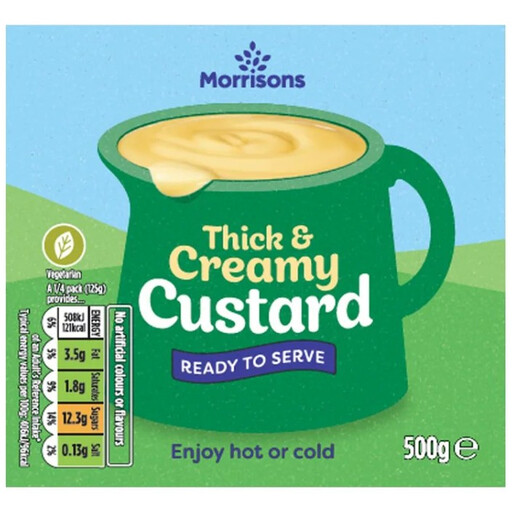
Morrisons Ready To Serve Custard 500g
A 500g ready-to-serve tub, not a tin, to consider if you can plan for leftovers. Store it in a cool, dry place unopened; it can be served chilled or gently heated. Refrigerate and consume within three days after opening, and check the current label for allergens.
Common questions
Can ready-to-serve custard stay in a student cupboard?
Yes, if the exact unopened pack specifies ambient storage. Sainsbury's cited ready-to-eat custards and M&S Silky Smooth Custard specify a cool, dry place; follow the separate refrigeration instructions once you open a pack.
Can I microwave custard in its tin or carton?
Do not microwave it in its packaging. Sainsbury's instructions for its cited product say to transfer the custard to a microwaveable dish, then follow the pack’s covering, stirring and heating directions.
How long can I keep custard after opening it?
Follow the instruction for the exact product: Sainsbury's cited standard and lighter 500g custards say to refrigerate and consume within three days, while M&S specifies refrigeration and consumption within two days for its cited custard.
Does a best-before date mean custard is unsafe the next day?
Not automatically. GOV.UK explains that a best-before date concerns quality, whereas a use-by date concerns safety. Read the date mark and storage instructions on your particular pack, and do not treat a use-by date as a best-before date.
Can someone with a milk allergy choose any ready-to-serve custard?
No assumption is safe across products. The cited Sainsbury's standard custard contains cows’ milk, and M&S lists milk ingredients in its Silky Smooth Custard. Check the current ingredient and allergen label on the exact pack before choosing.


