Allergen-conscious bake-sale organisers
If families need ingredient information, keep the original packaging and check the current label of each custard used. Do not infer an egg ingredient, or its absence, from the word custard.


Choose ready-to-serve custard when volunteers need to pour it over cakes without making a batch; consider powder only if there is time and equipment to prepare it. Match the pack size to likely portions and its instructions for leftovers. For a school bake sale, keep the exact pack available for ingredient checks: custard as a category does not tell you whether a product contains egg.
If families need ingredient information, keep the original packaging and check the current label of each custard used. Do not infer an egg ingredient, or its absence, from the word custard.
Ready-to-serve custard avoids making a sauce during the sale. Decide whether it will be poured cold or warmed, then check the chosen pack's serving directions.
Estimate how much custard the topping station will use. An unopened storecupboard pack and an opened pack have different storage requirements, which can affect the amount worth opening.
For a school bake sale, settle the allergen-information and serving arrangements before choosing a pack size or recipe.
| Concern | What to check | Who this matters to |
|---|---|---|
| Allergens and labelling | Check the current ingredients and allergen statements on each pack. If food is packed before customers select it, establish whether the organiser is operating as a food business and whether prepacked-for-direct-sale rules apply. | I need to answer families' ingredient questions without guessing from the type of custard. About 36% of consumers put accurate allergen information and applicable sale labelling first. |
| Serving and heating | Choose a ready-to-serve format if preparation time is limited; follow its specific cold-serving or heating instructions. | When volunteers are serving cake quickly, I need custard that fits the available serving setup. Quick, straightforward service is the primary concern for about 29% of consumers. |
| Pack size and leftovers | Estimate portions and check the exact pack's refrigeration and use-by instructions after opening. | If turnout is uncertain, I want to avoid opening more custard than we can use. Managing portions and leftovers comes first for about 21% of consumers. |
| Recipe choice | For powder, check the preparation instructions and required ingredients. For ready-to-eat variants, compare ingredients and nutrition information per 100g on the actual packs. | I may want to make a batch or choose between different custard recipes, but only if the preparation fits the event. Recipe choice is the main concern for about 14% of consumers. |
The checked ASDA, Tesco and M&S canned custards list milk without egg in their displayed ingredients, while a separate M&S chilled custard lists egg yolk. Neither example establishes the ingredients of another pack.
Check the current label, including precautionary allergen statements, and keep the packaging available at the sale.
Opened-pack directions vary: the checked Sainsbury's 400g can says to use it within one day, M&S Silky Smooth Custard within two days, and Tesco Ready To Serve Custard within three days.
Estimate portions before opening a pack and follow its own transfer, refrigeration and consumption instructions.
Opening more than the sale can use may leave custard to discard.
The checked Tesco and ASDA directions call for transferring custard to suitable cookware or a microwaveable container; their instructions should not be replaced with a single method for every product.
Read the pack before warming it, including any directions about stirring, boiling or reheating.
Bird's custard powder needs preparation, unlike ready-to-serve custard. Once made, its custard must be refrigerated and treated as fresh food.
Choose powder only if the event has time and facilities to prepare and serve it; check the recipe on the exact pack.
Preparation also means arranging the recipe ingredients, equipment and washing-up.
Its Devon 400g can is a ready-to-serve option for custard poured hot or cold over cake.
Its 350g Original Custard Powder is a storecupboard preparation route, not a ready-to-serve tin.
Tesco Ready To Serve Custard 400g is an ambient, ready-to-serve option.
The checked range includes a Stamford Street Co. 400g can and a 500g lighter ready-to-eat custard.
The checked Just Essentials 400g custard is a ready-to-serve can.
Silky Smooth Custard is a canned option whose listed ingredients include whole milk and cream.
These selections include ready-to-serve custard in several sizes and a powder option for organisers who can prepare a batch. Check the exact container type where a tin or carton is essential, and use the current pack for allergen and serving instructions.
 No image available
A 400g option to consider for a smaller cake-topping station where ready-to-serve custard suits the setup. Check the current pack for ingredients, heating directions and how to store leftovers.
 No image available
Consider the 1kg size when you expect to use a larger quantity of custard. If the serving setup requires a tin or carton, confirm the container type before ordering; check the pack's ingredients and opened-pack instructions too.
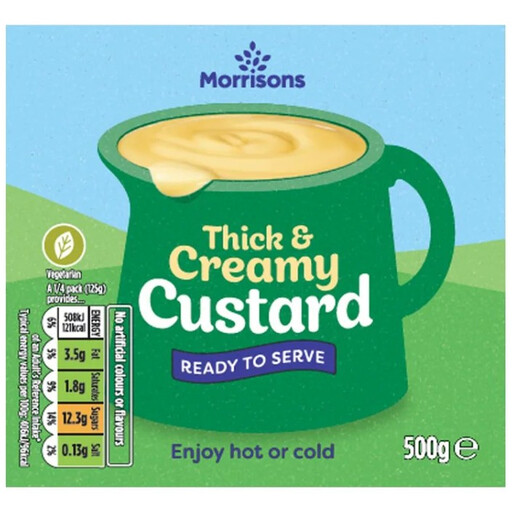 No image available
The 500g ready-to-serve pack is an option when volunteers do not plan to make custard from scratch. Confirm its container type if that affects service, and follow the current pack's allergen and storage directions.
 No image available
Consider this 400g Devon custard for a smaller topping station. Ambrosia describes its Devon 400g can as ready to serve hot or cold; check the exact pack's heating, ingredient and storage instructions before the sale.
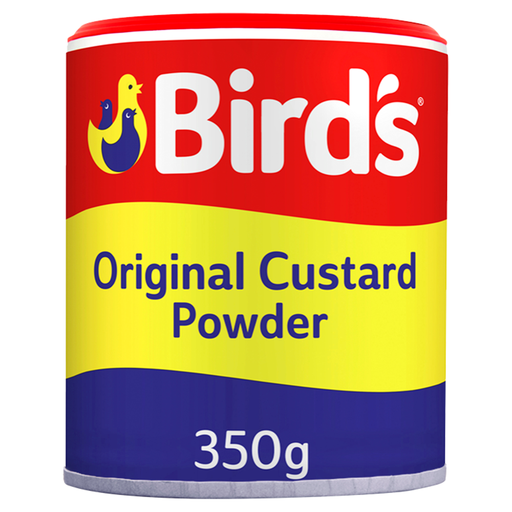 No image available
This 350g powder is a choice for an event with facilities to prepare custard rather than pour it straight from a pack. Check this variant's recipe and allergen information; refrigerate the prepared custard according to its directions.
No: the category name is not an allergen declaration. The checked ASDA Just Essentials, Tesco Ready To Serve and M&S Silky Smooth canned custards list milk but not egg in their displayed ingredients; a separate M&S chilled custard lists egg yolk. Check the exact current pack, including precautionary statements.
GOV.UK says food supplied at school fetes and fundraisers must comply with food law and be safe to eat. Where a food business makes food that is prepacked for direct sale, the applicable rules require the food name, a full ingredients list and emphasised allergens on the package. Whether those rules apply depends on how the event operates and when the food is packed; check the circumstances with the local authority if unsure, and keep ingredient information available for families.
Yes, keep the original packaging available for ingredient checks, but store any leftover custard as its own pack directs. Tesco specifies transfer to a covered non-metallic container, refrigeration and consumption within three days; the checked Sainsbury's 400g can specifies one day, and M&S Silky Smooth Custard specifies two days.
Use the chosen product's stated heating method instead. The checked Tesco and ASDA directions call for transferring custard to a suitable pan or microwaveable container; read the pack for any further cautions about boiling or reheating.
Not necessarily. Sainsbury's describes its 500g lighter custard as having 50% less fat than its standard custard; that comparison does not establish its sugar content. Compare the sugars value per 100g on the exact packs if sugar is part of your choice.