Small-buffet planners
If custard is one option alongside cake, crumble or fruit, a manageable tin lets you open more only when needed. Ambrosia labels its standard 400g Devon Custard tin as three portions.


Choose a standard ready-to-serve tin for a flexible Boxing Day cupboard backup, a light recipe if its declared sugar and fat figures are your priority, or a cream-containing recipe if that better suits the dessert you are serving. Plan the number of tins around the portions on the pack, check milk allergens for your guests, and follow the exact tin's refrigeration and use-by instructions after opening.
A ready-to-serve tin can be kept in the cupboard until the buffet needs a dessert accompaniment. The recipe and the amount you open matter just as much as the convenience.
If custard is one option alongside cake, crumble or fruit, a manageable tin lets you open more only when needed. Ambrosia labels its standard 400g Devon Custard tin as three portions.
For a ready-to-serve option with lower declared sugar and fat than Ambrosia's standard Devon Custard, the brand's Light Devon Custard offers a within-range comparison. Check the nutrition panel and ingredients on the tin you buy.
If the custard's recipe matters alongside a sponge, pie or crumble, check cream-containing options such as Ambrosia Deluxe or M&S Silky Smooth Custard. Compare their ingredients and nutrition rather than relying on the product name alone.
For a Boxing Day buffet, start with the amount you expect to serve, then choose the recipe and check what will happen to any opened custard.
| Concern | What to check | Who this matters to |
|---|---|---|
| Ready-to-serve quantity | Check the format, pack weight and stated portions. Ambrosia labels its standard 400g Devon Custard tin as three 130g portions. | If custard is only one accompaniment on my buffet, I want enough without opening several tins unnecessarily. Around 33% of consumers would put ready-to-serve quantity first. |
| Declared sugar and fat | Compare the nutrition panels per 100g and check which standard product a light-recipe claim refers to. | When I want a lighter recipe but still need custard ready to serve, the figures on the tin guide my choice. About 25% of consumers would prioritise declared sugar and fat. |
| Cream-containing recipe | Look for cream in the ingredients and compare fat and saturates per 100g across the products you are considering. | For a pudding at the centre of the buffet, I would choose the custard recipe to suit that dessert. Roughly 25% of consumers would make the richer recipe their primary concern. |
| Allergens and opened storage | Read the exact pack's milk-allergen declaration and its instructions for refrigerating and using leftovers. | If guests have a milk allergy, or custard may be left after serving, I need to know whether the product is suitable and how to store it. Around 17% of consumers would put those checks first. |
Bird's powder appears alongside ready-to-serve custard in Sainsbury's category, but powder needs preparation. It will not serve the same last-minute purpose as an unopened ready-to-serve tin.
Check the pack format before buying; choose powder when you intend to make the custard.
Ambrosia Light Devon Custard contains milk ingredients. A lighter nutrition profile does not establish whether a product suits a guest with an allergy.
Read the allergen declaration on the exact pack before serving it.
An unopened storecupboard product needs different handling once opened. Ambrosia instructs shoppers to remove leftover standard Devon Custard from the can, refrigerate it and consume it within three days; M&S gives its Silky Smooth Custard a two-day opened life.
Estimate portions before serving, open additional tins only as needed and follow each pack's storage instructions.
Opening more than the buffet uses can leave custard that must be eaten within a short time or discarded.
“Light” and “deluxe” describe different recipes, but do not replace a comparison of ingredients and nutrition on the same per-100g basis.
Check the current labels before deciding which recipe suits the desserts and guests at your buffet.
These ranges provide points of reference for recipe and format choices; a brand name alone does not establish that every product is a ready-to-serve tin.
Ambrosia has 400g standard and Light Devon Custard tins, as well as a Deluxe Custard option.
Tesco lists its own 400g ready-to-serve custard alongside Ambrosia tins in its tinned-custard category.
Sainsbury's custard category brings ready-to-serve choices and Bird's custard powders into the same shopping decision.
M&S Silky Smooth Custard is a 400g canned option made with whole milk and cream.
Bird's appears here as a custard-powder alternative, not a like-for-like ready-to-serve tin.
These ready-to-serve custards cover standard, light and strawberry-flavour choices for the buffet. The 1kg Ambrosia carton and 500g Morrisons tub are alternatives if a tin is not essential; check their pack formats when planning what to open.
 No image available
A ready-to-serve option to consider when declared fat content matters to your buffet choice. The 400g pack contains milk; check its current allergen declaration and opened-storage instructions before serving.
 No image available
A standard ready-to-serve tin for a buffet with warm or cold desserts. Ambrosia labels this 400g product as three portions; it contains milk. After opening, the brand says to remove leftovers from the can, refrigerate them and consume them within three days.
 No image available
Consider this strawberry-flavour variation if it suits the desserts you plan to serve. It is a 400g product; check the current pack for portions and opened-storage directions. Its product information identifies milk as an allergen.
 No image available
The 1kg size may suit a buffet expecting to serve more custard, provided a carton rather than a tin works for your plans. Check the portions on this pack before opening it. It contains milk, and opened custard needs refrigeration according to its pack directions.
 No image available
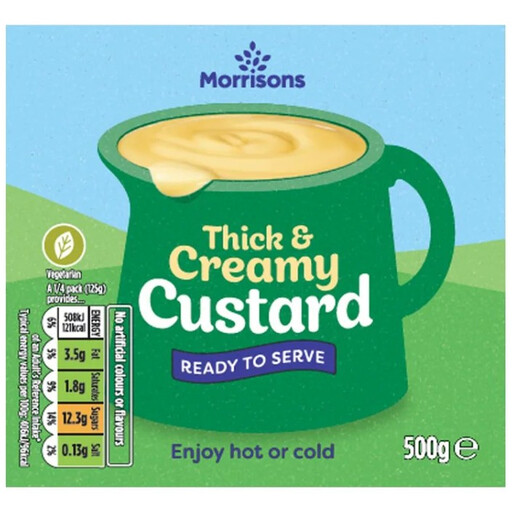
A 500g ready-to-serve choice if a tub rather than a tin suits your buffet. Check the pack for portions before deciding how much to open. Its product information identifies milk as an allergen and calls for refrigeration after opening.
Ambrosia says its standard, Light and Deluxe ready-to-serve custards can be served hot or cold. If heating a tin, follow that product's directions; the checked Ambrosia instructions say to empty it into a saucepan and heat gently while stirring, without boiling.
Follow the exact pack: Ambrosia instructs shoppers to remove leftover custard from its checked tins, refrigerate it and consume it within three days. M&S says to refrigerate its Silky Smooth Custard and eat it within two days. Food Standards Scotland advises checking labels for the right storage method.
The checked Ambrosia and M&S examples contain milk ingredients, so do not serve those products to someone with a milk allergy. Read the current allergen declaration on the exact product you buy; the answer does not apply automatically to every custard.
No. An opened product has its own storage and use instructions, separate from the date for an unopened pack. GOV.UK advises following the manufacturer's open-life instructions; check the tin before planning leftovers.
The Bird's products listed in the checked Sainsbury's custard category are ready-to-make or instant powders, not the same ready-to-serve tin format. Choose powder if preparing custard fits your buffet plans.