Households wanting a familiar dessert without preparation
If a fussy eater accepts a particular ready-to-serve custard, a tin or an individual pot lets you repeat that choice without making a fresh batch.


Start with a ready-to-serve tin if the eater already accepts its flavour and you want custard without making a batch. Buy several tins or a larger carton only when you can use them within the pack’s storage instructions; individual pots offer separate portions, while powder suits households willing to cook and adjust each batch.
If a fussy eater accepts a particular ready-to-serve custard, a tin or an individual pot lets you repeat that choice without making a fresh batch.
Separate pots give each serving its own unopened pack. With a tin or larger carton, plan how you will use the remainder and follow that product’s instructions after opening.
Bird’s powder offers a way to adjust preparation for repeated meals, but it needs cooking. Bird’s says prepared custard should be refrigerated and treated as fresh food.
| Concern | What to check | Who this matters to |
|---|---|---|
| Familiar flavour and instant serving | Check the exact flavour and whether the pack is ready to serve. Try an accepted format before stocking up. | When mealtimes are easier with a familiar custard that needs no cooking, consistency comes first; about 50% of consumers put familiar, immediate serving ahead of other needs. |
| Portions and leftovers | Check portion format and the exact pack’s refrigeration and consumption instructions after opening. | If an opened tin often goes unfinished, separate servings can matter more than a larger pack. About 33% of consumers make portion control and avoiding leftovers their primary concern. |
| Batch control and dietary checks | Check preparation requirements, ingredients and allergen statements on the current pack. | To adjust a homemade batch or choose a product around dietary requirements, I need to examine what goes into it; roughly 17% of consumers prioritise batch control or dietary-label checks. |
A promotion on individual tins does not turn them into a fixed multipack, and an offer may end.
Check what is actually included and the offer end date before deciding how many tins you can use.
A larger carton or several tins leave more custard unused if the eater rejects that flavour or texture.
Try one manageable pack of a familiar flavour before buying more.
Marks & Spencer instructs buyers to refrigerate its Silky Smooth Custard and eat it within two days of opening; Ambrosia gives a three-day refrigerated period for its plant-based custard.
Follow the instructions on the exact product and plan portions before opening a larger pack.
Ambrosia’s plant-based custard and Bird’s powder both carry a “may contain milk” statement in their product information.
For an allergy, check the current physical pack’s ingredients and allergen statements rather than relying on the product description alone.
Ready-to-serve custard in cans, cartons and snack pots, according to Ambrosia.
Tesco Groceries lists its own 400g ready-to-serve custard alongside branded tins.
Custard powder for making repeated batches rather than opening ready-to-serve tins.
Marks & Spencer describes its 400g Silky Smooth Custard as made with whole milk.
These ready-to-serve choices include 400g tins and larger non-tinned packs. Choose by an accepted flavour and a pack size you can use after opening; the larger formats are not tinned multipacks.
 Image unavailable
A ready-to-serve 400g tin to consider if Devon Custard is already an accepted flavour. Check the current pack for milk allergen information and instructions for any custard left after opening.
 Image unavailable
This ready-to-serve 400g tin is an option when you specifically want the Low Fat variant. Its name alone cannot tell you whether a fussy eater will accept it; check the current milk allergen and opened-pack instructions.
 Image unavailable
A ready-to-serve 400g tin for someone who accepts strawberry-flavoured custard. Try the flavour before buying several; check the current milk allergen information and storage instructions.
 Image unavailable
Consider this ready-to-serve 1kg carton when several servings are planned over a short period. It is not a tin; check that the flavour is accepted and follow the current pack’s milk allergen and opened-pack instructions.
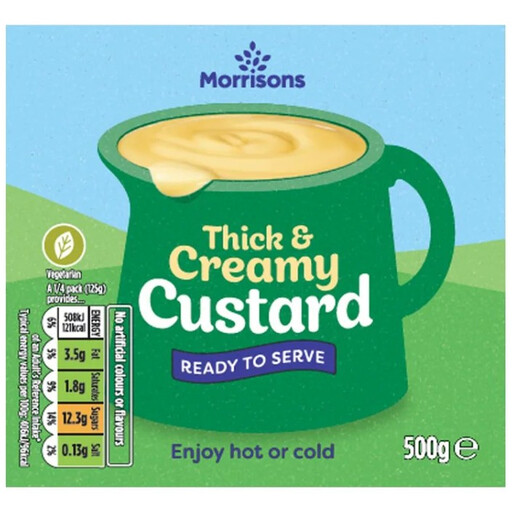 Image unavailable
This 500g ready-to-serve custard is a non-tinned option when you want a pack between the 400g tins and the 1kg carton. Check the current milk allergen information and plan how to use it after opening.
Only if the eater accepts the product and you can use the opened pack as instructed. Marks & Spencer, for example, says to refrigerate its 400g Silky Smooth Custard after opening and eat it within two days; separate pots may be easier when portions regularly go unfinished.
Ambrosia describes its Devon Custard as suitable for hot or cold serving, and its individual Devon Custard pots as ready to eat cold. Check the exact pack’s instructions if you want to warm it.
Do not assume so from “plant-based” alone. Ambrosia says its plant-based custard may contain milk; check the current physical pack’s ingredients and allergen statement before choosing it for someone with a milk allergy.
It can serve repeated homemade batches if you are willing to prepare them, but it is not ready-to-serve custard. Bird’s preparation uses milk, sugar, heating and stirring, and the brand says made-up custard should be refrigerated and treated as fresh food.
Confirm the accepted flavour, pack format, ingredients, allergen statements and instructions after opening on each product. A multi-buy offer on separate tins is not the same thing as a fixed multipack.