Hosts serving dessert quickly
If custard is going over cake, crumble or fruit, a ready-to-serve pack avoids mixing it during the party. Ambrosia and Tesco describe their cited ready-to-serve custards as suitable for serving hot or cold.


Choose ready-to-serve tinned custard if you want to pour dessert without mixing a batch; check the pack if you plan to serve it hot rather than cold. A lighter-labelled recipe may suit guests who specifically want to compare nutrition panels, while instant powder offers adjustable consistency but needs preparation. Whichever format you choose, check the exact pack for allergens, serving guidance and storage directions.
If custard is going over cake, crumble or fruit, a ready-to-serve pack avoids mixing it during the party. Ambrosia and Tesco describe their cited ready-to-serve custards as suitable for serving hot or cold.
Start with the number of portions you expect to serve, then compare the serving guidance and pack sizes. The cited ranges include 400g cans and larger ready-to-eat packs; neither size alone tells you how much each guest will take.
Check the ingredient and allergen information on the exact pack before serving. If a lighter-labelled recipe is of interest, compare its nutrition panel with the particular standard product you would otherwise buy.
Decide whether pouring straight from a ready-to-serve pack or preparing custard to a chosen consistency matters more, then plan portions and check the label for your guests.
| Concern | What to check | Who this matters to |
|---|---|---|
| Quick serving | Look for ready-to-serve wording and check whether the pack permits hot or cold serving. | If dessert needs to be served without mixing custard during the party, a pourable pack takes priority. About 36% of consumers put that immediate serving need first. |
| Enough for the group | Use the exact pack’s serving guidance and consider whether custard is a small topping or a larger part of dessert. | When several guests want custard, running short matters more than choosing between recipes. For about 29% of consumers, planning the quantity is the primary concern. |
| Allergens and recipe | Read the exact pack’s ingredients, highlighted allergens and nutrition panel; check guest requirements before serving. | A guest’s milk allergy or a preference for a particular recipe can determine whether a pack is suitable at all. About 21% of consumers place that check first. |
| Consistency | Decide whether adjustable thickness is worth the boiling water and mixing required for instant powder. | If custard needs a particular thickness for the planned dessert, being able to adjust it can matter more than pouring it straight away. That is the leading need for about 14% of consumers. |
Portions depend on whether custard is a little topping or a substantial part of dessert. ASDA’s cited 400g cans suggest two servings, while other ready-to-eat products come in larger packs.
Estimate portions for your menu using the guidance on the packs you intend to buy.
Unopened storecupboard storage directions do not apply to leftovers. The cited Tesco and ASDA products require refrigeration after opening; M&S gives a different consume-within period for its custard.
Transfer leftovers to a covered, suitable non-metallic container, refrigerate them and follow the chosen pack’s use-by-after-opening direction.
Several cited custards contain milk or milk-derived ingredients. A recipe description does not establish suitability for a guest with a milk allergy.
Ask about guests’ requirements and read the ingredients and allergen information on the exact pack before serving.
Bird’s Instant Custard allows consistency to be adjusted, but it must be made up rather than poured from a can.
Choose powder when you want that preparation control; choose ready-to-serve custard when mixing would interrupt the serving plan.
Making up the powder also calls for boiling water, a suitable vessel and time to mix it.
Its cited range includes a ready-to-serve Devon Custard 400g can and Light custard pots. Check the format as well as the recipe when planning how to serve dessert.
Its cited Instant Custard sachets are a powder alternative when you are willing to prepare dessert accompaniment at the party.
Tesco Ready To Serve Custard 400g is an own-label can for hosts who want stated serving and storage directions.
Its cited ambient custard range spans several pack sizes, including 400g, 500g and 1kg ready-to-eat options.
The cited own-label range includes Creamy Custard and Just Essentials Custard in 400g ready-to-serve cans.
M&S Silky Smooth Custard is a cited 400g storecupboard can for serving with desserts or fruit.
These ready-to-serve custards cover standard, strawberry-flavoured and lighter-labelled options for a garden-party dessert. Check each container format if you specifically need tins rather than another ready-to-serve pack.
 Image unavailable
For pouring over a shared dessert without mixing custard, this 400g can is ready to serve. Joybuy’s product directions say it contains milk and that leftovers should be removed from the can, refrigerated and consumed within three days.
 Image unavailable
For a shared dessert where a Light-labelled recipe matters, this ready-to-serve 1kg variant offers a different format from a 400g tin. It is described as a carton and contains milk; check its nutrition panel and after-opening directions on the current pack.
 Image unavailable
For a ready-to-serve 400g can with a Low Fat variant name, compare its nutrition panel with the standard custard you are considering. It contains milk; transfer leftovers from the can, refrigerate them and follow the three-day use direction.
 Image unavailable
For guests who want a strawberry-flavoured topping, this 400g ready-to-serve variant offers a change from standard Devon Custard. It contains milk; refrigerate opened contents and follow the three-day use direction.
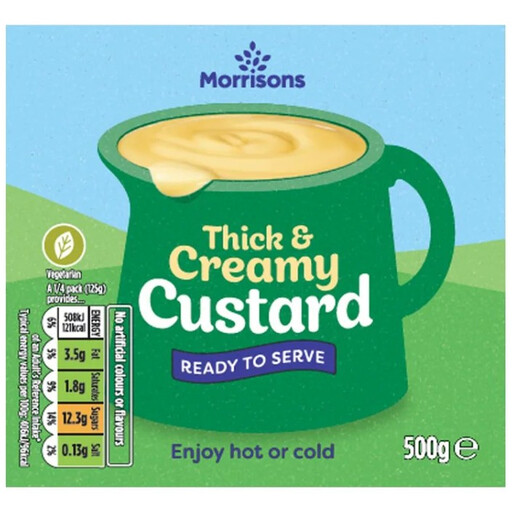 Image unavailable
For a ready-to-serve dessert accompaniment in a 500g pack, this Morrisons product is an alternative to the 400g cans. It is described as a tub, not a tin, and contains milk; refrigerate it after opening and follow the three-day use direction.
Start with the serving guidance on the exact pack and the portions you plan to offer. ASDA’s cited 400g cans suggest two servings each, but a small topping over fruit or cake calls for a different amount from a larger serving of custard.
Yes, the cited Ambrosia and Tesco ready-to-serve custards say they can be served cold or hot. If you prefer to heat one, follow that pack’s heating instructions and use a suitable container where directed.
Transfer it to a covered, suitable non-metallic container and refrigerate it, following the chosen pack’s directions. The cited Tesco and ASDA products specify use within three days after opening, while Marks & Spencer specifies two days for its Silky Smooth Custard.
Do not assume that a tinned custard is suitable: the cited ready-to-serve products contain milk ingredients. Check the exact current pack and the guest’s requirements before serving. The Food Standards Agency says allergens must be emphasised in the ingredients list of pre-packed food.