No-prep late-night dessert keepers
If you want custard straight from a prepared pack, a ready-to-serve tin avoids making powder. Ambrosia describes its standard 400g can as suitable for serving hot or cold.


Keep ready-to-serve custard in the cupboard if late-night convenience matters more than making custard from powder. Choose a pack you can finish within its after-opening instructions, then compare the exact recipe and allergen label. Powder remains an option if you are happy to prepare it at supper time.
If you want custard straight from a prepared pack, a ready-to-serve tin avoids making powder. Ambrosia describes its standard 400g can as suitable for serving hot or cold.
If a tin may last beyond one supper, check its size and after-opening instructions. Ambrosia says to refrigerate leftovers from its standard can and use them within three days; M&S gives two days for its Silky Smooth Custard.
If fat per 100g is your main recipe criterion, compare the nutrition panels on the exact cans rather than relying on a product name. Sainsbury's lists an Ambrosia Low Fat Custard Can, but its milk ingredients still matter for allergen checks.
Start with whether the custard needs to be ready to serve. Then match the pack and recipe to how you expect to use it after opening.
| Concern | What to check | Who this matters to |
|---|---|---|
| Immediate serving | Look for ready-to-serve wording; check the instructions if you plan to heat it. | If supper is late and I do not want to make custard from powder, I need a prepared pack I can serve cold or warm. About 36% of consumers put immediate serving first. |
| Leftovers and storage | Check pack weight and the exact refrigeration and use-up instructions after opening. | When I am serving a small portion, I want a pack whose leftovers I can finish in time. For about 29% of consumers, managing the opened pack is the main concern. |
| Lower-fat recipe | Compare fat per 100g on current labels, and check allergens separately. | I still want prepared custard, but fat per 100g is the recipe detail that drives my choice. That is the primary need for about 14% of consumers. |
| Richer recipe | Read the ingredient list for cream rather than treating descriptive names as equivalent. | For a dessert-style supper, I may prefer a recipe containing cream over a standard one. A richer recipe comes first for about 21% of consumers. |
Bird's Original Custard Powder is a cupboard ingredient, but Sainsbury's lists it as ready to make, not ready to eat.
Choose a pack labelled ready to serve or ready to eat if preparation at supper time is the deciding issue.
After-opening instructions differ: Ambrosia gives three days for its standard 400g can, while M&S gives two days for Silky Smooth Custard.
Transfer leftovers from the can where the label directs, refrigerate them and follow that product's use-up instruction.
An opened pack that is too large to finish within its stated period may lead to waste.
The cited Ambrosia Low Fat Custard Can contains milk ingredients. Fat content and allergen suitability are separate questions.
Read the current ingredient and allergen statement on the exact pack.
Names such as Deluxe or Silky Smooth do not establish that two custards have the same ingredients or texture.
Check the exact recipe, pack weight and serving instructions before choosing a cream-containing option.
Its cited 400g cans include standard Devon Custard and a Low Fat variant, giving ready-to-serve recipe choices.
Tesco Groceries lists a 400g own-label Ready To Serve Custard in its tinned-custard category.
Its cupboard-custard listings include ready-to-eat own-label packs, Ambrosia cans and Bird's powder.
M&S Silky Smooth Custard is a 400g tinned recipe containing whole milk and cream.
Bird's Original Custard Powder is a dry ingredient for making custard, rather than a ready-to-serve tin.
These selections cover prepared custard for a late-night supper: three 400g Ambrosia cans, plus a larger carton and a ready-to-serve tub. Check the container type if a tin specifically matters to you.
 No image available
A ready-to-serve 400g can for a cold bowlful or a warmed dessert topping. Ambrosia states three portions. It contains milk; after opening, remove leftovers from the can, refrigerate and use within three days.
 No image available
A prepared 400g can to consider when comparing fat per 100g across recipes; check the current label for the figure. It can be served hot or cold, contains milk and needs refrigeration after opening, with use within three days.
 No image available
A ready-to-eat strawberry-flavour option when you want a prepared dessert rather than powder. The 400g can can be served hot or cold; it contains milk and its instructions call for refrigeration and use within three days after opening.
 No image available
This ready-to-serve carton is an alternative when several servings are planned, not a substitute for someone who needs a tin. Its description states approximately eight servings and hot-or-cold use. It contains milk; refrigerate after opening and use within three days.
 No image available
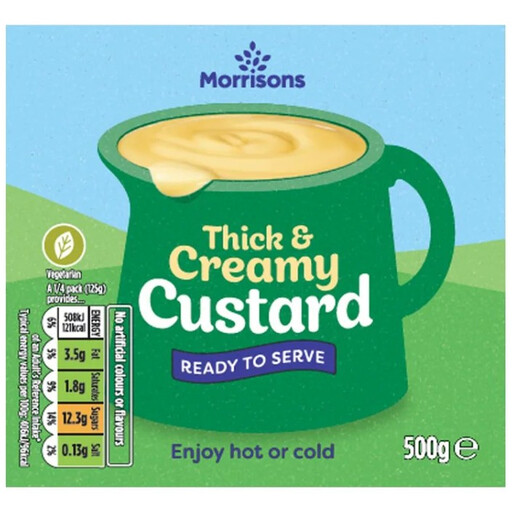
This prepared custard suits someone considering a cupboard-stored pack without requiring a can. The 500g tub can be served chilled or gently heated. It contains milk; refrigerate after opening and use within three days.
Yes, if the tin is labelled ready to serve. Ambrosia describes its standard Devon Custard and Deluxe cans as suitable hot or cold; if heating either one, empty it into a suitable pan or microwave-safe container rather than heating the can.
Follow that product's label rather than a rule for all tins. Ambrosia says to transfer leftovers from its standard 400g can, refrigerate and consume within three days; M&S says to refrigerate its Silky Smooth Custard and eat within two days.
No. The cited Ambrosia Low Fat Custard Can contains milk ingredients. Check the ingredient and allergen statement on the current pack if milk must be avoided.