Salt-conscious dessert hosts
If salt is the main consideration, compare the declared amount per 100g on each exact pack. A Light label describes a different product claim and does not establish that the custard has less salt.


For a New Year's Eve dessert table, compare the salt declared per 100g on the exact custard pack, then consider how much guests are likely to serve. M&S declares 0.10g per 100g for its Silky Smooth Custard 400g, while Ambrosia declares 0.11g for its standard Devon Custard 400g and 0.12g for its Light can. Ambrosia's Light claim concerns sugar and fat, not a reduction in salt; pack size, milk allergens and storage after opening also affect the choice.
If salt is the main consideration, compare the declared amount per 100g on each exact pack. A Light label describes a different product claim and does not establish that the custard has less salt.
Ready-to-serve custard can accompany crumble, pudding or fruit without making custard from scratch. Check whether the chosen product can be served at the temperature you want and how leftovers must be stored.
When serving several guests, match the pack size to the desserts and likely portions. Check salt and milk-allergen information on the chosen pack rather than assuming that different sizes share the same declaration.
Start with the salt declaration for the exact product, then choose a pack and serving method that fit the dessert table.
| Concern | What to check | Who this matters to |
|---|---|---|
| Declared salt | Compare salt per 100g on the exact pack, then check the amount for the portion you plan to serve. Do not read a Light claim as a salt claim. | I want to choose custard by its salt declaration rather than its front-of-pack wording. About 42% of consumers put that comparison first. |
| Serving and storage | Check hot-or-cold serving directions, heating instructions and the refrigerated storage period after opening. | If desserts need to be served quickly, I want custard I can prepare as directed and leftovers I can use in time. Serving convenience comes first for about 33% of consumers. |
| Pack quantity | Match the pack size to expected portions and any planned use for leftovers; check the nutrition and allergen label on that size. | With several desserts to serve, I need enough custard without opening more than we can use. About 25% of consumers prioritise the quantity they need. |
Ambrosia says its Light Devon Custard can has 30% less sugar and fat than its standard Devon Custard. Ambrosia declares 0.12g salt per 100g for the Light can, compared with 0.11g for the standard can.
If salt drives your choice, compare the salt line on the current packs separately from sugar and fat claims.
Portion sizes can differ, and guests may serve themselves more than once. The NHS says its adult daily salt guidance includes salt already in food as well as salt added during cooking or at the table.
Compare custards per 100g first, then consider the portions and the rest of the party menu.
Ambient storage before opening does not mean an opened can can stay in the cupboard. Ambrosia instructs shoppers to refrigerate remaining custard and use it within 3 days; M&S gives 2 days for its Silky Smooth Custard.
Choose a pack size around expected servings and follow the exact pack's instructions for transferring and refrigerating leftovers.
Custard left beyond its labelled storage period may go to waste.
The Ambrosia standard and Light cans and M&S Silky Smooth Custard contain milk ingredients. Serving custard as a topping does not remove that concern for a guest with a milk allergy.
Read the current allergen declaration before serving and arrange a separately checked alternative if a guest needs one.
Ambrosia offers standard and Light ready-to-serve Devon Custard in 400g cans that can be served hot or cold.
M&S Silky Smooth Custard comes in a 400g ambient can.
Sainsbury's lists own-label ready-to-eat ambient custard in 500g and 1kg formats.
Tesco lists a 400g Ready To Serve Custard in its tinned-custard range.
These selections include 400g custards for a dessert table and larger ready-to-serve alternatives. Check the exact pack's salt declaration and format when those details determine your choice.
 No image available
A 400g ready-to-serve can for serving custard hot or cold with party desserts. Ambrosia declares 0.11g salt per 100g for its standard Devon Custard can. It contains milk; after opening, transfer remaining custard from the can, refrigerate it and use it within 3 days.
 No image available
The strawberry-flavour variant offers a different flavour for the dessert table. It is a 400g pack; check this variant's current salt and milk-allergen declarations rather than using the figures for standard Devon Custard.
 No image available
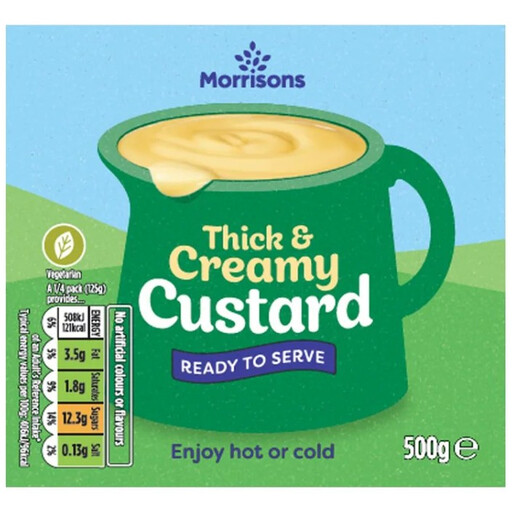
Consider this 500g ready-to-serve pack if you need more custard than a 400g can. Check the pack format if a tin matters, and read its current salt and milk-allergen declarations before serving.
 No image available
This 400g Low Fat variant is another pack size for a dessert table. Low Fat does not itself describe the salt content: check this exact pack's salt declaration rather than applying the standard can's figure. Check the milk-allergen label and storage directions too.
 No image available
The 1kg Light pack is an option when planning custard for a larger group. Confirm its format, current salt declaration and opened-pack storage directions on this exact product; the declared salt figure for Ambrosia's 400g Light can should not be assumed to apply to the 1kg pack. Check the milk-allergen label before serving.
No. Ambrosia says its 400g Light Devon Custard can has 30% less sugar and fat than its standard Devon Custard, but declares 0.12g salt per 100g for Light and 0.11g for the standard can. Read the salt line on the exact pack you intend to serve.
Compare declared salt per 100g on the exact packs, then consider the portions guests are likely to take. The NHS says its adult daily salt guidance covers salt already in food and salt added during cooking or at the table, so custard is only one part of the menu to consider.
No: follow Ambrosia's instructions to empty the custard into a saucepan for hob heating or a microwaveable container for microwave heating. Heat it gently, stir and do not boil it.
Follow the exact product label. Ambrosia instructs shoppers to remove remaining custard from its cans, refrigerate it and use it within 3 days; M&S says to refrigerate opened Silky Smooth Custard and eat it within 2 days.
The Ambrosia standard and Light cans and M&S Silky Smooth Custard contain milk ingredients, so they are not milk-free choices. Check every exact pack's current allergen declaration before serving, particularly when offering other variants.