Batch dessert planners
You are making several portions and want a pack you can finish within its labelled opened life.


For several planned portions, choose a larger ready-to-serve pack only if you can finish it within its labelled opened life; a 400g can may be easier to use for a smaller batch. Bird's powder offers control over consistency but needs milk, sugar and cooking. If fat content guides your choice, compare the exact products' per-100g nutrition panels.
You are making several portions and want a pack you can finish within its labelled opened life.
You need custard for a few portions and would rather avoid opening more than your meal plan can use.
You want either to compare the fat content of ready-made products or to adjust the consistency and sweetness of custard made from powder.
Work out how much custard your recipes need and when you will use it. Pack size, opened-life instructions and preparation method can then guide the choice.
| Concern | What to check | Who this matters to |
|---|---|---|
| Quantity for several portions | Match the pack weight to your planned recipes. Tesco Groceries lists its Ready To Serve Custard in a 1kg pack. | If I am preparing several desserts, I want enough custard without opening multiple packs. About 36% of consumers put batch quantity first. |
| Using an opened pack | Check the exact label's refrigeration and use-by instructions after opening; the products checked give different periods. | For a small batch, I need to finish what I open before its stated deadline. Avoiding leftover waste comes first for about 29% of consumers. |
| Fat content | Compare fat per 100g on the exact packs, along with the stated basis of any light claim. | I want ready-made custard but need to compare its fat content with another option. That is the primary concern for about 21% of consumers. |
| Recipe control | Check the powder instructions and whether you have the required milk, sugar and cooking time. Bird's says its milk quantity can be varied for consistency. | When a recipe calls for a particular thickness or sweetness, I would rather prepare the custard myself. About 14% of consumers put that control first. |
Opened-life instructions differ: Sainsbury's states one day for Stamford Street Co. 400g Custard, while Tesco states three days for its Ready To Serve Custard 1kg.
Plan the portions before opening a pack, then follow its own refrigeration and use-by directions.
ASDA Groceries lists 1.6g fat per 100g for Asda Light Custard and describes it as 50% less fat than its standard equivalent. That claim does not describe every light custard.
Compare the per-100g panels and the claim's stated comparison product on the exact packs you are considering.
Bird's Original Custard Powder requires milk, sugar and cooking. Bird's says prepared custard should be refrigerated and treated as fresh food.
Choose powder when its preparation suits your schedule, not when you need custard that can be served straight from the pack.
A ready-to-serve custard range that includes Devon Custard and Light variants.
A powder option for cooks who want to adjust a prepared custard's consistency.
Its ready-to-serve range includes a 1kg standard custard and a 1kg Light Custard.
Stamford Street Co. offers a 400g ready-to-serve custard for smaller-quantity planning.
Its 400g ready-to-serve range includes Creamy Custard and Light Custard.
Its Silky Smooth Custard is a 400g ambient option.
These custards offer 400g, 500g and 1kg pack choices for planned desserts, including products labelled Light or Low Fat. Choose a size that fits the portions you intend to serve and check the exact pack for storage and allergen information.
 Image unavailable
The 1kg pack is an option when several portions are planned. Check its opened-pack directions before deciding whether that quantity fits your schedule.
 Image unavailable
This 400g Low Fat variant offers a smaller pack for planned portions. Use its own nutrition panel to compare it with another custard.
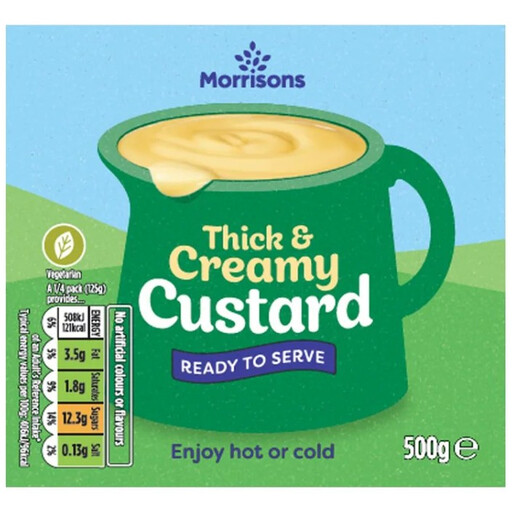 Image unavailable
The 500g ready-to-serve pack is another quantity to consider for planned desserts. Check how much your recipes need and follow the pack's directions for any leftovers.
 Image unavailable
This ready-to-serve 400g custard can suit a recipe needing a smaller quantity. Ambrosia describes Devon Custard as suitable for serving hot or cold; follow the exact pack's heating and storage directions.
Choose the size you can use within that product's opened life. Tesco says to consume its Ready To Serve Custard 1kg within three days of opening; Sainsbury's gives one day for Stamford Street Co. 400g Custard. Plan the portions before opening either pack.
Some ready-to-serve products give heating instructions, but follow the directions on the exact pack. Use the container and method it specifies rather than heating a tin itself.
Follow the product label's instructions for transferring, covering and refrigerating leftovers, and for when to use them. Food Standards Scotland advises checking labels because storage directions vary between foods.
Check the ingredients and allergen declaration on the exact pack before serving it. GOV.UK states that prepacked foods containing any of the 14 regulated allergens must clearly identify them; do not assume different custards, or powder and ready-made versions, have the same ingredients.