Easy-chew meal planners
If preparation needs to be simple, a ready-to-serve pack avoids making custard from powder. For a small household, choose an amount that can be used within the particular pack's instructions after opening.


Choose a ready-to-serve 400g tin when you want custard without mixing or cooking and can use the opened pack within its stated storage period. A larger ready-to-serve pack needs a plan for more portions; individual pots reduce the need to portion out one opened pack, while powder requires preparation. If someone has a prescribed swallowing or texture requirement, do not assume ordinary custard meets it: follow their clinician's plan and confirm the required texture at serving time.
If preparation needs to be simple, a ready-to-serve pack avoids making custard from powder. For a small household, choose an amount that can be used within the particular pack's instructions after opening.
Compare energy, fat and sugars per 100g rather than assuming plain, Light and own-brand custards have the same listed values. Check the current label for the amount you expect to serve.
Easy chewing and a prescribed swallowing texture are different considerations. The International Dysphagia Diet Standardisation Initiative (IDDSI) uses specific tests to assess food texture; a smooth appearance alone does not establish a product's IDDSI level.
Start with whether the custard must be ready to serve, then check the amount you can use after opening. A prescribed texture requirement takes precedence over convenience or pack size.
| Concern | What to check | Who this matters to |
|---|---|---|
| Preparation and storage | Check that it is ready to serve, how many portions the pack provides and its instructions after opening. | When cooking or mixing is difficult, I want a pack I can serve simply and finish in time. About 36% of consumers would put that convenience and manageable storage first. |
| Prescribed texture | Follow the individual's swallowing plan and confirm the required texture using the applicable IDDSI guidance. | If someone has a prescribed texture, I cannot judge suitability by how smooth the custard looks. Roughly 29% of consumers would make texture verification their primary concern. |
| Nutrition label | Compare energy, fat, saturates, sugars and salt per 100g, then consider the portion to be served. | When choosing between plain and Light custard, I want to compare like with like despite different suggested portions. About 21% of consumers would prioritise the nutrition label. |
| Pack size and portions | Compare the quantity, portion format and opened-pack instructions against how much will be used. | For one serving at a time, I may prefer separate portions; for several eaters, I can consider a larger pack. Around 14% of consumers would put portion planning first. |
A custard that looks smooth is not automatically suitable for someone following an IDDSI plan. Cambridge University Hospitals NHS Foundation Trust describes Level 4 purée as holding its shape rather than pouring, and IDDSI says a combination of tests may be needed to establish a food's level.
Follow the person's clinician-provided plan and confirm that the product meets the required level at serving time; do not assign ordinary custard a level from its name or appearance.
A larger ready-to-serve pack leaves more custard to manage if only one person eats it. Separate portions avoid opening the whole quantity at once.
Match the pack size to planned servings and read its particular refrigeration and use-after-opening instructions.
Suggested portions can differ between products: the checked Ambrosia Devon 400g listing uses a 130g portion, while Sainsbury's Stamford Street Co. listing uses half a can.
Compare the label values per 100g first, then consider the amount you intend to serve.
ASDA Groceries' Ambrosia Devon 400g listing instructs buyers to remove leftovers from the can, refrigerate them and consume them within three days. Marks & Spencer's Silky Smooth Custard listing says to refrigerate and eat within two days after opening.
Follow the instructions on the pack you buy, including whether leftovers need transferring to another container.
Its ready-to-serve range includes the checked standard and Light 400g custard cans, alongside other pack formats.
The checked Stamford Street Co. 400g custard is a ready-to-eat own-brand option; Sainsbury's also lists larger ready-to-eat custard formats.
Its checked Silky Smooth Custard 400g can uses whole milk and cream ingredients.
The checked custard powder is an alternative for making custard, not a ready-to-serve tin.
These custard selections cover 400g options and larger 500g and 1kg packs for planning easy-chew meals. Check the particular product's ingredients, preparation and storage instructions before choosing it.
 Image unavailable
A 400g option to consider when you can plan servings from one opened pack. If comparing nutrition, use this product's current per-100g label rather than values from another Ambrosia variant; check its milk-allergen information and storage directions too.
 Image unavailable
Consider this 400g option if strawberry flavour suits the meal rather than plain custard. Check the current ingredients and opened-pack instructions, particularly when serving someone with an allergy or a prescribed texture requirement.
 Image unavailable
The 1kg quantity is worth considering when several servings are planned. Confirm its physical pack format if a tin matters, and make sure the quantity fits the product's storage instructions after opening; do not apply nutrition values from the 400g Light can to this variant.
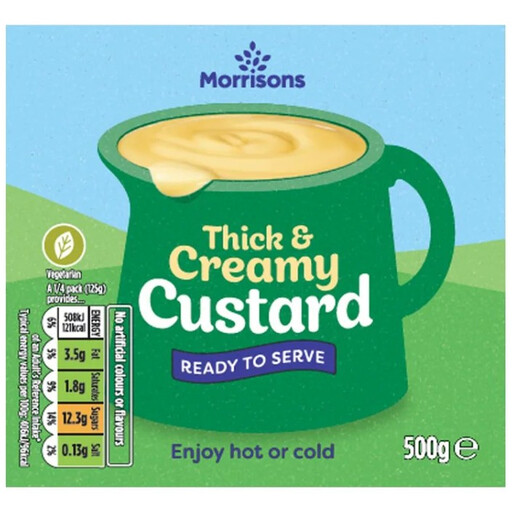 Image unavailable
This ready-to-serve 500g option sits between a 400g pack and a 1kg pack by quantity. If you specifically need a tin, confirm the packaging before ordering; also check the current allergen label and instructions for leftovers.
Do not assume that it does. The International Dysphagia Diet Standardisation Initiative says a combination of tests may be needed to determine a food's level; Cambridge University Hospitals NHS Foundation Trust describes Level 4 purée as holding its shape rather than pouring. Follow the individual's clinician-provided plan and confirm the custard's texture at serving time.
Do not microwave the checked Ambrosia Devon 400g can: its instructions say to empty the custard into a microwaveable container first. Follow the heating directions on the particular pack you use.
For the checked Ambrosia Devon 400g can, ASDA Groceries says to remove the remaining contents from the can, refrigerate them and consume them within three days. Instructions differ: Marks & Spencer gives two days after opening for its Silky Smooth Custard, so follow your own pack's label.
The checked Ambrosia Devon, Ambrosia Light, Stamford Street Co. and M&S Silky Smooth Custard products list milk-containing ingredients or allergen information. Check the current label of the exact product before serving it to someone with a milk allergy, as recipes can change.