Parents keeping a quick dessert option
Ready-to-serve custard can be served cold or heated without mixing a batch from powder. That distinction matters when preparation time and washing-up are limited.


For a quick storecupboard dessert, a ready-to-serve 400g tin is a practical starting point when you expect to use a few portions; choose a larger pack when several portions are planned within its opened-life. Compare the exact labels if sugar, fat or milk ingredients affect your choice. Custard powder offers more control over preparation but needs milk, sugar, mixing and heating.
Ready-to-serve custard can be served cold or heated without mixing a batch from powder. That distinction matters when preparation time and washing-up are limited.
Pack size matters if only a little custard is needed at a time. Ambrosia’s standard 400g can and Sainsbury’s 1kg ready-to-eat custard both specify refrigeration and consumption within three days of opening.
Someone choosing between standard and lighter ready-to-serve custard may want to compare the stated sugar and fat figures alongside ingredients. Ambrosia’s Light Devon Custard still lists milk-derived ingredients.
Decide whether custard needs to be ready at serving time, then match the pack to likely portions and check the exact product label.
| Concern | What to check | Who this matters to |
|---|---|---|
| Serving with little preparation | Look for ready-to-serve custard if you want to serve it cold or heat it without making a batch from powder. | When a dessert needs to be assembled quickly, I want custard that does not require mixing ingredients. About 40% of consumers put immediate serving first. |
| Pack size and leftovers | Compare the amount you expect to use with the pack’s portions and refrigerated opened-life. Ambrosia labels its standard 400g can as three portions; Sainsbury’s labels its 1kg pack as eight 125g servings. | If only a few portions are likely, I do not want a larger opened pack left in the fridge beyond its stated limit. Avoiding leftovers is the primary concern for about 30% of consumers. |
| Sugar, fat and milk ingredients | Compare nutrition figures on the same per-100g basis and read the allergen statement. Ambrosia compares its Light 400g can with its standard Devon Custard, not with every custard. | When choosing between similar tins, I want to know what the sugar and fat labels say without mistaking “Light” for milk-free. For about 20% of consumers, label comparison comes first. |
| Control over preparation | Choose powder only if you are willing to supply ingredients, mix and heat it. Bird’s says prepared custard should be refrigerated and treated as fresh food. | I would rather decide how to make the custard myself, even if it takes extra steps. About 10% of consumers prioritise that preparation control. |
Sainsbury’s labels its 1kg ready-to-eat custard as eight servings and says to refrigerate it and consume it within three days of opening. Ambrosia’s standard 400g can is labelled as three portions, with the same three-day opened-life.
Think about how many portions you will use over the next few days before choosing a pack size.
Custard left beyond the pack’s opened-life may have to be discarded.
Ambrosia Light Devon Custard lists milk-derived ingredients. Bird’s Original Custard Powder is labelled “may contain milk”, so switching to powder does not settle a milk-allergen question.
If milk avoidance is necessary, check the full ingredient and allergen statement on the exact pack.
Bird’s Original Custard Powder requires milk, sugar, mixing and heating. A ready-to-serve product removes those preparation steps when it is served cold.
Keep powder for occasions when you want to prepare the custard; choose ready-to-serve custard when preparation time is the deciding factor.
Powder also requires the additional ingredients and utensils specified in its preparation directions.
GOV.UK distinguishes best-before dates, which concern quality, from use-by dates, which concern safety. The date does not replace the pack’s storage and after-opening instructions.
Read the date type and the instructions on the custard you buy, including how long it may be kept after opening.
Ambrosia offers standard and Light Devon Custard in ready-to-serve 400g cans that the manufacturer describes as suitable for hot or cold serving.
Tesco lists own-brand ready-to-serve custard in several pack sizes, including reduced-fat options.
Sainsbury’s 1kg ready-to-eat custard is a larger hot-or-cold serving option.
M&S lists a 400g Silky Smooth Custard in its food-cupboard range.
Bird’s Original Custard Powder is a make-at-home alternative, not ready-to-serve tinned custard.
These ready-to-serve custards include 400g tins and larger packs for different portion plans. Check the exact label for ingredients, serving guidance and storage instructions before choosing.
 Image unavailable
Consider this ready-to-serve tin when you want custard without mixing a batch. Ambrosia labels the standard 400g can as three portions and suitable for hot or cold serving.
It contains milk. Ambrosia instructs buyers to remove leftovers from the can, refrigerate them and consume them within three days.
 Image unavailable
Consider this 1kg ready-to-serve pack when several portions are planned, rather than when you need a small tin for one dessert. Check its current label for serving guidance and for the comparison behind its Light description.
It contains milk. Refrigerate after opening and consume within three days.
 Image unavailable
This 400g ready-to-eat tin is an option when strawberry flavour is wanted with hot or cold serving. Check the pack’s portion guidance against the amount you expect to use.
It contains milk. Refrigerate after opening and consume within three days.
 Image unavailable
Consider this 400g ready-to-serve tin if you want to compare its fat and sugar label with another custard. Check the current per-100g figures and portion guidance rather than treating the Low Fat name as a complete nutrition comparison.
It contains milk. Refrigerate after opening and consume within three days.
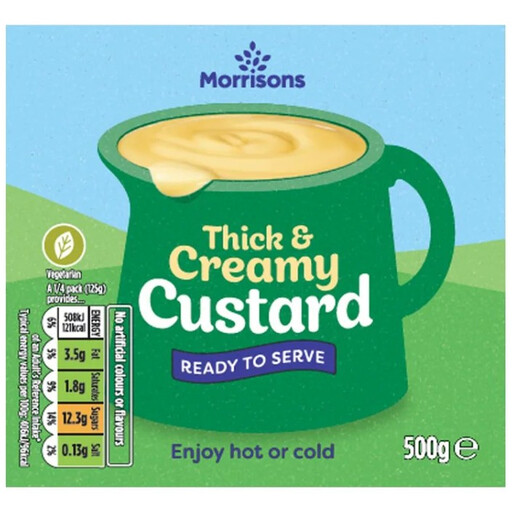 Image unavailable
This 500g ready-to-serve custard is an option when you want chilled or heated serving. Check the pack’s portion guidance to see whether the quantity fits your plans.
It contains milk. Refrigerate after opening and consume within three days.
Follow the exact pack’s instructions. Ambrosia’s checked 400g cans and M&S Silky Smooth Custard specify a cool, dry place before opening; their instructions require refrigeration after opening.
The limit varies by product. Ambrosia’s checked standard and Light 400g cans and Sainsbury’s 1kg ready-to-eat custard specify three days refrigerated after opening; M&S Silky Smooth Custard specifies two days. Follow the exact pack, including any instruction to remove leftovers from a can.
No. GOV.UK says a best-before date concerns quality, while a use-by date concerns safety. Check which date appears on your custard and follow its storage instructions as well.
Not in the case of Ambrosia Light Devon Custard 400g: its ingredient list includes skimmed milk, buttermilk and whey. Bird’s Original Custard Powder is also labelled “may contain milk”. If you need to avoid milk, read the current allergen statement on the exact product.
Check the product’s heating directions before reheating it. Sainsbury’s instructions for its 1kg ready-to-eat custard say not to reheat it once cooled.