Small-group Mexican-night hosts
If dessert follows a meal with little preparation time to spare, a ready-to-serve tin avoids making custard from powder. Ambrosia describes its standard 400g can as three portions, served hot or cold.


For a small Mexican-night dessert, a standard ready-to-serve 400g tin is a straightforward choice when roughly three portions are enough. Consider a light tin if its stated recipe difference matters to you, or a deluxe custard if you prefer its cream-containing recipe; for more guests, compare the quantity you will use with a larger ready-to-serve pack rather than assuming several tins are necessary. Check the exact product’s milk declaration and instructions for any leftovers.
If dessert follows a meal with little preparation time to spare, a ready-to-serve tin avoids making custard from powder. Ambrosia describes its standard 400g can as three portions, served hot or cold.
When one tin will not cover the portions you plan to serve, compare pack weights and stated servings before choosing between several tins and a larger ready-to-serve pack. A larger pack also means considering how much opened custard you can use.
Standard, light and deluxe custards have different recipes. Ambrosia describes its light can as reduced in sugar and fat relative to its standard Devon Custard; check the exact pack’s ingredients and milk declaration if either affects your choice.
Work out how many portions dessert needs, then choose the preparation format and recipe. These checks also help you decide whether a tin or a larger pack fits the meal.
| Concern | What to check | Who this matters to |
|---|---|---|
| Enough custard without excess | Compare pack weight and stated servings with the portions you plan to serve; check instructions for storing any remainder. | If I am serving several people, I need enough for everyone without opening more custard than we can use afterwards. About 45% of consumers put usable quantity first. |
| Preparation and serving | Check whether the product is ready to serve or a powder, and whether its directions allow cold serving or require heating in another container. | When dessert needs to follow the main meal quickly, I want to know whether I can serve the custard straight away. For about 33% of consumers, minimal preparation is the primary need. |
| Recipe and milk suitability | Read the exact pack’s ingredients and allergen declaration; compare nutrition information on the same per-100g basis if recipe differences matter. | If I am choosing between light and cream-containing recipes, or checking for a milk allergy, the label matters more than the word custard. Recipe or allergen fit comes first for about 22% of consumers. |
Ambrosia states three portions for its standard 400g can. One tin may suit a small dessert course but may not cover a larger group.
Decide how much custard you intend to serve, then compare stated servings and pack weights. Account for how you will store and use any opened remainder.
Bird's Original is a custard powder, whereas the Ambrosia Devon Custard can is ready to serve. They call for different amounts of dessert preparation.
Choose a product labelled ready to serve when you want to pour or warm it without making up a batch; choose powder when preparing the custard fits your plans.
Powder requires preparation time and may require milk, depending on its directions.
Ambrosia’s microwave directions for its standard can require the custard to be transferred to a microwaveable container. Its instructions also specify refrigeration after opening and use within three days.
Empty the can into a suitable dish before microwave heating, or use a saucepan as directed. Follow the storage instructions on the pack you bought.
Ambrosia’s light claim is a reduction relative to its standard custard, not a statement that the product meets every dietary requirement. Its verified standard and deluxe custards contain milk.
For an allergy or a particular nutrition requirement, check the current pack’s ingredients, allergen declaration and nutrition panel for the exact variant.
Its ready-to-serve range includes standard, light and deluxe 400g custard cans, giving shoppers distinct recipes within the tin format.
Its own-label 500g ready-to-eat custard offers a larger-pack alternative when a 400g tin does not fit the planned portions.
Tesco lists ready-to-serve custard in 400g and 1kg sizes, which allows a comparison of quantities for different group sizes.
Its 400g Silky Smooth Custard is a whole-milk recipe to consider alongside ready-to-serve tins.
These ready-to-serve custards cover 400g recipe and flavour choices alongside 500g and 1kg options for planning a Mexican-night dessert. Use the pack size and label to decide what fits your portions and serving plans.
 Image unavailable
A ready-to-serve choice for a small dessert group: Ambrosia states that its 400g can provides three portions and can be served hot or cold. It contains milk; transfer the custard out of the can for heating and follow the pack’s instructions for leftovers.
 Image unavailable
This 400g custard offers a low-fat-labelled variant for shoppers comparing ready-to-serve recipes. Check its own nutrition and milk-allergen information on the pack; do not apply a reduction claim from a differently named light variant to this product.
 Image unavailable
The 1kg size is worth considering when a larger group needs more ready-to-serve custard than one small tin supplies. Check the portions you intend to serve, the pack’s milk declaration and its storage directions; do not assume this size is packaged in a tin.
 Image unavailable
Choose this 400g strawberry-flavour variant if that flavour suits the dessert you plan to serve. Check the pack for portions, milk ingredients and instructions for storing any opened custard rather than assuming they match the standard recipe.
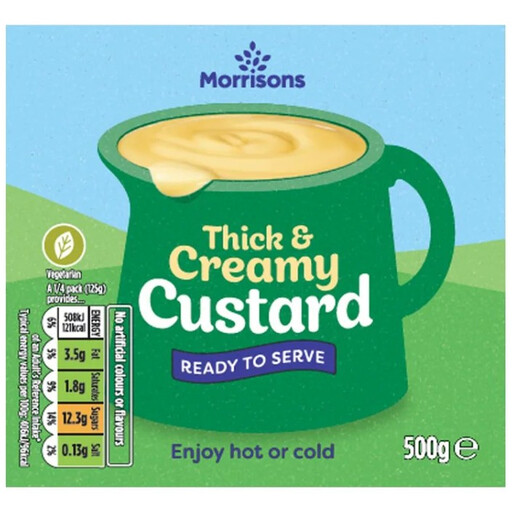 Image unavailable
This 500g ready-to-serve custard is an alternative when a larger quantity than a 400g tin better fits dessert plans. Compare the portions you need with the pack size, and check its milk declaration and storage instructions on the product you receive.
No. Ambrosia’s directions for its standard Devon Custard can say to transfer the contents to a microwaveable container before microwave heating. For hob heating, empty the can into a saucepan and follow the pack’s stirring and heating directions.
Ambrosia’s standard 400g can and Sainsbury's 500g ready-to-eat custard both specify refrigeration after opening and use within three days. Follow the instructions and date marking on the particular pack you have if they differ.
Do not assume so: the standard Ambrosia Devon Custard can contains milk ingredients, including skimmed milk, buttermilk and whey. Check the ingredients and emphasised allergens on the exact pack before serving it to someone with a milk allergy.
No. Bird's Original is a powder that must be prepared, while a ready-to-serve tin does not require making up the custard. Choose the powder only if its preparation directions fit the time and ingredients available for your dessert.
GOV.UK distinguishes a use-by date, which relates to food safety, from a best-before date, which relates to quality. Check which marking the specific custard carries and follow its storage directions, including any instructions that apply after opening.