Occasional tea-time shoppers
If custard is a cupboard backup for cake, fruit or crumble, a 400g ready-to-serve tin avoids mixing custard from powder. Check how much you will use and how soon the remainder must be refrigerated and eaten.


A 400g ready-to-serve tin is a practical cupboard backup for an occasional tea-time dessert; consider a larger ambient pack if you expect to use several servings within its opened-pack storage period. Compare nutrition per 100g and the portions you plan to serve, then check the current pack for allergens, heating instructions and how long it keeps after opening. Do not assume that every custard contains egg.
If custard is a cupboard backup for cake, fruit or crumble, a 400g ready-to-serve tin avoids mixing custard from powder. Check how much you will use and how soon the remainder must be refrigerated and eaten.
Read the current ingredient and allergen information before serving. The researched ambient tins from Ambrosia, Tesco, Asda and M&S list milk ingredients without listing egg in their displayed ingredients; separate chilled custards from Sainsbury's and M&S list egg yolks.
Compare sugars, fat and saturated fat per 100g, then look at the portion you intend to serve. Ambrosia's claim that its Light 400g can has 30% less sugar and fat is a comparison with Ambrosia Devon Custard, not with every custard.
| Concern | What to check | Who this matters to |
|---|---|---|
| Pack fit | Check whether it is ready to serve, its stated servings and its storage instructions after opening. | For an occasional tea time, I want a cupboard pack without a large amount left over. About 33% of consumers put ready-to-serve convenience and pack fit first. |
| Allergens | Read the selected pack's current ingredient list and allergen declaration; do not infer egg content from the word custard. | When an ingredient must be avoided, I need to know what is in this particular pack before serving it. Allergen certainty is the primary concern for about 25% of consumers. |
| Sugars and fat | Compare values per 100g and check the serving size and the named product behind any comparison claim. | If I am choosing between ready-to-serve options, I want to compare their labels on the same basis. About 25% of consumers chiefly look for a lower-sugar or lower-fat option. |
| Usable servings | Match the pack's servings to your plans and its refrigerated use period after opening. | With several desserts planned, I want enough custard without leaving an opened pack unused past its label instructions. Avoiding unused custard comes first for about 17% of consumers. |
The displayed ingredients for the researched ambient tins list milk, while separate chilled luxury custards from Sainsbury's and M&S list egg yolks. The product and recipe matter more than the category name.
Check the exact pack's current ingredients and allergen declaration before serving, particularly when someone needs to avoid milk or egg.
A larger ambient pack can leave several servings to refrigerate. The researched Sainsbury's 500g and 1kg cartons instruct use within three days of opening; the M&S 400g tin states two days.
Choose a pack size that fits the servings you have planned and follow its own opened-pack instructions.
Custard left beyond the stated refrigerated use period may have to be discarded.
Serving bases differ: Ambrosia describes 130g portions for its standard 400g can, while Sainsbury's cartons use 125g servings. A pack-to-pack comparison does not hold portion size constant.
Start with the per-100g figures, then check the amount you intend to serve.
Ingredients, nutrition information and allergen declarations can change with a recipe or packaging update.
Use listings to narrow your choice, but read the current physical pack before purchase and serving.
Its researched Devon Custard and Light 400g cans are ambient, ready-to-serve options for hot or cold serving.
The researched ready-to-serve product is a 1kg foodservice carton, rather than a 400g tin.
Tesco's researched own-label custard is an ambient, ready-to-serve 400g can.
Its researched ambient, ready-to-eat custards are 500g and 1kg cartons.
The researched Just Essentials and Creamy Custard options are distinct 400g ambient tins.
M&S Silky Smooth Custard is the researched 400g food-cupboard tin; its chilled luxury custard is a separate product.
These options cover 400g Ambrosia cans for an occasional cupboard dessert, a larger Ambrosia pack for planned servings, and a 500g Morrisons ready-to-serve alternative. Choose by pack format as well as the label details that matter to your household.
 No image available
A ready-to-serve 400g can for an occasional tea-time dessert, served hot or cold. Ambrosia lists three 130g portions and 10.6g sugars per 100g for this product. It contains milk; refrigerate after opening and use within three days, following the current pack instructions.
 No image available
A 400g ready-to-serve can to consider when comparing sugars and fat within the same cupboard format. Ambrosia lists 7.4g sugars per 100g for its Light 400g custard and makes its lower-sugar and lower-fat comparison specifically against Ambrosia Devon Custard. Check the current pack for milk ingredients and refrigerate opened contents for use within three days.
 No image available
The 1kg format is worth considering when several servings are planned rather than a single tea time. The product information describes hot or cold serving and instructs refrigeration and use within three days after opening. Check the current pack's ingredients and nutrition for this 1kg variant.
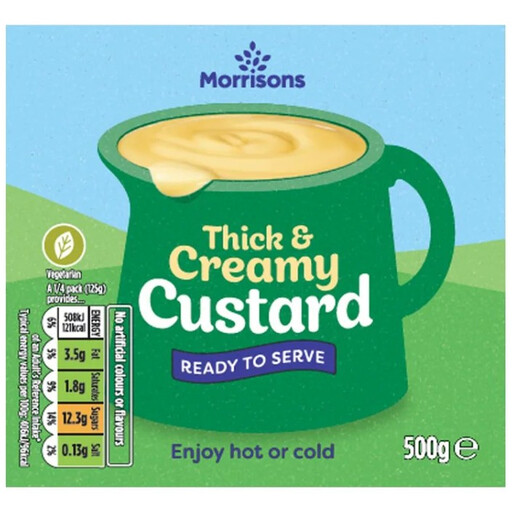 No image available
This 500g ready-to-serve option may suit more than one planned serving, but its described tub format is not a tin. The product information describes chilled or gently heated serving and instructs refrigeration and use within three days after opening. Check the current pack for milk and other declared allergens before serving.
No. The displayed ingredient lists for the researched ambient tins from Ambrosia, Tesco, Asda and M&S include milk but do not list egg. Separate chilled custards from Sainsbury's and M&S explicitly list egg yolks. Check the current label of the exact product you plan to serve.
Check the ingredient list and emphasised allergens on the particular prepacked product. GOV.UK guidance for England, Wales and Northern Ireland and Food Standards Scotland guidance for Scotland describe allergen information requirements; neither a product name nor a previous pack replaces the current label.
Do not put the tin in the microwave. The researched Tesco and Sainsbury's heating instructions call for custard to be transferred to a suitable non-metallic container before microwaving. Follow the chosen pack's heating and stirring directions.
Follow the period on the exact pack and refrigerate it as instructed. The researched ambient products from Ambrosia, Tesco, Asda and Sainsbury's state use within three days after opening, while the researched M&S 400g tin states two days.