Hosts serving a small dessert course
If you are putting custard alongside cake, fruit or crumble, the stated number of servings helps you decide whether to open one tin or more. Sainsbury's labels its Stamford Street Co. 400g tin as two servings.


A 400g tin is a starting point if you need two dessert servings: Sainsbury's labels its Stamford Street Co. tin as serving two. For more guests, compare the serving statement on a larger pack; Tesco describes its Ambrosia Devon Custard 1kg carton as eight 125g servings. Whichever format you choose, check the exact pack for allergens and instructions for opened custard.
If you are putting custard alongside cake, fruit or crumble, the stated number of servings helps you decide whether to open one tin or more. Sainsbury's labels its Stamford Street Co. 400g tin as two servings.
A larger ready-to-eat pack may be easier to serve than several tins when you need more portions. Tesco describes its Ambrosia Devon Custard 1kg carton as eight 125g servings; check the serving statement on the pack you choose.
When guests have dietary requirements, read the current pack before serving. Sainsbury's product information for Stamford Street Co. custard lists cows' milk and whey and instructs you to refrigerate opened contents in a non-metallic container and use them within one day.
For coffee with friends, work out the portions you intend to serve before choosing a pack size, then consider what you will do with any custard left after opening.
| Concern | What to check | Who this matters to |
|---|---|---|
| Enough servings | Read the exact pack's serving statement and decide whether custard is an accompaniment or the main dessert. Sainsbury's labels its Stamford Street Co. 400g tin as two servings; Tesco describes its Ambrosia Devon Custard 1kg carton as eight 125g servings. | If I am serving custard with cake for a few friends, I need to know whether one pack will provide the portions I intend. About 42% of consumers put serving quantity first. |
| Manageable leftovers | Choose an amount you expect to use and read the opened-pack storage instructions. Do not assume a tin and a carton have the same storage period. | When guest numbers might change, I would rather open only what we can use than leave a large pack unfinished. For about 33% of consumers, avoiding unwanted leftovers is the main concern. |
| Ingredients and serving | Check ingredients and declared allergens on the current pack. If serving custard warm, follow that product's heating and reheating instructions. | If a guest needs to avoid milk, I need to check the ingredients before serving; warming custard also makes the heating directions relevant. Around 25% of consumers place ingredient and serving checks first. |
A tin's weight alone does not tell you how many intended portions it provides. Sainsbury's labels its Stamford Street Co. 400g custard as two servings.
Count the guests who want custard and check the serving statement on the tin you plan to buy.
A larger pack can cover more servings, but attendance and portion sizes may leave custard unused after opening.
Check the exact pack's storage instructions before choosing its size, particularly if you expect to serve only part of it.
Sainsbury's describes its Stamford Street Co. custard as suitable for vegetarians, but its product information also lists cows' milk and whey.
For a guest with an allergy or intolerance, read the ingredients and allergen information on the current pack before serving.
Sainsbury's instructions for Stamford Street Co. 400g custard say not to reheat it once cooled. They also say to transfer opened contents to a non-metallic container, refrigerate and use within one day.
Follow the directions on the product you bought, and heat only the amount you intend to serve when numbers are uncertain.
Ready-to-eat Devon Custard appears in 400g cans and a 1kg carton. Tesco describes the 1kg carton as eight 125g servings.
Sainsbury's lists its ready-to-eat own-label custard in 500g and 1kg formats.
Sainsbury's labels its 400g ready-to-eat custard tin as two servings.
These packs include a 1kg custard option, two 400g cans and a 500g tub. Compare the size and container with your serving plan, then check the exact pack for portions, ingredients and storage directions.
 No image available
Consider this larger pack if you expect to serve several guests. Check the serving count and opened-pack storage directions for this Light variant rather than applying another Ambrosia product's instructions to it.
 No image available
This smaller can is an option for a modest dessert course. Read its own serving statement before deciding whether one can is enough for your guests.
 No image available
Choose this smaller can if strawberry flavour suits the dessert you are serving. Check its declared servings rather than assuming they match those of another 400g custard.
 No image available
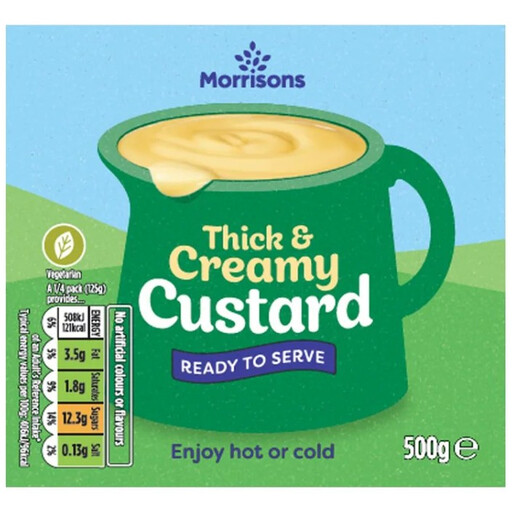
This 500g tub offers a size between the listed 400g cans and 1kg pack. It is not a tin, so check the container format if tinned custard is important to your plans.
Check the statement on the exact tin. Sainsbury's labels its Stamford Street Co. 400g custard as two servings; another product's declared portions need not be the same.
A 1kg pack is worth considering when its declared servings match your group and you expect to use any opened remainder as directed. Tesco describes its Ambrosia Devon Custard 1kg carton as eight 125g servings; check the instructions on the particular pack you buy.
Follow the heating directions on the exact product. Sainsbury's provides hob and microwave directions for Stamford Street Co. 400g custard and says not to reheat it once cooled; do not put a metal tin in a microwave.
Read the ingredients and allergen information on the current physical pack before serving. Sainsbury's product information for Stamford Street Co. custard lists cows' milk and whey, so its vegetarian description does not make it milk-free.