Allergen-aware bake-sale organisers
You need the chosen pack’s ingredient information at the stall and a serving arrangement that helps avoid mix-ups and cross-contact. Follow the school’s allergy arrangements when planning the stall.


Choose a custard pack around the cake portions you expect to serve: a 1kg carton suits a plan for about eight portions, while smaller packs let you open custard as needed when attendance is uncertain. Before serving, check the exact pack for allergens, keep its ingredient information available at the stall and plan for refrigerated storage after opening.
You need the chosen pack’s ingredient information at the stall and a serving arrangement that helps avoid mix-ups and cross-contact. Follow the school’s allergy arrangements when planning the stall.
You expect enough portions to use a larger carton and can arrange refrigerated storage for any custard left after opening.
You may prefer smaller packs that can be opened as cake sales justify them, rather than committing a large carton at the start.
Set the ingredient-information and serving plan first, then match pack size to the cake portions you expect. Compare recipes only among packs that work for that plan.
| Concern | What to check | Who this matters to |
|---|---|---|
| Allergens and cross-contact | Check the exact pack’s ingredients, highlighted allergens and precautionary statements. Keep that information available and agree how utensils and foods will be separated. | If children or visitors have food allergies, I need to explain what is being served without relying on a general claim about custard. About 46% of consumers would put clear allergen information and service arrangements first. |
| Portions and leftovers | Compare the stated servings with planned cake portions, and check the pack’s storage instructions for opened custard. | With an uncertain turnout, I would rather open another pack when needed than leave a large amount unused. For about 36% of consumers, matching quantity to demand would be the primary concern. |
| Recipe preference | Compare ingredients and nutrition per 100g on the specific packs if choosing between a lighter recipe and a cream-containing one. | Once serving and quantity are manageable, I may want a particular custard style to accompany the cakes. Roughly 18% of consumers would make that recipe choice their main priority. |
Ambrosia and Premier Foods identify milk in the ready-to-serve Ambrosia Light and Bird’s products considered here; their published ingredient information does not list egg. That does not establish the ingredients of every custard or every future pack.
Write stall information from the physical pack being served, including any precautionary allergen statement. Do not label it egg-containing, egg-free or allergen-free on the basis of its category.
Ambrosia labels its Light Devon Custard 1kg carton as approximately eight servings. Its instructions call for refrigeration after opening and consumption within three days.
Estimate cake portions before opening it. Keep additional packs unopened until needed, and arrange suitable refrigerated storage for leftovers.
Helpers and visitors need to be able to check what is in the food they are offered. GOV.UK’s community-event guidance and Anaphylaxis UK’s bake-sale guidance both make ingredient communication relevant to stall planning.
Keep the packaging at the stall or prepare an accurate ingredient record from it. Check the school’s allergy arrangements for serving utensils and separation of foods.
The Ambrosia Deluxe 400g recipe listed by Tesco contains cream. A richer recipe is a separate choice from deciding how many portions the stall needs.
Choose the recipe to suit the cakes being served, then compare pack size, ingredients and nutrition per 100g before settling on a format.
Ambrosia offers ready-to-serve Devon Custard in a 1kg Light carton and smaller 400g formats, including standard and Deluxe custard.
Bird’s has ready-to-serve custard formats, including a 750g carton described by Iceland Foods as six servings and a foodservice 1kg format described by Premier Foods Food Service.
Tesco lists a Stockwell & Co. ready-to-serve custard in a 385g can, a smaller format to consider for a modest stall.
These ready-to-serve packs cover a 1kg carton for a larger cake service and smaller 400–500g options for opening as needed. Choose the flavour and pack size that fit the stall’s serving plan, then check the physical pack’s allergen information.
 No image available
Consider this carton if the cake plan calls for approximately eight servings. Ambrosia states a 1kg pack with eight portions and describes this recipe as having 30% less sugar and fat than its standard Devon Custard.
It contains milk. Refrigerate after opening and consume within three days; check the exact pack’s complete allergen information before serving.
 No image available
This 400g can is an option when you want to open a smaller amount at a time. The product information describes it as ready to serve hot or cold.
It contains milk. Transfer unused contents from the can, refrigerate and consume within three days; use the pack for current allergen details.
 No image available
This standard Devon Custard can suits a smaller planned service; its product information states three 130g portions.
It contains milk. Move leftovers out of the can, refrigerate and consume within three days, and check the physical pack before preparing allergen information.
 No image available
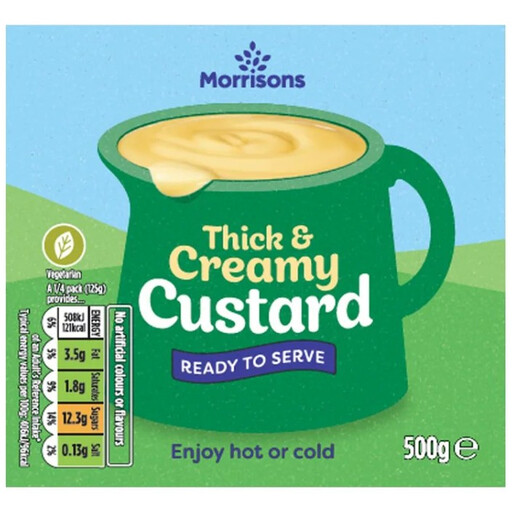
The 500g pack offers a size between the 400g cans and 1kg carton shown here. Its product information describes chilled or gently heated serving.
It contains milk. Refrigerate after opening and consume within three days; check the pack’s ingredients and serving instructions.
 No image available
Consider this 400g can if strawberry-flavoured custard fits the cakes on offer. Its product information describes hot or cold serving.
It contains milk. Refrigerate unused custard after opening and consume within three days; check the exact pack for its full allergen information.
Do not assume that it does—or that it does not. The Ambrosia Light and Bird’s ready-to-serve products described by their manufacturers identify milk but do not list egg in their published ingredient information. Check the actual pack being served, including any precautionary allergen statement, before giving visitors an answer.
Keep the custard’s packaging accessible or make an accurate ingredient record from the pack being served. GOV.UK’s guidance for community and charity events addresses food safety at school fundraisers, while the school’s own allergy arrangements may specify how food and utensils should be handled.
The Ambrosia Light 1kg, Ambrosia Devon Custard 400g and Bird’s foodservice custards covered here instruct users to refrigerate after opening and consume within three days. For custard left in a can, check the pack’s transfer and storage directions rather than storing leftovers in the opened can.
The Ambrosia and Bird’s ready-to-serve products covered here describe hot or cold serving. If heating custard for the sale, follow the chosen pack’s instructions, use a suitable container rather than heating a can, and agree how hot portions will be handed to children.
Yes. For schools in England, Department for Education guidance says schools must publish an allergy safety policy covering arrangements to reduce contact with known allergens. Check the individual school’s policy before deciding how to label, position and serve custard at its bake sale.