Two-person dessert planners
If custard is going alongside one dessert for two, compare the pack weight with the portions you intend to serve before buying a larger pack for its sharing description.


For a date-night dessert for two, choose a 400g ready-to-serve custard if it will be a modest topping; compare a 500g pack if you want more generous portions, or a 1kg carton if you plan to keep leftovers. A lighter recipe calls for a check of the exact nutrition label, while a richer chilled custard is a different choice from a pantry tin. Check the pack’s allergen and storage instructions before serving.
If custard is going alongside one dessert for two, compare the pack weight with the portions you intend to serve before buying a larger pack for its sharing description.
Ready-to-serve custard avoids making custard from powder during dinner. Ambrosia describes its Devon Custard 400g as suitable for serving warm or cold; follow the directions for whichever product you choose.
If you are choosing between standard, lighter and richer recipes, compare the exact packs’ ingredients, nutrition information and allergens rather than relying on the style name alone.
Decide how much custard the dessert needs, then choose between a ready-to-serve pantry product and a chilled alternative. Check the recipe and label of the particular pack before serving it to someone else.
| Concern | What to check | Who this matters to |
|---|---|---|
| Portions and leftovers | Compare 400g, 500g and 1kg packs with the portions you plan to serve; read the after-opening instructions if you expect leftovers. | If custard is only a topping, I do not want a large open carton; if we want seconds, I need enough for both plates. About 36% of consumers put portion size and leftovers first. |
| Preparation and serving | Check that the product is ready to serve, and follow its directions if you plan to heat it or serve it cold. | When dessert already takes time to prepare, I would rather not make custard from powder during the meal. Avoiding that extra step is the primary need for about 29% of consumers. |
| Recipe and format | Check whether the pack is a pantry product or a chilled custard, then compare the ingredients of the exact recipes. | For the finish to a special dinner, I might choose a cream-and-egg-yolk recipe even though it needs chilled storage. A richer dessert finish comes first for about 21% of consumers. |
| Nutrition and allergens | Compare nutrition values on the exact packs, and read ingredients and allergen statements before serving a guest. | If a guest has an allergy, I need to check the actual product label; a lighter recipe name cannot answer that question. Recipe and label checks are the primary concern for about 14% of consumers. |
Pack weights and formats differ: Ambrosia’s 1kg Devon Custard is a carton, while its 400g product is a can. A larger pack may leave more custard than you intended after one dessert for two.
Choose the weight against your planned portions, then check whether the exact product is a tin, carton or chilled pack.
A fat or sugar comparison says nothing about whether an ingredient that matters to your guest is present.
For an allergy-sensitive guest, read the exact pack’s ingredients, allergen information and precautionary statements before serving.
Ingredients and storage directions can change, so an earlier description may not describe the pack in your hands.
Check its current label, date marking and after-opening instructions when you buy or receive it.
M&S lists its Madagascan Vanilla Luxury Custard as a chilled dessert. It is not a like-for-like format replacement for a tin you intend to keep in the cupboard.
Decide which storage format works for your dinner plans, and check the chosen product’s use-by and storage information.
Ambrosia has ready-to-serve Devon Custard in a 400g can and larger formats, including a 1kg carton.
Tesco lists its own-label ready-to-serve custard in 500g and 1kg packs.
M&S lists a 400g Silky Smooth Custard and a 500g Madagascan Vanilla Luxury Custard in its chilled-desserts range.
Bird's Original Custard Powder is a make-it-yourself alternative to ready-to-serve custard.
These ready-to-serve options cover compact 400g portions, a 500g choice and a 1kg carton for planned leftovers. Compare the amount you need and the exact recipe before choosing for dinner.
 Image unavailable
Consider this 400g can when custard will be a modest accompaniment for two. Ambrosia describes it as ready to serve warm or cold; check the pack’s ingredients and after-opening directions before serving.
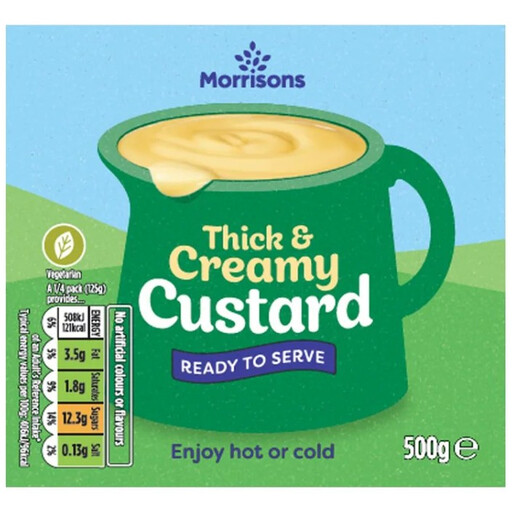 Image unavailable
This 500g ready-to-serve option is worth comparing when a 400g pack looks small for your planned portions. Check its pack format, serving directions and allergen label before buying.
 Image unavailable
Consider this 400g variant if you want to compare a lower-fat recipe for a modest dessert topping. Read its current nutrition, ingredient and allergen information; the variant name does not establish suitability for an allergy.
 Image unavailable
This 400g strawberry-flavour variant offers a different flavour choice when you are planning a modest custard accompaniment. Check that the flavour suits your dessert, along with the current ingredients and allergen label.
 Image unavailable
Consider this 1kg carton if you deliberately want a larger pack and are comparing lighter recipes. Tesco describes Ambrosia Light Devon Custard 1kg as containing 30% less fat and 30% less sugar than Ambrosia Devon Custard; that comparison is not an allergen claim. Check the current label and after-opening directions.
A 400g tin can suit two modest portions when custard is a topping rather than the main part of dessert. Decide how much you want on each plate; if you want generous servings or seconds, compare a 500g pack instead.
Ambrosia describes its Devon Custard 400g as suitable for serving cold or heated. Follow the serving instructions on the exact product you buy rather than applying one pack’s heating directions to another.
Tesco’s description of the Ambrosia Devon Custard 1kg carton says it can be refrigerated and enjoyed over three days. That guidance is specific to the product; follow the current label on your chosen carton.
Do not use a light recipe name as an allergy check. Tesco’s fat-and-sugar comparison for Ambrosia Light Devon Custard 1kg does not establish that it is free from milk or any other allergen. Read the exact pack’s ingredients and allergen statements before serving it to an allergy-sensitive guest.
Not for a plan that requires pantry storage. M&S lists its Madagascan Vanilla Luxury Custard as a chilled product made with cream and egg yolks. If that recipe appeals, check its storage instructions and use-by date rather than treating it as a shelf-stable tin.