Salt-first comfort-dinner shoppers
You want ready-to-serve custard and will compare salt per 100g before relying on low-fat wording or pack design.


For a comfort dinner, compare the declared salt per 100g on ready-to-serve custards rather than treating low-fat wording or a green traffic light as a reduced-salt claim. Marks & Spencer lists 0.10g per 100g for M&S Silky Smooth Custard, ASDA lists 0.11g for ASDA Creamy Custard, and Tesco Groceries lists 0.12g for Ambrosia Low Fat Custard. Check milk ingredients, fat, pack size and opened-pack directions alongside the salt figure.
You want ready-to-serve custard and will compare salt per 100g before relying on low-fat wording or pack design.
You want custard to serve hot or cold, but lower fat matters alongside salt. A low-fat variant is not necessarily the option with the lowest declared salt.
You need custard for a dessert such as crumble, cake or fruit, and want a pack size and opened-pack storage period that suit the meal.
For a ready-to-serve custard at a comfort dinner, compare salt per 100g first if that is your priority; then check the recipe and how much of the pack you expect to use.
| Concern | What to check | Who this matters to |
|---|---|---|
| Declared salt | Compare salt per 100g on ready-to-serve packs; use the serving figure for the portion you plan to eat. | If salt is my deciding factor, I need a like-for-like figure rather than a low-fat label or a colour alone. About 46% of consumers put declared salt first. |
| Fat and recipe | Read fat and saturates per 100g alongside salt, and check ingredients if milk or cream affects your choice. | When I want a less rich custard with pudding, the recipe may matter more to me than the lowest salt figure. About 27% of consumers make that their primary concern. |
| Serving and leftovers | Check pack weight and the instructions for heating, refrigeration and use after opening. | If I am serving only part of a pack, I need to know whether the remainder will fit another meal. About 27% of consumers put serving convenience and leftovers first. |
Tesco Groceries lists 0.12g salt per 100g for Ambrosia Low Fat Custard, while Marks & Spencer lists 0.10g for M&S Silky Smooth Custard. The two choices answer different priorities.
Compare salt, fat and saturates per 100g, then decide which label value matters for this dessert.
The checked Ambrosia serving is 130g, while the Tesco and Sainsbury's serving figures use 125g. Salt amounts for those servings are not a direct like-for-like comparison.
Compare products per 100g first, then read the figure for the portion you intend to serve.
Bird's Original Custard Powder requires preparation with milk and sugar according to Bird's instructions. It cannot be compared with a ready-to-serve tin using the dry powder's nutrition values alone.
Choose powder when you want to make the custard; choose a ready-to-serve product when preparation time is the deciding issue.
The checked ready-to-serve products contain milk. Marks & Spencer says to refrigerate M&S Silky Smooth Custard and eat it within 2 days of opening; several other checked products specify 3 days.
Check the physical pack for allergens and follow its storage and transfer instructions for any leftovers.
Its ready-to-serve range includes a 400g Low Fat Custard tin that can be served hot or cold.
Original Custard Powder is a make-it-yourself alternative, not a ready-to-serve tin.
Its checked Ready To Serve Custard is a 500g ambient pack for serving hot or cold.
Its checked Ready To Eat Custard is a 500g ready-to-serve pack.
Creamy Custard is a 400g ready-to-serve can.
Silky Smooth Custard is a 400g ready-to-serve option; the brand also has a separate chilled luxury custard.
These custards suit a ready-to-serve dessert. Compare the salt and storage details on the exact pack, especially if you need a tin rather than another ambient pack format.
 No image available
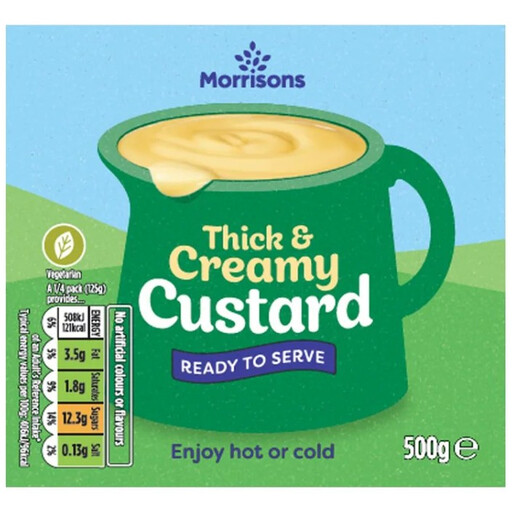
A ready-to-serve option if a 500g pack suits the dessert. Compare salt per 100g on the exact pack and check its milk-allergen and opened-pack instructions.
 No image available
Consider this 400g tin when fat matters alongside salt: Tesco Groceries lists 2.0g fat and 0.12g salt per 100g. It contains milk; follow the pack instructions for leftovers.
 No image available
The 1kg quantity may suit a shared dessert if you can use the pack as directed after opening. Check its salt per 100g, milk information and pack format before choosing it when a tin is essential.
No. Food Standards Agency guidance presents traffic lights as a way to compare labelled salt content; a green indication alone does not establish a reduced-salt claim. Check the pack wording and compare salt per 100g.
Do not assume so: the checked Ambrosia, Tesco, ASDA, Sainsbury's and M&S products contain milk. Check the allergen information on the physical pack before serving.
Follow the instructions on the specific pack. Marks & Spencer says to refrigerate Silky Smooth Custard and eat it within 2 days of opening; the checked Ambrosia, Tesco, ASDA and Sainsbury's products specify 3 days. Transfer leftovers from a can when its label instructs you to do so.
Transfer it out of the can before heating. The checked Tesco, ASDA and Sainsbury's instructions describe heating the contents in a suitable pan or dish; follow the method and precautions on your pack.