Salt-conscious movie-night hosts
If custard is one part of the evening's food, you may want to compare its salt per 100g and in the portion you plan to serve. A light description is not a substitute for reading the salt line.


For a ready-to-serve custard at movie night, compare salt per 100g on the current packs, then consider how much each person is likely to have. A light, low-fat or reduced-sugar description does not establish that a custard is lower in salt; if you choose powder instead of a tin, its preparation and finished recipe also need a separate check.
If custard is one part of the evening's food, you may want to compare its salt per 100g and in the portion you plan to serve. A light description is not a substitute for reading the salt line.
A ready-to-serve tin avoids making custard from powder, but the pack still needs to suit the group. Ambrosia describes its 400g Devon Custard tin as containing three 130g portions, so consider whether you will use the remainder.
If a low-fat or reduced-sugar variant appeals to you, assess that preference separately from salt. Check the nutrition information for the particular variant rather than assuming the descriptors mean the same thing.
For movie-night custard, compare ready-to-serve products on the same per-100g basis before deciding how much to serve and which format fits the group.
| Concern | What to check | Who this matters to |
|---|---|---|
| Salt content | Compare salt per 100g, then check the amount for your intended portion. Read a salt-specific claim separately from light or low-fat wording. | I want a quick dessert topping without losing track of its salt content alongside the evening's snacks. About 50% of consumers put salt comparison first. |
| Pack and portions | Check pack weight, stated servings and instructions for storing any remainder. | When a few people share dessert, I want enough custard without opening more than we can use. About 30% of consumers make portion planning their primary concern. |
| Flavour and serving | Check the particular recipe's ingredients, allergens and hot-or-cold serving instructions. | I want a flavour and serving method that fit the dessert, while still checking the pack's salt and allergen information. For about 20% of consumers, that choice comes first. |
Light, low-fat and reduced-sugar wording can refer to nutrients other than salt, so it does not answer a salt-focused buying question.
Compare the salt line per 100g on the specific products you are considering, then look at the amount in your intended serving.
A whole-pack total reflects the pack's size as well as its salt content. Ambrosia states that its 400g Devon Custard tin contains three 130g portions.
Use salt per 100g to compare ready-to-serve products, then consider the portion you expect to eat.
If one dessert does not use the whole tin, the remaining custard needs to be stored according to that product's instructions.
For Ambrosia Devon Custard 400g, Ambrosia says to transfer the remainder from the tin, refrigerate it and consume it within three days.
An unused remainder may go to waste if it cannot be used within the stated opened-pack period.
Custard powder requires preparation, and the ingredients added affect the finished dish. Dry-product information is not a like-for-like basis for judging a served portion against tinned custard.
Choose powder only if preparation suits your plans, and assess the finished recipe when salt is a priority.
Ambrosia offers ready-to-serve Devon Custard in a 400g tin, alongside other custard variants.
Tesco lists a 400g own-brand ready-to-serve custard as well as branded custard.
Sainsbury's custard listings include ready-to-serve products and Ambrosia variants.
Asda lists own-brand ready-to-serve custard and Ambrosia Devon Custard 400g.
M&S describes its Silky Smooth Custard as made with whole milk.
Bird's Original Custard Powder is a make-at-home option, not a ready-to-serve tin.
These selections include 400g Ambrosia custards for a ready-to-serve dessert, plus larger or differently packaged ready-to-serve options. If you specifically want a tin, check the pack format; for every option, compare salt on the current label.
 Image unavailable
A ready-to-serve tin to consider for a small shared dessert. Ambrosia lists three 130g portions and 0.11g salt per 100g, or 0.14g per stated portion; those figures do not establish a reduced-salt claim. The product contains milk. Ambrosia says to transfer any remainder from the tin, refrigerate it and consume it within three days.
 Image unavailable
Consider this 400g strawberry-flavour variant if flavour is important to the dessert. Compare the current pack's salt declaration with other custards and check its stated servings before dividing it among the group. The product contains milk.
 Image unavailable
The 1kg pack is worth considering when more people will share custard, but this option is identified as a carton rather than a tin. Light does not mean reduced salt: read its own salt declaration and serving information. It contains milk.
 Image unavailable
This 400g custard is an option if you want a low-fat variant in a ready-to-serve format. Low fat is not a salt comparison, so check the current pack's salt value and stated portions before choosing it for movie night. It contains milk.
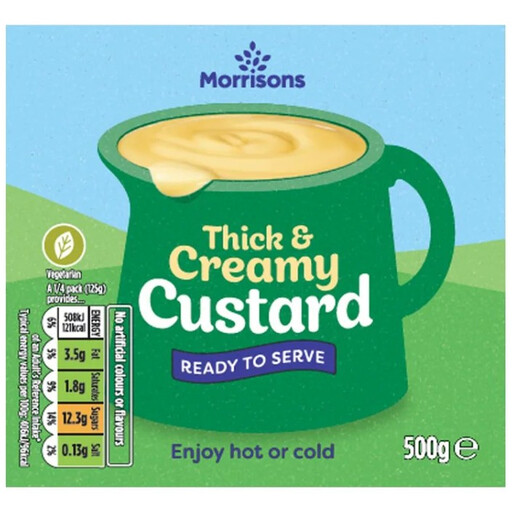 Image unavailable
The 500g ready-to-serve pack offers another size for a shared dessert, though it is identified as a tub rather than a tin. Check the current nutrition panel before relying on a salt amount for your portion: the listed per-portion and per-100g figures need to be reconciled. It contains milk.
Start with salt per 100g on each current pack so the comparison uses the same quantity of custard. Then check the salt in the portion you expect to serve. For context, the NHS advises adults to have no more than 6g of salt a day.
No. Those descriptions address fat or sugar, not necessarily salt. Read the salt declaration on each variant you are considering rather than using its light, low-fat or reduced-sugar wording as a salt comparison.
Check what product the claim compares it with, then read the current salt amount per 100g and consider your serving size. The Chartered Trading Standards Institute's Business Companion distinguishes comparative nutrition claims from the salt figure in a nutrition declaration.
Follow the instructions for that product. For Ambrosia Devon Custard 400g, Ambrosia says to remove the remainder from the can, refrigerate it and consume it within three days; other products may give different instructions.
Do not serve a product that declares milk to someone with a milk allergy. Ambrosia Devon Custard 400g lists milk ingredients; check the current ingredient and allergen information for every product you consider, as recipes can change.