Salt-conscious weekly shoppers
If custard is a regular cupboard purchase, compare salt per 100g and the portion you expect to serve rather than choosing by a “light” label alone.


For a weekly shop focused on salt, compare the figure per 100g rather than relying on “light” or “reduced fat” wording. ASDA Groceries lists 0.10g salt per 100g for its JUST ESSENTIALS 385g can and 0.11g for the Ambrosia Devon Custard Dessert Can 400g; check pack size, portions and milk declarations before choosing. Tesco Groceries lists 0.15g per 100g for Tesco Reduced Fat Custard 500g, but that listing does not establish it as a tin.
If custard is a regular cupboard purchase, compare salt per 100g and the portion you expect to serve rather than choosing by a “light” label alone.
If one pack needs to cover several desserts, check its weight and suggested number of portions alongside its nutrition panel.
If you are willing to make custard from powder, compare prepared-product nutrition using the stated milk and preparation method, not the powder pack alone.
Start with salt per 100g for a like-for-like label check, then consider how many portions you need and whether the pack must be a tin.
| Concern | What to check | Who this matters to |
|---|---|---|
| Salt level | Compare salt per 100g, then check the stated serving size. The NHS defines low salt as 0.3g or less per 100g. | If I choose custard regularly, I want to compare the salt in products and in the portion I will serve. About 42% of consumers would put salt comparison first. |
| Pack size and portions | Check pack weight and suggested servings against the desserts you plan to make. | When I am planning several family desserts, I need a pack that covers the portions I expect to serve; roughly 33% of consumers would make that their main concern. |
| Ready-to-serve format | Confirm whether the product is a ready-to-serve tin, another ambient pack or powder requiring preparation. | If I need custard ready to serve without making it from powder, pack format matters most to me. Around 17% of consumers would prioritise that convenience. |
| Ingredients and preparation | Read the exact pack’s allergen declaration; for powder, compare nutrition on the stated preparation basis. | When ingredients or the milk used to prepare custard affect my choice, I want to check the exact product and recipe. Approximately 8% of consumers would put that control first. |
Tesco Groceries lists 0.15g salt per 100g for Tesco Reduced Fat Custard 500g, compared with 0.10g for the ASDA JUST ESSENTIALS can and 0.11g for the Ambrosia can listed by ASDA Groceries.
Compare the salt line per 100g directly, then look at the amount you expect to serve.
ASDA Groceries lists a 385g JUST ESSENTIALS can and a 400g Ambrosia can, each with three suggested portions. The pack weights still differ.
Check the weight and suggested servings against the desserts planned for the week.
Tesco Groceries gives Bird’s Original Custard Powder nutrition as prepared with semi-skimmed milk. A different preparation may change the finished custard.
Use the stated preparation basis when comparing nutrition, and check the milk and quantities you intend to use.
Recipes and product information can change, which matters particularly when checking salt or milk declarations.
Read the current label on the exact pack before use, especially if you need to avoid an ingredient.
ASDA Groceries lists ready-to-serve ambient custard, including JUST ESSENTIALS Custard 385g and Creamy Custard 400g.
The Devon Custard Dessert Can 400g is a branded ready-to-serve tin listed by ASDA Groceries.
Tesco Reduced Fat Custard 500g is an ambient option when a tin is not essential.
Bird’s Original Custard Powder is for making custard rather than buying it ready to serve.
M&S Madagascan Vanilla Luxury Custard is a chilled custard option, rather than a like-for-like tinned choice.
These selections cover Ambrosia custards in different sizes and variants, plus Morrisons ready-to-serve custard. Check the exact pack format when a tin is essential.
 Image unavailable
A 400g option for shoppers comparing ready-to-serve custard. If salt is your priority, check the current pack’s figure per 100g and its milk allergen declaration.
 Image unavailable
Consider this 400g variant if strawberry flavour suits the desserts you have planned. Check its own salt figure and milk declaration rather than using figures for plain Devon Custard.
 Image unavailable
The 1kg pack may suit a plan involving several desserts. It is a carton rather than a tin; compare its current salt label separately, and check storage instructions if you will not use it all at once.
 Image unavailable
This 400g variant is worth checking if you are considering fat content as well as salt. Read its own nutrition panel: “Low Fat” in the name does not tell you how its salt compares with another custard.
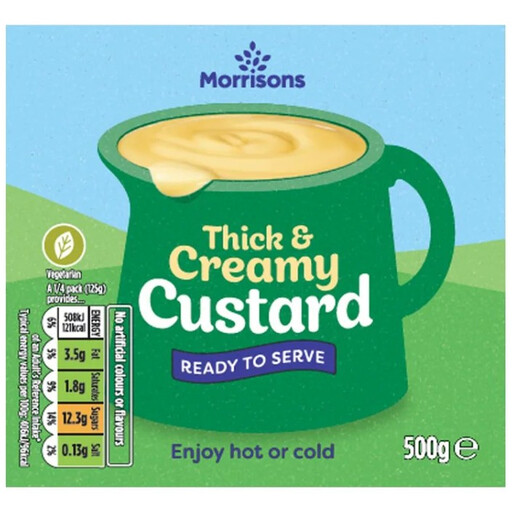 Image unavailable
A 500g ready-to-serve option if a tin is not essential: the listing identifies a tub. Compare the current salt figure per 100g and check the pack’s instructions for keeping any custard left after opening.
The NHS defines low salt as 0.3g or less per 100g. Use that figure to interpret the label, then check the portion you expect to serve.
ASDA Groceries lists 0.10g salt per 100g for JUST ESSENTIALS Custard 385g and 0.11g per 100g for Ambrosia Devon Custard Dessert Can 400g. Both are below the NHS low-salt threshold of 0.3g per 100g; check the current labels and serving sizes when choosing.
No. Tesco Groceries lists 0.15g salt per 100g for Tesco Reduced Fat Custard 500g, while ASDA Groceries lists 0.10g and 0.11g per 100g for the two cans above. Compare the salt line rather than inferring it from the fat description.
Compare the finished custards on a consistent preparation basis. Tesco Groceries gives figures for Bird’s Original Custard Powder as prepared with semi-skimmed milk, so check the milk and recipe you will actually use.
Read the allergen declaration on the exact current pack. The ASDA Groceries listings for the ready-to-serve cans identify milk, and Bird’s states that its Original Custard Powder may contain milk.