Salt-conscious TV-dinner shoppers
You want a ready-to-serve dessert but compare the salt figures rather than taking Light to mean less salt. The NHS advises checking food labels when considering salt intake.


Compare salt per 100g, then check the amount you intend to serve; a Light name does not establish a salt reduction. Ambrosia lists 0.11g salt per 100g for its standard 400g Devon Custard can and 0.12g for its Light 400g can. The Light version is the one to consider if its lower fat and sugar figures matter more to you than the small difference in declared salt.
You want a ready-to-serve dessert but compare the salt figures rather than taking Light to mean less salt. The NHS advises checking food labels when considering salt intake.
You are considering a different nutrient profile as well as salt. Ambrosia says its Light 400g can has 30% less fat and sugar than its standard Devon Custard; its salt figure needs a separate check.
You want custard that can be served hot or cold and need a pack size that works for dinner and any leftovers. Check the portion information and the instructions for storing an opened pack.
For a TV-dinner dessert, decide whether salt, the fat-and-sugar profile or serving convenience is your main concern. Compare nutrition figures on the same per-100g basis before considering your portion.
| Concern | What to check | Who this matters to |
|---|---|---|
| Salt in the intended portion | Compare salt per 100g, then check the amount you plan to serve. Ambrosia lists 0.11g per 100g for its standard 400g can and 0.12g for its Light 400g can. | If salt is my priority, the Light name alone will not settle my choice; I need the figures for the custard I will actually eat. About 50% of consumers put salt comparison first. |
| Fat and sugar | Read both nutrient lines separately from salt. Ambrosia lists 2.9g fat and 10.6g sugars per 100g for standard Devon Custard, against 2.0g fat and 7.4g sugars for its Light can. | I may prefer the Light can's fat-and-sugar profile, even though its declared salt is slightly higher. Lower fat and sugar are the primary concern for about 30% of consumers. |
| Serving and leftovers | Check pack size, the stated serving size and after-opening storage. Ambrosia lists three 130g portions for its standard 400g can; the checked cans require refrigeration after opening and use within three days. | When dessert is for a small dinner, I need to know whether the remaining custard will fit my plans. Pack size and leftover management come first for about 20% of consumers. |
Ambrosia lists slightly more salt per 100g for its Light 400g can than for its standard 400g can. Its stated reduction concerns fat and sugar.
Compare the salt lines on the current packs, and choose between those products according to the nutrient difference that matters to you.
A salt figure for a 130g portion cannot be compared directly with one for a 125g serving. The stated portions may also differ from what you intend to serve.
Start with salt per 100g for the product comparison, then use your intended portion to judge the amount on your plate.
The checked Ambrosia cans and Sainsbury's ready-to-eat custard require refrigeration after opening and state a three-day use period.
Choose a pack size with the number of diners and planned leftovers in mind. Follow the can's instructions for transferring and storing any remainder.
Custard left beyond the stated storage period may have to be discarded.
The checked M&S Madagascan Vanilla Luxury Custard is chilled, so its storage requirements differ from an ambient can. It also contains milk and egg.
Confirm the packaging, storage instructions and allergens before treating a chilled custard as a substitute for a tin.
These examples show why the product format and nutrition panel matter more to this decision than the brand name alone.
Its standard and Light Devon Custard 400g cans are ready to serve hot or cold.
Its checked Ready To Eat Custard is a 500g hot-or-cold serving option if a metal tin is not essential.
Its Madagascan Vanilla Luxury Custard is a chilled 500g alternative, not an ambient tinned option.
These ready-to-serve custards offer 400g options alongside a larger 500g option. If a metal tin is essential, confirm the packaging for the product you choose.
 Image unavailable
Consider this 400g strawberry-flavour option if flavour is part of your dessert choice. Check its current salt figure per 100g and the storage instructions before ordering.
 Image unavailable
This standard can suits a comparison with Ambrosia's Light 400g can when salt is the deciding figure. Ambrosia lists 0.11g salt per 100g and 0.14g per stated 130g portion; the custard can be served hot or cold. It contains milk, and leftover custard must be refrigerated and used within three days.
 Image unavailable
Consider this 400g variant if you are comparing fat as well as salt. Low Fat in the product name does not establish a salt reduction: check both lines on the current nutrition panel rather than treating it as interchangeable with the standard can.
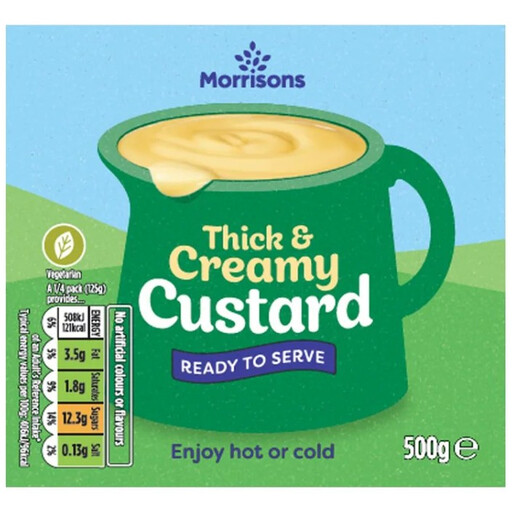 Image unavailable
This 500g option is worth considering when you want a larger ready-to-serve pack. Confirm its packaging if you require a tin, and check the current label's salt figures before comparing the amount in your intended serving.
Not in the checked Ambrosia 400g cans: Ambrosia lists 0.12g salt per 100g for Light Devon Custard and 0.11g for standard Devon Custard. Its Light comparison concerns fat and sugar, so check the current salt line separately.
Start with salt per 100g on each label, then consider the amount you will serve. For the checked products, Ambrosia lists 0.11g per 100g for standard Devon Custard and 0.12g for Light, while Sainsbury's lists 0.15g for its Ready To Eat Custard.
Yes, the checked Ambrosia cans and Sainsbury's Ready To Eat Custard say they can be served hot or cold. If you heat canned custard, transfer it to a suitable pan or microwaveable dish rather than heating the can.
For the checked Ambrosia cans, remove any remaining custard from the can, refrigerate it and use it within three days. Follow the storage instructions on the current pack you buy.
Yes, milk appears in the allergen information for the checked Ambrosia Devon Custard 400g can. Check the current pack's ingredients and allergen information before serving it to anyone who needs to avoid milk.