Budget-minded cupboard shoppers
If custard is an occasional dessert, the pack you can use up matters alongside its size. Compare ready-to-serve ambient custards with one another rather than treating powder or chilled pots as equivalent.


For a budget storecupboard, start with a ready-to-serve pack you can finish within its after-opening storage window: a 400g tin may be easier to use up than a larger pack. Choose a different flavour or lighter recipe because you want that particular product, not because every custard in a tin has the same ingredients or needs no preparation.
If custard is an occasional dessert, the pack you can use up matters alongside its size. Compare ready-to-serve ambient custards with one another rather than treating powder or chilled pots as equivalent.
A 400g can may suit a crumble or sponge when there are few people to serve. Check whether any remainder can be refrigerated and used within that product’s stated window.
Ambrosia describes its Light Devon Custard 400g as having 30% less sugar and 30% less fat than its standard Devon Custard. That is a comparison between those two recipes, not a claim about every custard.
Decide how much custard you will use after opening, then check whether you want a ready-to-serve product and which recipe suits the occasion.
| Concern | What to check | Who this matters to |
|---|---|---|
| Pack size and leftovers | Check pack weight and the exact after-opening refrigeration and use instructions. | For a dessert shared by only a few people, I want a pack I can finish without leaving much behind. About 37% of consumers put manageable portions and leftovers first. |
| Recipe choice | Read the per-100g nutrition panel and identify the exact products in any recipe comparison. | If I am choosing between standard and lighter custard, I want to know what the label actually compares. About 27% of consumers make the recipe their primary concern. |
| Ready-to-serve format | Look for “ready to serve” or “ready to eat”; a powder tin requires preparation. | When dessert needs to be served without making custard from powder, convenience comes first for about 18% of consumers. |
| Milk declarations | Check the current ingredients and allergen statement on the exact pack. | If milk declarations affect which product I can buy, the word “light” does not answer that question. About 18% of consumers put the allergen statement first. |
Ambient custard can be kept in the cupboard before opening, but the remaining contents may have a short refrigerated use window.
Choose a pack size that fits the desserts you have planned and follow its own after-opening instructions.
Bird’s Custard Powder comes in a tin but needs to be made up; it is not the same format as ready-to-serve custard.
Check the preparation directions when opening and serving without preparation matters to you.
Powder also takes preparation time and calls for ingredients specified in its directions.
Ambrosia says to remove remaining custard from its standard 400g can, refrigerate it and consume it within three days. M&S gives its Silky Smooth Custard a two-day refrigerated window after opening.
Follow the instructions on your particular pack rather than applying its unopened storage directions to leftovers.
Ambrosia’s Light Devon Custard 400g is described as containing less sugar and fat than its standard recipe, but it still contains milk.
Check nutrition information and allergen declarations separately on the current label.
Ready-to-serve 400g cans include standard Devon Custard and recipe variations.
Own-label ready-to-serve custard includes a 400g tin and a larger 1kg option in Tesco’s listed range.
Its listed ambient ready-to-eat custards include 400g, 500g and 1kg options.
M&S describes its 400g Silky Smooth Custard as made with whole milk.
Bird’s 350g Custard Powder is a make-up alternative, not ready-to-serve tinned custard.
These options cover ready-to-serve cupboard custards in 400g and larger packs. The Morrisons 500g product is described as a tub, while the Ambrosia Light 1kg product is a larger pack rather than a 400g tin.
 Image unavailable
A standard ready-to-serve can for a smaller dessert occasion. Ambrosia says it can be served hot or cold; it contains milk, and remaining custard must be removed from the can, refrigerated and used within three days.
 Image unavailable
A 400g strawberry-flavour variation for shoppers who want a different custard recipe. Check its current milk declaration and storage instructions before serving or keeping leftovers.
 Image unavailable
A 400g option for shoppers considering a low-fat-labelled recipe. Read this product’s own nutrition panel and milk declaration; do not assume that a comparison stated for a different Ambrosia variant applies to it.
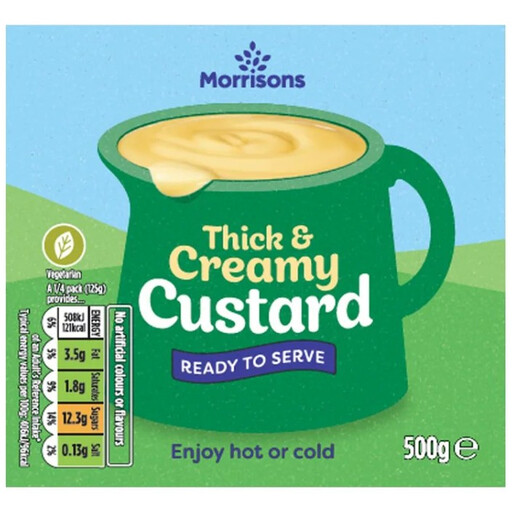 Image unavailable
A ready-to-serve 500g choice when a pack larger than a 400g can suits your plans. It is described as a tub, not a tin; check the pack’s allergen and after-opening instructions.
 Image unavailable
A larger Light Devon Custard pack to consider when you expect to use more custard. It is not the 400g can used in Ambrosia’s stated recipe comparison; check this pack’s own nutrition, milk declaration and after-opening directions.
Follow the storage directions on the exact pack. Ambrosia and M&S specify cool, dry storage before opening for the products described here; their instructions change once the custard is opened.
Use the time stated on your product’s label. Ambrosia directs shoppers to remove leftovers from its standard and Light 400g cans, refrigerate them and consume them within three days; M&S specifies refrigeration and use within two days for Silky Smooth Custard.
Ambrosia’s directions for its Devon Custard 400g say to empty it into a saucepan or a microwaveable container for heating, rather than heat it in the can. Follow the directions on the product you buy.
No. Ambrosia’s standard and Light Devon Custard 400g cans contain milk. Check the current ingredients and allergen declaration on the exact variant rather than using a recipe description to judge its allergens.
No. Bird’s Custard Powder needs to be made up, unlike ready-to-serve custard. Its product information says to refrigerate the prepared custard and treat it as fresh food.