Consumers avoiding added sugar
If syrup is your main concern, check the packing liquid and ingredients rather than assuming a low-fat fruit tin has no added sugar. The NHS advises choosing tinned fruit in natural juice or water with no added sugar.


If you want to reduce added sugar while following a low-fat diet, start with tinned fruit in water or natural juice with no added sugar rather than syrup, as the NHS advises. Check the ingredients and compare fat and ‘of which sugars’ per 100g between comparable products: fruit in juice can still contain naturally occurring sugars. Choose a pack size you can use within its after-opening instructions.
If syrup is your main concern, check the packing liquid and ingredients rather than assuming a low-fat fruit tin has no added sugar. The NHS advises choosing tinned fruit in natural juice or water with no added sugar.
For breakfasts, snacks or lunchboxes, a smaller pack may be easier to finish. Check its stated serving size as well as sugars per 100g; a single portion does not necessarily contain less sugar per 100g.
If a dessert calls for a particular fruit cut or syrup-packed fruit, check that the tin suits the recipe. Compare its ingredients and sugar declaration before using it as your everyday reduced-added-sugar choice.
For a low-fat diet with reduced added sugar in mind, check the packing liquid first, then compare nutrition labels on similar fruit and choose a workable pack size.
| Concern | What to check | Who this matters to |
|---|---|---|
| Added sugar | Look for water or natural juice with no added sugar; read the ingredients for sugar or syrup. | If avoiding added sugar is my main aim, I need to distinguish the packing liquid from the fruit itself. About 50% of consumers put added-sugar control first. |
| Fat and total sugars | Compare fat and ‘of which sugars’ per 100g between similar fruits and packing styles. | Even when I choose fruit in juice, I want to see its total sugars as well as its fat declaration. About 30% of consumers make label comparison their primary concern. |
| Portions and leftovers | Check serving size, pack size and the label’s after-opening storage instructions. | If I only need fruit for one snack or lunchbox, I want a pack I can finish without leaving the rest unused. About 20% of consumers prioritise portion and leftover planning. |
Princes lists sugar as an ingredient in its Fruit Cocktail in Light Syrup and declares 15g sugars per 100g. Its Fruit Cocktail with Juice declares 9g per 100g; those figures apply to these two products, not every fruit in syrup or juice.
If avoiding added sugar is the priority, check the exact variant’s ingredients rather than relying on ‘light’ in the name.
Fruit and fruit juice contain naturally occurring sugars, which still appear under ‘of which sugars’ on the nutrition panel.
Use the ingredients to check for added sugar, then compare total sugars per 100g between similar fruits if that figure matters to your choice.
After-opening storage instructions vary by product. An M&S grapefruit listing, for example, says to transfer unused fruit to a non-metallic container, refrigerate it and eat it within two days.
Check the tin’s own instructions before choosing a larger pack, or choose a smaller portion if you are unlikely to use the remainder.
Fruit left unused beyond its stated storage period may go to waste.
Princes sells fruit cocktail in both juice and light syrup, with different ingredients and sugar declarations.
Check the fruit, packing liquid and nutrition panel on the particular variant you are buying, even if you know another tin from the brand.
Del Monte offers prepared fruit in different packing liquids, including pear halves in juice.
Princes has fruit cocktail variants in juice and light syrup.
Tesco lists own-label tinned fruit in juice, including apricot halves.
Nature's Finest has a 4 x 113g tropical-fruit pack in juice.
M&S has grapefruit segments in juice.
These juice-packed fruit choices include a two-serving tin, individual pots and larger tins. Use the pack format to narrow your choice, then check the current ingredients and nutrition label for your added-sugar and low-fat priorities.
 Image unavailable
Consider this tin if you want pineapple chunks in juice. The 432g pack is described as containing two servings; check the current label for ingredients, nutrition and how to store any remainder.
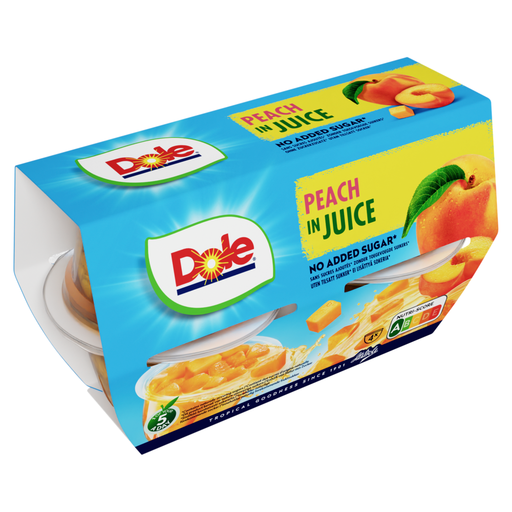 Image unavailable
The four 113g pots suit a plan built around individual portions rather than an open tin. Check the ingredients if you avoid sweeteners, and read the nutrition panel rather than treating juice-packed fruit as low in total sugars.
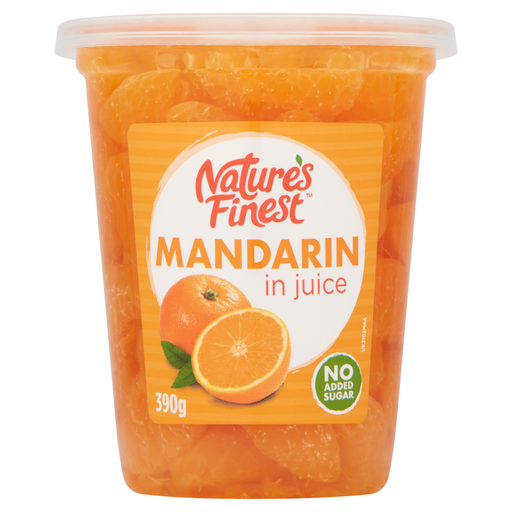 Image unavailable
Choose this format if mandarin segments in juice suit your meals or snacks and you can use a 390g pack. Check the current ingredients, fat and sugars declarations, and after-opening instructions.
 Image unavailable
Peach halves may suit a recipe that needs larger fruit pieces rather than chunks. This is a 415g juice-packed tin; check its current nutrition panel and plan how to store any fruit left after opening.
 Image unavailable
Consider the pear halves if that fruit and cut suit your intended serving or recipe. The 415g tin is packed in juice; confirm its ingredients, per-100g nutrition and after-opening instructions on the current label.
Start with natural juice or water with no added sugar if that is your priority: the NHS advises choosing tinned fruit in juice rather than syrup. Check the ingredients on the particular tin, because fruit in juice can still contain naturally occurring sugars.
No. Fruit and juice can contribute naturally occurring sugars even when none has been added. Read ‘of which sugars’ per 100g to compare similar fruit products.
No. Fat and sugars are separate entries on the nutrition panel. Princes declares 9g sugars per 100g for its Fruit Cocktail with Juice, while its light-syrup version lists sugar as an ingredient and declares 15g per 100g; check both the ingredients and nutrition of the variant you want.
Follow the instructions on your particular product. An M&S grapefruit listing says to transfer unused fruit to a non-metallic container, refrigerate it and eat it within two days; another product may give different instructions.
Read the ingredients on the specific tin. GOV.UK says that if a prepacked food contains any of the 14 regulated allergens as ingredients, they must be clearly labelled in the ingredients list.