Lower-fat dessert planners
If fat content is part of your baking decision, compare the figure per 100g on the tin. Check sugars and serving size separately: a low-fat choice is not necessarily a low-sugar one.


For a lower-fat home bake, start with fruit in natural juice or water if you also want to avoid added sugar from syrup, then compare the exact tin’s nutrition per 100g. Great Britain’s low-fat claim threshold for solid foods is no more than 3g fat per 100g, according to Department of Health and Social Care guidance; it does not tell you how much sugar the fruit contains. Choose slices, halves or chunks to suit the recipe, and check the drained weight when the recipe specifies a fruit quantity.
If fat content is part of your baking decision, compare the figure per 100g on the tin. Check sugars and serving size separately: a low-fat choice is not necessarily a low-sugar one.
The fruit’s cut matters as well as its packing liquid. Slices can be arranged across a tart, while halves or smaller pieces may suit a different filling or topping.
Compare the usable fruit quantity with the recipe and read the after-opening instructions if you expect leftovers.
For a lower-fat bake, the label, the fruit’s form and the amount you can use answer different parts of the buying question.
| Concern | What to check | Who this matters to |
|---|---|---|
| Fat and sweetness | Compare fat and sugars per 100g, then read whether the fruit is packed in juice, water or syrup. | If I am planning a lower-fat dessert, I want to check fat without mistaking juice-packed fruit for sugar-free fruit. About 50% of consumers would put this label and sweetness decision first. |
| Fruit cut and flavour | Choose the fruit and cut for the bake; use drained weight when the recipe specifies a drained amount. | For a tart with arranged fruit, the right pieces and usable quantity matter more to me than the tin’s total weight. Around 30% of consumers would make recipe fit their primary concern. |
| Pack size and leftovers | Check the tin size against the recipe and read its after-opening storage directions. | When I need only part of a tin, I want a plan for the remaining fruit rather than leaving it in the opened can. Roughly 20% of consumers would prioritise portion and leftover planning. |
The NHS advises choosing canned fruit in natural juice or water with no added sugar or salt. That guidance does not make juice-packed fruit sugar-free: Tesco, Sainsbury’s and Princes list 9.7g, 11.0g and 11.8g sugars per 100g, respectively, for the peach products discussed below. Light syrup remains an option when the recipe calls for syrup-packed fruit, but check its ingredients and sugars rather than judging it by fat content alone.
Juice-packed peaches can still contribute sugars to a dessert. The peach products listed by Tesco, Sainsbury’s and Princes each show sugars on their nutrition information.
Compare sugars per 100g and decide how much additional sugar, if any, the recipe needs.
A tin packed in liquid contains less drained fruit than its total stated weight. Tesco lists 250g drained weight for its 410g peach-slice tin.
If the recipe gives a drained fruit weight, match it to the drained quantity on the label.
The reviewed Tesco, Sainsbury’s and M&S fruit labels instruct shoppers to transfer leftovers to a non-metallic container, refrigerate them and use them within two days.
Follow the directions on your own tin and plan another use if the bake needs only part of it.
Peach slices, mixed fruit and grapefruit segments produce different shapes and flavours in a bake. M&S also notes that its grapefruit segments may contain pips.
Settle on a fruit and cut that suit the recipe, then compare the packing liquid and nutrition of suitable tins.
Tesco’s peach slices in pear juice from concentrate are one juice-packed option for a peach bake.
Sainsbury’s peach slices in refined grape juice offer another juice-packed peach format.
Princes offers peach slices with juice in 410g and 220g sizes, allowing a choice of tin size for the recipe.
Sainsbury’s lists Del Monte peach slices in both juice and light syrup, alongside other fruit and cut options.
M&S grapefruit segments in grapefruit juice offer a sharper flavour where a recipe calls for citrus rather than peaches.
These tins offer pineapple, peach and pear cuts packed in juice, plus peach slices in light syrup. Choose the fruit shape and packing liquid for your bake, then confirm the nutrition and usable quantity on the tin.
 Image unavailable
Consider the sliced pineapple format when a bake needs fruit pieces arranged across a topping. The 435g tin is packed in juice; check its drained weight against the recipe and its sugars per 100g when deciding on added sugar.
 Image unavailable
Peach halves suit a dessert that calls for larger pieces rather than slices. This 415g tin is packed in juice; compare the drained weight with the recipe and check sugars per 100g before adding other sweet ingredients.
 Image unavailable
Choose chunks rather than slices when smaller pineapple pieces suit the filling or topping. This 432g tin is packed with juice; confirm the drained quantity on the pack if your recipe specifies one.
 Image unavailable
Pear halves offer a different fruit and cut for a bake that does not call for peach or pineapple. The 415g tin is packed in juice; check the drained weight if the recipe specifies a usable fruit amount.
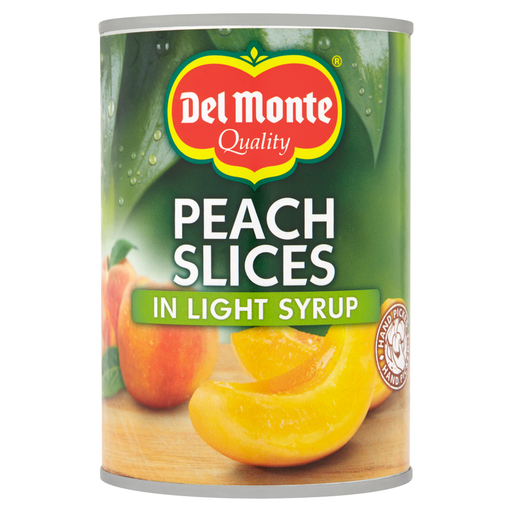 Image unavailable
Consider these slices when the recipe calls for syrup-packed peaches rather than fruit in juice. The 420g tin contains light syrup; check its sugars and drained weight before deciding how much additional sugar or fruit the bake needs.
No. Department of Health and Social Care guidance says a solid food making a low-fat claim in Great Britain must contain no more than 3g fat per 100g; that threshold does not describe its sugars. For example, Tesco, Sainsbury’s and Princes list 9.7g, 11.0g and 11.8g sugars per 100g, respectively, for their juice-packed peach products.
Choose natural juice or water with no added sugar when avoiding added sugar from syrup is part of the plan; this follows NHS advice for canned fruit. Light syrup may fit a recipe that calls for syrup-packed fruit, but read its ingredients and sugars per 100g before adjusting the recipe’s other sweet ingredients.
Use the drained net weight when the recipe specifies the amount of fruit after draining, rather than relying on the total tin weight. GOV.UK food-labelling guidance requires a drained net weight for solid foods packed in liquid; Tesco’s 410g peach tin, for example, lists 250g drained weight.
Follow the instructions on the tin you open. The reviewed Tesco, Sainsbury’s and M&S products direct shoppers to transfer unused fruit to a non-metallic container, refrigerate it and use it within two days; directions for another product may differ.