What matters when buying?
Start with the packing liquid and ingredients, compare salt on a common per-100g basis, then choose a fruit shape and drained quantity that work for your tea table.
| Concern |
What to check |
Who this matters to |
| Packing liquid and added sugar |
Read the ingredients for juice, water or syrup, and check the sugars declaration. |
When serving fruit beside sweet bakes, I want to know whether the packing liquid adds sweetness. About 50% of consumers put the packing liquid and avoiding added sugar first. |
| Salt declaration |
Compare salt per 100g on the exact tins; note whether a figure is stated as ‘less than’ a value. |
If salt guides my choice, I need figures on the same label basis rather than an assumption about juice-packed fruit. Salt-label comparison comes first for about 30% of consumers. |
| Serving and storage |
Check the fruit cut, drained weight and product-specific instructions for leftovers. |
For a small tea table, I need enough fruit in a shape I can serve neatly without overlooking what to do with the remainder. Around 20% of consumers make serving convenience their primary concern. |
Tinned fruit on Joybuy
These Joybuy selections cover four Del Monte fruits labelled as packed in juice and one Tiger Tiger pineapple option described as packed in light syrup. The syrup option is for a tea table where added sweetness is intentional. For a salt-led choice, compare the nutrition panel on the exact tin rather than treating either packing liquid as a reduced-salt claim.
 Image unavailable
Del Monte Pineapple Slices in Juice 435g
Consider the slices if you want pineapple pieces to arrange on a fruit plate. The 435g tin is labelled as packed in juice; check its salt declaration and drained weight on the exact tin before deciding how many to serve.
View on Joybuy
 Image unavailable
Del Monte Peach Halves in Juice 415g
Peach halves are a choice for a plated fruit course rather than a bowl of small pieces. This 415g tin is labelled as packed in juice; compare its salt per 100g with other tins and check the drained quantity for your serving plan.
View on Joybuy
 Image unavailable
Del Monte Fruit Cocktail in Juice 415g
The fruit cocktail suits a mixed-fruit bowl when you do not want to arrange separate fruit types. Its 415g tin is labelled as packed in juice; check the tin's salt declaration and drained weight if those details will determine your choice.
View on Joybuy
 Image unavailable
Del Monte Pear Halves in Juice 415g
Pear halves provide another shape for individual plates. This 415g tin is labelled as packed in juice; check the exact tin for its per-100g salt declaration and the drained amount available to serve.
View on Joybuy
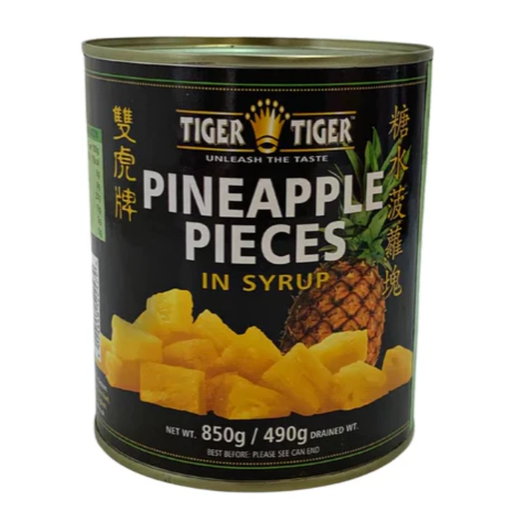 Image unavailable
Tiger Tiger Canned Pineapple Pieces 830g
Consider these pineapple pieces when a sweeter, syrup-packed fruit is intentional for the spread. The listing describes light syrup, so this is not the juice-packed route for avoiding added sugar. Check the 830g tin's salt declaration and drained weight before comparing it with the other options.
View on Joybuy
Common questions
Do I need to look for ‘reduced salt’ tinned fruit?
Use the exact tin's salt declaration per 100g rather than relying on ‘in juice’ as a reduced-salt claim. If avoiding added sugar is also important, the NHS advises choosing tinned fruit in natural juice or water with no added sugar or salt.
Should I choose fruit in juice or syrup for afternoon tea?
Choose natural juice or water when you want to follow NHS advice on avoiding added sugar or salt in tinned fruit, and check the ingredients on the particular tin. Syrup is a different option when added sweetness is part of the dessert you intend to serve.
How much tinned fruit counts as one 5 A Day portion?
The NHS states that 80g of canned fruit counts as one 5 A Day portion. A product's suggested serving may be a different amount, so use its drained weight when planning both portions and the quantity needed for your table.
How should I keep tinned fruit after opening?
Follow the instructions on the individual product and refrigerate unused fruit in a suitable container rather than leaving it in the opened tin. The storage time can differ between products, so check the label before planning to serve leftovers later.
Can ‘in juice’ be treated as a reduced-salt label claim?
No: ‘in juice’ describes the packing liquid, not a reduced-salt claim. The Department of Health and Social Care's UK guidance explains that nutrition claims on foods are subject to specific rules. Check whether the particular tin actually makes the claim and compare its accompanying salt declaration.


