Hosts adding fruit to a small buffet
If fruit is one element of a wider spread rather than a serving for every guest, compare the drained quantity with your menu and consider what you will do with any leftovers.


For a christening-party dessert or buffet garnish, choose slices when you want to arrange the fruit visibly, or chunks when you plan to mix it into a dish. Compare drained weight with the amount you intend to serve, rather than relying on the tin’s net weight, and check the pack’s storage instructions if you expect leftovers.
If fruit is one element of a wider spread rather than a serving for every guest, compare the drained quantity with your menu and consider what you will do with any leftovers.
For a cake table or plated dessert where the fruit’s shape will be visible, check whether the tin contains slices, halves or chunks.
If the type of juice, syrup or sugar content matters to your menu, read the ingredients and nutrition panel on the exact tin rather than relying on the fruit name alone.
Decide how the fruit will be served, then compare the cut, usable quantity and label details of tins that suit that dish.
| Concern | What to check | Who this matters to |
|---|---|---|
| Usable fruit and leftovers | Compare drained weight, where stated, with the fruit’s role on the menu; read the after-opening instructions. | If I only need a small garnish, I want enough fruit to serve without opening far more than I can use. About 40% of consumers put usable quantity and leftovers first. |
| Cut and presentation | Check whether the fruit comes as slices, halves or chunks, and match the cut to the dish. | For a plated dessert, I need pieces I can arrange; for a mixed dish, that shape matters less. Serving format comes first for about 30% of consumers. |
| Packing liquid and label | Read the ingredients for the packing liquid and compare sugars per 100g on the current tins. | When I have a particular juice or sweetness preference, I need to know what is in the tin before choosing it. About 30% of consumers make the packing liquid and nutrition label their primary concern. |
Net weight includes the packing liquid. Tesco Groceries lists its 227g pineapple-slices tin at 136g drained, a substantial difference when the fruit is intended for a small dessert component.
Use the drained weight, where stated, to judge how much fruit you can serve.
A tin that supplies more fruit than the party dish needs also leaves more to store. After opening, the instructions for Del Monte peach slices listed by Sainsbury’s say to transfer unused contents to a suitable non-metallic container, cover and refrigerate them, and use them within three to four days.
Check the instructions on the tin you buy and choose a quantity you can use within its stated period.
The fruit and packing juice can differ between products; Del Monte’s listed peach slices may use a different juice depending on the season.
Check the current ingredients and nutrition panel if a particular juice ingredient or sugar value affects your choice.
Tesco Groceries lists a 227g tin of pineapple slices in juice with 136g drained weight.
Sainsbury’s lists its own-brand peach slices in fruit juice in a 213g tin.
Sainsbury’s lists Del Monte peach slices in juice at 415g net and 250g drained.
Princes lists pineapple chunks in juice in 227g and 432g formats.
These tins offer slices, halves or chunks for a christening-party dessert, topping or small buffet fruit component. Match the cut and quantity to the dish you plan to serve.
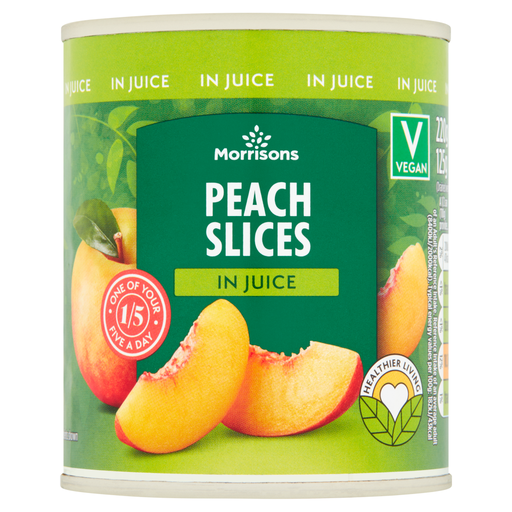 Image unavailable
Consider these peach slices when you want fruit to arrange on a plated dessert. The tin is 220g; check its drained weight if the exact serving quantity matters. The product information warns that occasional stone fragments may remain, so take care when serving.
 Image unavailable
The pineapple slices provide a defined shape for a visible dessert topping. This is a 435g tin; compare its drained weight with the amount your dish needs and plan how to use any remainder.
 Image unavailable
Peach halves are an option for a serving dish where larger pieces suit the presentation. The tin is 415g; check the drained quantity against your serving plan and follow its after-opening storage instructions for leftovers.
 Image unavailable
Chunks suit fruit mixed into a salad, topping or dessert bowl. This tin is 432g net, including liquid, so check the drained weight before using it to plan fruit servings.
 Image unavailable
These mango slices offer another visible fruit shape for a dessert. The 425g tin is packed in light syrup rather than juice; check that the packing liquid suits your menu, and confirm the drained weight before planning servings.
One tin can work as a garnish or part of a wider dessert spread, but plan quantities before relying on it for every guest. Use drained weight where stated: Tesco Groceries lists its pineapple-slices tin at 227g net and 136g drained.
Choose slices when you want to arrange visible pieces on a dessert; choose chunks for fruit you will spoon into a bowl or mix into another dish. Check the cut on the exact tin, since the shape changes how you can serve it.
The words “in juice” describe the packing liquid, not a low-sugar claim. Compare the sugars per 100g and ingredients on the nutrition panels of the tins you are considering.
Follow the instructions on the tin you buy. For the Del Monte peach slices listed by Sainsbury’s, the instructions say to transfer unused fruit to a suitable non-metallic container, cover and refrigerate it, then use it within three to four days.