Sugar-label comparers
Christmas shoppers choosing fruit for desserts or breakfasts who want to distinguish juice from syrup and compare sugars per 100g before buying.


If avoiding syrup is your priority for the Christmas food shop, start with tinned fruit labelled ‘in juice’, then compare sugars per 100g on the exact can: juice-packed does not mean sugar-free or establish a reduced-sugar claim. Choose the fruit and drained quantity for your dish, and pick a can size you can use within its stated post-opening storage period.
Christmas shoppers choosing fruit for desserts or breakfasts who want to distinguish juice from syrup and compare sugars per 100g before buying.
Shoppers matching peaches, pineapple or other tinned fruit to a pudding, fruit salad or topping, where the cut and drained quantity affect the recipe.
People buying for limited portions who need a can size they can use in line with the product’s post-opening instructions.
For a Christmas dish, decide which fruit and cut the recipe needs, then compare packing liquid, the nutrition panel and the amount you will use. A preference for juice over syrup is a starting point, not a substitute for checking sugars on the exact product.
| Concern | What to check | Who this matters to |
|---|---|---|
| Packing liquid and sugars | Check whether the fruit is in juice or syrup, then compare sugars per 100g on the exact can. | If I want to avoid syrup in a Christmas dessert, I still need to know how much sugar the juice-packed fruit contains. About 36% of consumers put the packing liquid and sugars label first. |
| Recipe fit | Match the fruit and cut to the dish; check drained weight if the recipe specifies a fruit quantity. | For a pudding that calls for pineapple pieces, the right cut and usable amount matter more to me than the tin’s overall size. Recipe fit is the primary need for about 29% of consumers. |
| Portions and leftovers | Compare can sizes with planned portions and read the exact product’s post-opening instructions. | When I only need a little fruit for a topping, I want to avoid opening more than I can use. About 21% of consumers chiefly consider portions and leftovers. |
| Choice at your retailer | Check the current variant and label where you shop; a range may contain both juice- and syrup-packed fruit. | If I am doing the Christmas shop in one place, I need an option there that fits the dish and my label preferences. Finding that option comes first for about 14% of consumers. |
‘In juice’ describes the packing liquid; it does not establish a reduced-sugar claim. Princes lists 10.0g sugars per 100g for its pineapple chunks in juice, while Marks & Spencer lists 7.3g per 100g for its grapefruit segments. These are different fruits, not a like-for-like comparison.
Use the packing description to narrow your choice, then read the ingredients and sugars per 100g on the can you intend to buy.
Sainsbury’s lists peach slices in both fruit juice and light syrup. A familiar fruit name alone will not tell you which packing liquid you are getting.
Read the full variant name, particularly if avoiding syrup is more important to you than having a sweeter liquid for the recipe.
The net weight includes packing liquid, so check drained weight when your recipe needs a particular amount of fruit. Post-opening instructions also vary by product.
Work out the fruit quantity needed and read the storage directions before choosing a can size.
Unused fruit may go to waste if it cannot be used within the product’s stated storage period.
Marks & Spencer advises shoppers that product details can change. A previous listing may not reflect the can being sold when you shop.
Check the current label if ingredients or the sugars figure will determine your choice.
A branded range to compare when looking for tinned fruit in juice.
A pineapple option for shoppers choosing between can sizes.
A grocery range where shoppers can compare different tinned-fruit formats.
An own-label and branded range for comparing packing liquids.
An own-label option for shoppers considering peach slices in fruit juice.
A grapefruit-segment option with product-specific nutrition and storage information.
These juice-packed pineapple, peach and pear options suit shoppers avoiding syrup while choosing a fruit format and can size for a Christmas dish. Compare the current label before treating any one of them as a reduced-sugar product.
 No image available
For a dish needing pineapple slices rather than chunks, this is a 435g juice-packed can. Check the drained weight if the recipe specifies the quantity of fruit, and compare sugars on the current label.
 No image available
Consider these 415g juice-packed peach halves when the dessert calls for halves rather than slices. Check the can’s drained weight for precise recipe quantities and read its nutrition panel.
 No image available
For a recipe needing pineapple pieces, this 432g can contains chunks with juice. Check the drained weight for the amount of fruit your dish requires, as well as the current nutrition panel.
 No image available
These juice-packed pear halves offer a 415g can for a dish calling for pears. If portions depend on the usable fruit quantity, check the drained weight on the can before buying.
 No image available
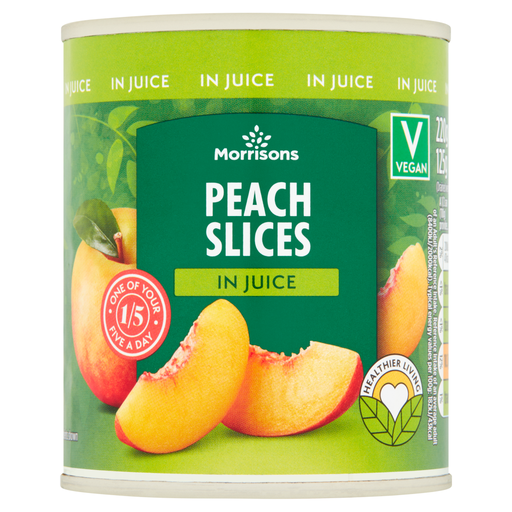
For a smaller planned portion of peach slices, this juice-packed can is 220g. Check its drained weight against the recipe and follow the current label’s instructions for any leftovers.
No. It describes the packing liquid, not a sugar-free or reduced-sugar claim. Princes lists 10.0g sugars per 100g for its pineapple chunks in juice, and Marks & Spencer lists 7.3g per 100g for its grapefruit segments. Compare the nutrition panel and ingredients of the exact fruit you are considering.
Start with the fruit, cut and quantity the recipe calls for: pineapple chunks and slices, for example, serve different preparation needs. Then check whether the product is packed in juice or syrup, its drained weight where relevant, and the sugars figure on that can.
Follow the directions on the exact product. Marks & Spencer instructs shoppers to transfer its grapefruit segments to a non-metallic container, refrigerate them and eat them within two days of opening; do not assume that timeframe applies to other tins.