Sugar-conscious dessert planners
If you would rather avoid a syrup-led Easter dessert, the packing liquid is a useful starting point. You still need the nutrition panel: fruit packed in juice contains sugars too.


For an Easter lunch dessert without syrup-led sweetness, start by comparing fruit packed in juice or explicitly labelled no added sugar, rather than assuming that light syrup has less sugar. Neither description guarantees a lower total sugars figure: compare similar fruit per 100g, then check the portion you plan to serve and the drained quantity needed for your dessert.
If you would rather avoid a syrup-led Easter dessert, the packing liquid is a useful starting point. You still need the nutrition panel: fruit packed in juice contains sugars too.
When several diners will share a tin, drained weight, fruit shape and stated servings are more useful for planning than the tin’s total weight alone.
A smaller tin may suit a modest dessert if a larger one would leave fruit unused. Check the pack’s instructions for refrigerating and using any leftovers.
Choose the fruit and packing liquid for the dessert you want to make, then compare sugars on the same nutrition basis and check how much fruit you can serve.
| Concern | What to check | Who this matters to |
|---|---|---|
| Packing liquid | Read the ingredients for juice, syrup and added sugars; compare sugars per 100g for similar fruit. | If I want a dessert without syrup-led sweetness, I need to know what the fruit is packed in. About 36% of consumers would put avoiding that sweetness first. |
| Fruit for the table | Check drained weight, stated servings and whether slices, halves or chunks suit the dish. | For a dessert shared around the table, I need enough fruit in a shape I can use. That would be the primary concern for about 29% of consumers. |
| Sugars in a portion | Compare like-for-like per-100g figures, then use the label’s serving information for your intended portion. | When I serve individual bowls, the amount each person gets matters more to me than the wording on the front of the tin. About 21% of consumers would prioritise the sugars in their intended portion. |
| Leftovers | Match the pack size to the diners and follow its after-opening storage instructions. | If only a little fruit will be eaten at lunch, I would rather avoid opening more than we can use. Limiting leftovers would come first for about 14% of consumers. |
Fruit and its packing juice both contribute sugars. Tesco, Asda and Sainsbury’s list different sugars figures for their juice-packed peach slices, so the packing description alone cannot settle the comparison.
Compare similar products per 100g, then check the amount you expect to serve.
A no-added-sugar description does not remove sugars naturally present in fruit or juice. Joybuy’s Dole Pineapple Chunks in Juice listing describes the pots as having no added sugar while reporting 12g sugars per 100g.
Use the claim alongside, not instead of, the nutrition panel.
Total weight includes the packing liquid. Tesco lists 250g drained fruit for its 410g Peach Slices in Juice tin.
Use drained weight and the stated servings to plan how much fruit the dessert needs.
The checked Tesco, Sainsbury’s and Asda peach products instruct shoppers to transfer unused fruit to another container and refrigerate it; their use-within instructions differ.
Follow the storage instructions on the tin you buy, including its stated time after opening.
Tesco Peach Slices in Juice is a 410g tin with 250g drained weight, which helps when planning a shared dessert.
Sainsbury’s lists Peach Slices in Fruit Juice in a 411g tin for desserts using sliced fruit.
Asda Peach Slices in Fruit Juice is a 411g option with a stated one-third-can serving.
Del Monte Peach Slices in Juice 415g offers a peach option packed in clarified pineapple juice from concentrate.
Princes Pineapple Chunks With Juice 432g is a pineapple option when chunks suit the Easter dessert better than peaches.
These Joybuy product listings are ordered by their reported sugars per 100g, not by overall suitability. Pineapple and peaches serve different dessert needs, and pack and portion sizes differ.
| Rank | Product | Main specifications | Reason for position | Platform |
|---|---|---|---|---|
| 1 | Princes Pineapple Chunks With Juice 432g | Pineapple chunks in juice; 10g sugars per 100g. | The Joybuy product information gives the lowest reported per-100g sugars figure among these three listings. This does not compare portion sizes or dessert suitability. | Joybuy |
| 2 | Del Monte Peach Slices in Juice 415g | Peach slices in juice; 11g sugars per 100g. | Joybuy reports a per-100g sugars figure between the two pineapple listings; the fruit and format differ. | Joybuy |
| 3 | Dole Pineapple Chunks in Juice 4 x 113g | Portioned pineapple chunks in juice; 12g sugars per 100g. | Joybuy reports the highest per-100g sugars figure in this list. The smaller pots offer a different serving format. | Joybuy |
These juice-packed pineapple, peach and mixed-fruit products offer different shapes and pack sizes for an Easter dessert. Compare the current label’s sugars and serving information before choosing.
 No image available
Chunks suit a dessert that calls for pineapple rather than peach slices. This juice-packed 432g tin lists two servings and 10g sugars per 100g; check the portion you plan to serve rather than treating “in juice” as a reduced-sugars claim.
 No image available
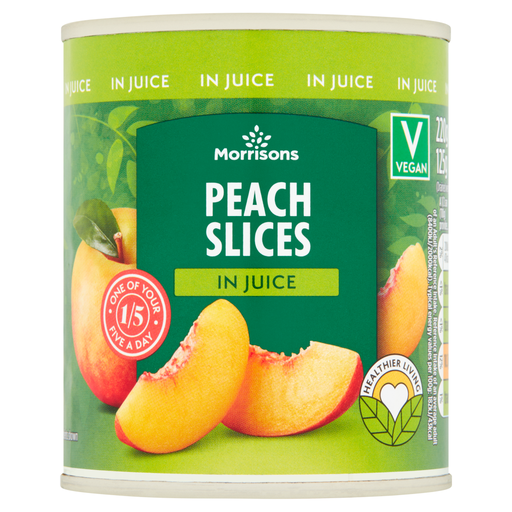
The 220g tin offers peach slices in juice for a smaller dessert. Check its drained weight and nutrition panel when deciding how many portions it will make.
 No image available
This 415g fruit cocktail offers mixed fruit in juice when a peach-only dessert is not what you have planned. Check the drained quantity and sugars figure for the portions you will serve.
 No image available
Peach halves suit a dessert that calls for larger pieces rather than ready-sliced fruit. The tin is 415g and packed in juice; check the drained weight and sugars on the pack before planning servings.
 No image available
Pineapple slices offer a different presentation from chunks for a shared dessert. This 435g tin is packed in juice; use the drained weight and nutrition panel to plan quantities and portions.
No. “In juice” describes the packing liquid, not a comparison with another product. Tesco, Asda and Sainsbury’s list sugars figures of 9.7g, 10g and 11g per 100g respectively for the juice-packed peach products discussed here, though their stated nutrition bases and serving sizes should be checked on each label.
No. Fruit and juice can contain naturally occurring sugars. Joybuy’s Dole Pineapple Chunks in Juice listing describes the product as having no added sugar while reporting 12g sugars per 100g; check the nutrition panel for the amount you intend to serve.
Transfer leftovers from the opened tin to a suitable non-metallic container, cover and refrigerate them. The checked Tesco and Sainsbury’s peach products say to use leftovers within two days, while the checked Asda product says four days. Follow the instructions on your particular pack.