What matters when choosing?
Decide whether salt, carbohydrate, a meal-sized portion or handling leftovers is your primary concern, then compare the relevant figures and instructions on the individual tin.
| Concern |
What to check |
Who this matters to |
| Salt on the label |
Read salt per 100g. Nidirect’s low-salt threshold is 0.3g or less per 100g; check each variant rather than assuming its packing liquid determines its salt content. |
If keeping salt low takes priority, I need a stated figure that lets me assess the tin before buying it. About 31% of consumers put a label-confirmed low-salt choice first. |
| Carbohydrate and ride use |
Compare carbohydrate per 100g and per serving, and decide whether the fruit is for a meal or for food carried on the ride. |
For a longer ride, I want to know how a fruit portion fits alongside the food I can actually carry and eat. Roughly 31% of consumers primarily need to plan carbohydrate around the ride. |
| Meal portion |
Check the stated serving and drained weight to judge how much fruit a meal portion provides. |
If I am adding fruit to breakfast or a post-ride meal, a predictable portion matters more to me than the whole tin’s weight. About 23% of consumers put meal portions first. |
| Leftovers |
Check the tin size and its instructions for refrigerating and using any contents left after opening. |
When I am eating alone, I need to know whether I can finish the fruit within the opened-pack storage period. Around 15% of consumers chiefly prioritise managing leftovers. |
Joybuy fruit selections
These juice-packed fruits and one light-syrup peach tin are options to consider for meals around cycling. Check each individual pack’s salt figure before choosing it specifically for a low-salt requirement.
 Image unavailable
Princes Pineapple Chunks with Juice 432g
Consider these pineapple chunks for a fruit portion with a meal before or after cycling. The 432g tin is packed with juice; check its per-100g salt and carbohydrate figures and its instructions for any leftovers.
View on Joybuy
 Image unavailable
Del Monte Peach Halves in Juice 415g
These peach halves are an option for adding fruit to a meal at home. The 415g tin is packed in juice; use the individual pack’s salt and carbohydrate values to assess how it fits your plans.
View on Joybuy
 Image unavailable
Del Monte Pineapple Slices in Juice 435g
These pineapple slices offer a juice-packed fruit option for a meal before or after a ride. The tin is 435g; check the label for the fruit’s drained weight, salt per 100g and opened-pack storage instructions.
View on Joybuy
 Image unavailable
Del Monte Fruit Cocktail in Juice 415g
Choose this 415g fruit cocktail if you want mixed fruit in juice for a meal. Sainsbury’s listing for the named product gives salt as less than 0.5g per 100g, which does not confirm it meets nidirect’s 0.3g-per-100g low-salt threshold; check the pack if that distinction matters.
View on Joybuy
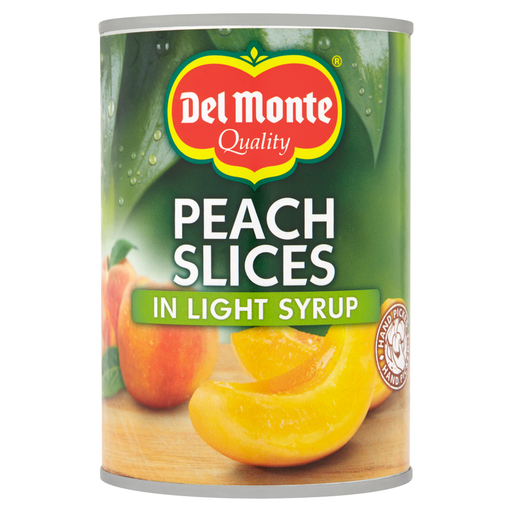 Image unavailable
Del Monte Peach Slices in Light Syrup 420g
Consider this light-syrup option if its carbohydrate content suits a meal around cycling. Sainsbury’s listing for the 420g product gives 15g carbohydrate per 100g but declares salt only as less than 0.5g per 100g, so that listing alone cannot confirm it meets the low-salt threshold.
View on Joybuy
Questions about tinned fruit and cycling
What counts as low salt on a tinned-fruit label?
Nidirect uses 0.3g salt or less per 100g as its low-salt threshold. Compare that figure on the individual tin; “reduced salt” is a different claim and does not, by itself, tell you the product’s salt content.
Does “less than 0.5g salt per 100g” confirm a tin is low salt?
No. A value below 0.5g per 100g could still be above nidirect’s 0.3g-per-100g low-salt threshold. Look for a more precise declaration if meeting that threshold is important to your choice.
Should I take tinned fruit to eat while cycling?
A tin is usually more practical before or after a ride than as your main food while cycling: it needs opening and contains liquid. If you need food during the ride, plan something you can carry and eat safely, alongside your drink plan.
Is fruit in juice or light syrup more suitable around a ride?
Choose by the individual product’s salt and carbohydrate figures and when you intend to eat it. Sainsbury’s lists 15g carbohydrate per 100g for Del Monte Peach Slices in Light Syrup 420g, versus Tesco Groceries’ 9.7g per 100g for Tesco Peach Slices in Juice 410g; those figures do not establish the salt content of other syrup or juice tins.
What if I take medicine and want tinned grapefruit?
Check with a pharmacist or prescriber if your medicine may interact with grapefruit. Collingwood Health Group advises that grapefruit can affect some medicines, so check compatibility before making grapefruit segments a regular choice.


