Trifle and fruit-salad hosts
If the dish needs several fruit types from one tin, a mixed-fruit format is worth checking. Princes describes its fruit cocktail in juice as suitable for a trifle, though its fruit proportions vary.


Choose fruit cocktail when one tin needs to supply several fruits for a trifle or fruit salad; choose slices or halves when the dessert calls for a consistent shape on each plate. Check the packing liquid, drained weight and serving guide against your recipe, then follow the particular tin’s instructions for any leftovers.
If the dish needs several fruit types from one tin, a mixed-fruit format is worth checking. Princes describes its fruit cocktail in juice as suitable for a trifle, though its fruit proportions vary.
For fruit arranged over cake or divided between bowls, uniform pieces may be easier to plan around. Tesco and Sainsbury’s list peach slices in juice with serving guidance.
When one tin might be more than the recipe needs, compare the drained amount and serving guide, then check the instructions for storing what remains. Tesco, Sainsbury’s and Del Monte list different post-opening periods for their peach tins.
For a dinner-party dessert, decide what fruit shape the dish needs before comparing the liquid, usable quantity and guest-facing label details.
| Concern | What to check | Who this matters to |
|---|---|---|
| Fruit format | Check whether the tin contains uniform slices or halves, or a mix whose fruit proportions can vary. | For a trifle, I may want several fruits; for individual plates, I may need matching pieces. About 33% of consumers put the fruit’s fit with the dessert first. |
| Packing liquid | Read the exact liquid description, ingredients and sugars line on the can; juice and light-syrup versions are both listed in retailer ranges. | If the dessert already has a sweet sauce, I want to choose its packing liquid deliberately. Roughly 27% of consumers make liquid and sweetness their primary concern. |
| Usable quantity | Compare drained weight and serving guidance with the recipe, then read the post-opening storage instructions. | For a small table, I need enough fruit without overlooking what remains after serving. About 20% of consumers put portions and leftovers first. |
| Guest-facing label details | Check the physical can’s ingredients, dietary information and any fruit-stone warning before serving. | When serving guests, I need to check whether the particular tin suits their stated requirements. Approximately 20% of consumers prioritise those label checks. |
The net weight includes liquid. Tesco lists 250 g drained weight for its 410 g peach-slice tin, so the number on the front is not the quantity of fruit for your recipe.
Compare drained weight and the stated servings with the amount your dessert needs.
Juice-packed fruit can still list sugars, and the packing juice may differ. Sainsbury’s listing for Del Monte peach slices says the juice can vary seasonally between pineapple, grape and pear.
Read the ingredients and nutrition panel on the particular can; choose a light-syrup version only if its liquid suits the recipe.
Tesco and Sainsbury’s instruct buyers to refrigerate unused peach slices in a non-metallic container and use them within 2 days. Sainsbury’s Del Monte listing gives a 3–4-day period after transfer and refrigeration.
Follow your can’s instructions rather than another product’s period, and note when you opened it.
Ingredients and packing liquid matter when preparing food for guests. Peach-slice listings also caution that stones may occasionally remain.
Read the physical label for ingredients, date marking and warnings, and check peach pieces while plating where practical.
Tesco lists a 410 g own-brand tin of peach slices in juice for desserts needing one consistent fruit shape.
Sainsbury’s lists 411 g own-brand peach slices in fruit juice with a two-serving guide.
The Del Monte 415 g peach-slice listing at Sainsbury’s gives 250 g drained weight for a dessert using uniform slices.
Princes lists peach slices with juice and a fruit cocktail with juice, covering single-fruit and mixed-fruit desserts.
M&S lists tinned grapefruit segments and rhubarb chunks for desserts calling for a different fruit from peaches.
These tins cover peach pieces for plating, pineapple chunks for a fruit-based dessert and fruit cocktail for a mixed-fruit dish. Match the cut and tin size to your recipe rather than treating them as interchangeable.
 No image available
Consider this smaller tin when the dessert calls for peach slices and you want to limit what remains. It contains 220 g net; check the can’s drained weight against the fruit quantity in your recipe, and watch for stone fragments when plating.
 No image available
Choose halves when larger peach pieces suit the planned presentation; they may need cutting for a dessert that calls for slices. The tin is 415 g net. Check its drained quantity and packing-liquid details on the can before using it for a measured recipe.
 No image available
Pineapple chunks suit a dish that needs pieces rather than a sliced garnish. This tin is 432 g net; if your recipe specifies an amount of drained pineapple, check the can for that quantity before buying.
 No image available
Consider fruit cocktail when a trifle or fruit salad calls for mixed fruit rather than matching slices. The tin is 415 g net. Check the physical label for the fruit mix, ingredients and drained quantity if a guest’s requirements or your recipe depend on them.
 No image available
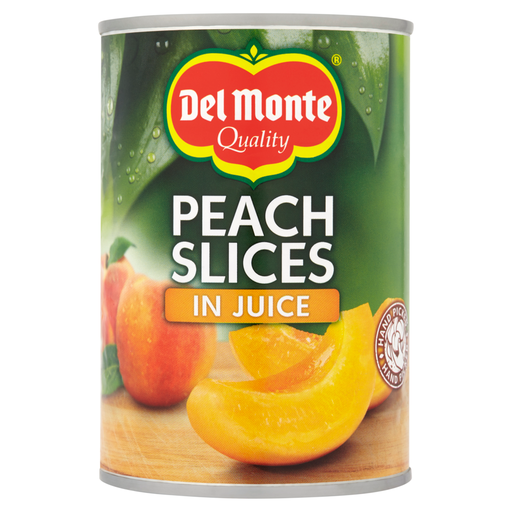
Peach slices give you a consistent cut for individual desserts. This tin is 415 g net; Sainsbury’s listing for Del Monte peach slices of the same size gives 250 g drained weight and says the packing juice can vary seasonally. Check the particular can when either detail matters to your recipe.
Do not judge the sweetness of a particular dessert from those descriptions alone. Juice-packed fruit can list sugars, and retailer ranges include both juice and light-syrup tins. Compare the ingredients and nutrition panel on the exact can you plan to serve.
Use the tin’s serving guide alongside the fruit quantity your recipe requires. Sainsbury’s says its 411 g peach-slice tin contains two servings; Tesco gives a half-can serving reference and lists 250 g drained weight for its 410 g tin. A topping and a fruit-led dessert may use different amounts.
Follow the instructions on the tin you opened. Tesco and Sainsbury’s say to transfer unused peach slices to a non-metallic container, refrigerate and use within 2 days. Sainsbury’s listing for Del Monte peach slices states 3–4 days after transfer and refrigeration.
Yes. Tesco and Sainsbury’s peach-slice listings caution that stones may occasionally remain despite removal during preparation. Check the pieces as you plate them and make guests aware of the warning.
GOV.UK explains that a best-before date concerns food quality, whereas a use-by date concerns safety. Check the tin’s date and storage instructions when planning ahead; do not treat the two types of date as equivalent.