Dinner hosts planning a shared dessert
If you are filling a serving bowl or several dessert plates, the fruit left after draining matters more than the weight printed prominently on the tin.


For a shared anniversary dessert, choose tins by the drained quantity you need and a fruit cut that suits the dish; a small multipack is more useful when you want to open separate portions. Check whether the fruit is packed in juice or light syrup, and plan for any leftovers from a larger tin.
If you are filling a serving bowl or several dessert plates, the fruit left after draining matters more than the weight printed prominently on the tin.
A visible garnish calls for a deliberate choice of cut, such as pineapple slices or peach halves. A fruit cocktail serves a different purpose when you want a mixed-fruit bowl.
If you will use only a little fruit at a time, smaller portions may let you open fewer containers. For a larger tin, make a plan for the unused fruit.
Work out how much fruit will reach the plates, then choose its cut and packing liquid for the dessert you have planned.
| Concern | What to check | Who this matters to |
|---|---|---|
| Usable fruit | Use the declared drained weight when you will discard the liquid; multiply it by the number of tins you plan to open. | If I am serving several people, I need enough fruit after draining to finish every plate or fill the bowl. About 40% of consumers put usable fruit first. |
| Fruit cut | Choose slices or halves for a visible topping, or pieces or fruit cocktail for a mixed bowl; confirm the exact cut on the label. | When the fruit will be visible on a dessert, I want its shape to fit the presentation I have planned. For about 30% of consumers, the cut is the primary concern. |
| Packing liquid and leftovers | Check the exact juice or syrup description and ingredients. For a larger tin, read its after-opening instructions. | If I need only small portions, I want to avoid opening more than I can use; the packing liquid also needs to suit my recipe. Managing portions or that liquid comes first for about 30% of consumers. |
Net weight includes the packing liquid. Sainsbury’s lists Del Monte peach slices at 415g net and 250g drained, while its Del Monte pineapple slices are 435g net and 260g drained.
Plan the portions from drained weight where it is declared, rather than treating the full tin weight as fruit.
The packing liquid changes what goes into a dessert. Princes lists pineapple slices with pineapple juice and citric acid; the Joybuy listing for Del Monte fruit cocktail in light syrup includes glucose-fructose syrup and sugar.
Read the ingredients for the exact variant and decide whether you will drain the liquid or use it in the dish.
Unused fruit needs the handling specified for that product. Sainsbury’s instructions for Del Monte pineapple slices say to move leftovers to a covered, non-metallic container, refrigerate them and use them within 3–4 days.
Check the tin’s own instructions before the dinner, or choose portions you expect to use when opened.
A range to consider when choosing between pineapple slices, peach slices and fruit cocktail for different desserts.
Relevant if pineapple slices in juice fit the dessert you are making.
Its own-label range offers a way to consider smaller fruit portions alongside standard tins during a grocery shop.
Its own-label listings are relevant when choosing a particular cut, including chunks, segments or halves.
An option to check if you are already choosing ingredients for the dinner from an M&S Foodhall.
These options include six-packs of standard tins, an 830g single tin and individual tins with cuts suited to a fruit bowl or plated dessert. Choose the format against the amount you intend to serve.
 No image available
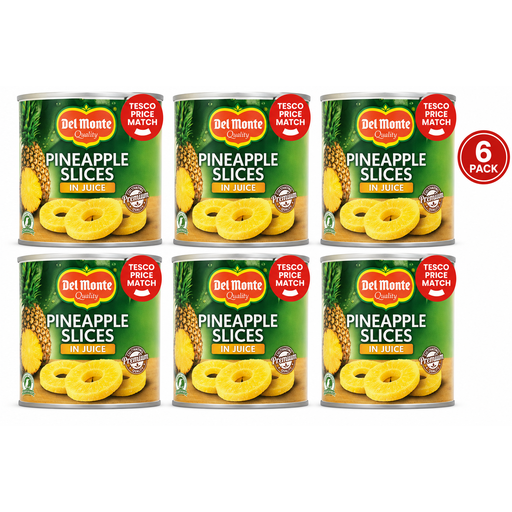
Consider the slices when pineapple will be a visible part of several desserts. Sainsbury’s lists the 435g tin with 260g drained fruit; use the drained quantity to plan how many of the six tins to open. Follow the tin’s instructions for any leftovers.
 No image available
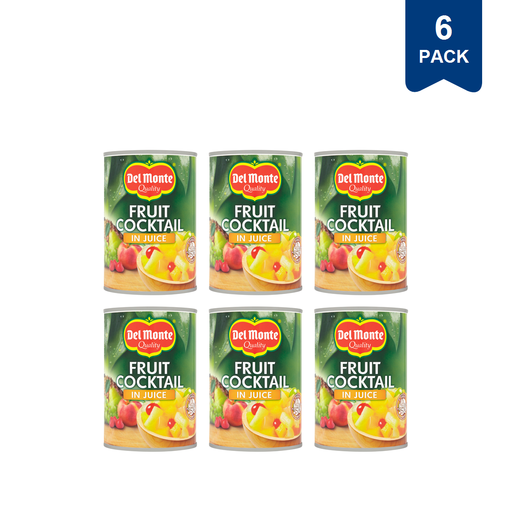
The mixed-fruit format suits a shared bowl when you want variety rather than a single fruit cut. This is a pack of six 415g tins; check the drained weight on the exact pack before working out the serving quantity.
 No image available
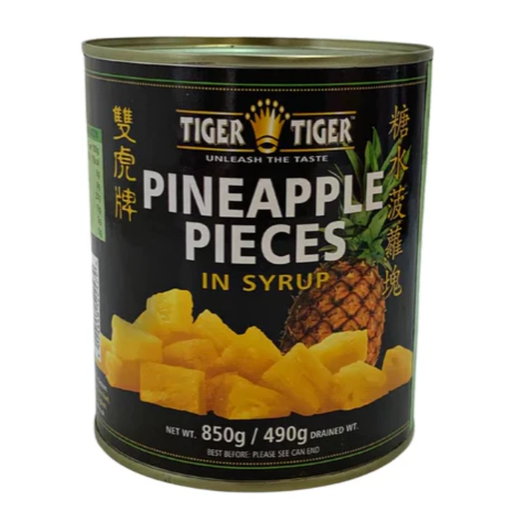
Consider this larger single tin if pineapple pieces fit a shared dessert or fruit salad. The stated 830g is the tin quantity, not a confirmed drained yield; check that figure, the packing liquid and the after-opening instructions before choosing it.
 No image available
Peach halves are an option when the dessert calls for a recognisable piece of fruit on each plate. This is one 415g tin, so check its drained weight and the number of halves against the portions you intend to serve.
 No image available
Choose chunks rather than slices when pineapple will be mixed through a dessert or fruit bowl. This is a 432g tin with juice; check its drained weight to decide how many tins the dish needs.
Use drained weight if the liquid will be discarded. Sainsbury’s lists Del Monte peach slices at 415g net and 250g drained, and Del Monte pineapple slices at 435g net and 260g drained. Check the exact tin before calculating how much fruit will be served.
Choose the packing liquid to fit the dessert: juice may suit fruit you plan to drain and pair with a separate topping, while light syrup is a deliberate option if the recipe uses that liquid. Check the exact ingredients rather than assuming two tins of the same fruit have the same packing liquid.
Follow that tin’s after-opening instructions. For the Del Monte pineapple slices listed by Sainsbury’s, move unused fruit to a suitable non-metallic container, cover it, refrigerate it and use it within 3–4 days; other products may give different instructions.
GOV.UK explains that a best-before date concerns quality rather than being a use-by date; food may not be of the same quality afterwards. Follow the product’s storage instructions, and do not treat the date guidance as a replacement for a product-specific warning or recall.