Shoppers comparing salt
People choosing tinned fruit for breakfasts, desserts or light meals who can manage soft, tender food and want to compare the salt declaration before buying.


Choose tinned fruit for an easy-chew meal by checking whether the fruit is soft and its pieces are manageable for the eater, then compare salt per 100g on the exact tin. If the eater has a prescribed soft-and-bite-sized plan, its requirements for piece size and packing liquid take priority; a lower salt declaration does not establish texture suitability.
People choosing tinned fruit for breakfasts, desserts or light meals who can manage soft, tender food and want to compare the salt declaration before buying.
People preparing fruit for someone prescribed a soft-and-bite-sized texture, where softness, piece size, moisture and separate packing liquid all affect serving.
People choosing a convenient cupboard product who need to consider pack size, ingredients and what to do with fruit left after opening.
For an easy-chew meal, assess the fruit as it will be served before using the salt line and pack information to choose between suitable tins.
| Concern | What to check | Who this matters to |
|---|---|---|
| Texture and pieces | Check softness and piece size before serving. For a prescribed soft-and-bite-sized texture, follow the individual plan for pieces and packing liquid. | If the fruit needs preparing for someone with limited chewing ability, manageable pieces come before the label comparison. About 42% of consumers put texture and preparation first. |
| Salt declaration | Compare salt per 100g on the current label of each exact product; do not use 'in juice' as a substitute for the figure. | When several texture-appropriate tins are available, I want to compare their listed salt on the same basis. For about 33% of consumers, that comparison is the primary concern. |
| Portions and leftovers | Check pack or drained weight and the tin's refrigeration and use-within instructions after opening. | If I prepare one small portion at a time, I need a pack whose leftovers I can use within its stated storage period. Portion and storage planning comes first for about 25% of consumers. |
Easy-to-chew food and a prescribed soft-and-bite-sized texture have different requirements. Royal Berkshire NHS Foundation Trust advises using texture guidance alongside the person's tailored speech-and-language therapy and dietetic advice.
Follow the eater's prescribed plan. University Hospitals Sussex NHS Foundation Trust specifies soft, fork-mashable pieces no larger than 15mm for its soft-and-bite-sized guidance; check how the plan requires any separate packing liquid to be handled.
Similar peach-in-juice products have different declarations: Princes Food and Drinks lists less than 0.01g salt per 100g for its Peach Slices with Juice, while Tesco Groceries lists 0.03g for Tesco Peach Slices in Juice and 0.1g for the Del Monte product it sells.
Compare the current per-100g declaration on the exact tin, rather than relying on its packing-liquid description or brand.
A stone fragment or an oversized piece can undermine the texture you intended to serve.
Inspect the fruit, remove any fragments and cut pieces as required by the eater's plan.
A tin that supplies more fruit than one serving needs also brings product-specific instructions for storing the remainder.
Compare pack and drained weights, then follow the exact label's instructions after opening.
An opened pack can go to waste if its remaining fruit cannot be used within the stated refrigerated storage period.
Princes Peach Slices with Juice offers a peach-in-juice format in 410g and 220g sizes.
Tesco Peach Slices in Juice is a 410g own-label tin for comparing peach slices in juice.
The Del Monte Peach Slices in Juice product listed by Tesco Groceries is a 415g tin with a 250g drained weight.
Marks & Spencer lists tinned-fruit formats including grapefruit segments and rhubarb chunks, alongside references to pineapple, peaches and pears.
These peach products offer a syrup-packed bottle and slices in juice to consider for an easy-chew meal. Check the exact fruit, liquid and label against the eater's needs before serving.
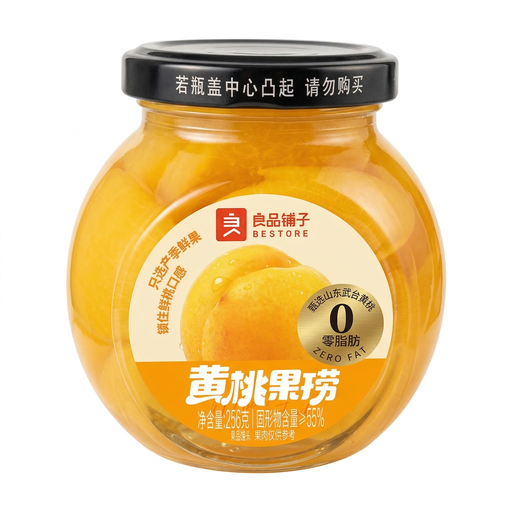 Image unavailable
Consider this yellow peach if a 256g bottle suits the portions you plan to serve. It is packed in syrup; check the fruit's softness and piece size, the packing liquid and the current salt declaration against the eater's needs.
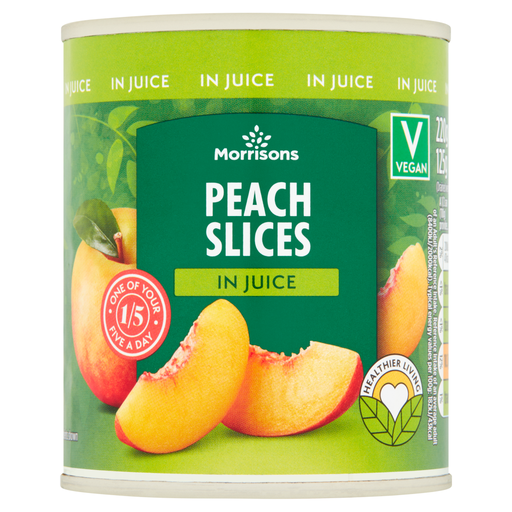 Image unavailable
Consider this 220g pack if peach slices in juice suit your portion plans. Inspect the slices for stone fragments and check their softness and size before serving; use the current tin's salt and storage information when making the final choice.
No: assess whether the fruit is soft, tender and manageable for the individual. For someone with a swallowing difficulty or a prescribed texture level, follow their tailored professional advice rather than assuming that a tinned format is suitable.
Compare salt per 100g on the current label of each exact tin. Princes Food and Drinks lists less than 0.01g per 100g for Princes Peach Slices with Juice; Tesco Groceries lists 0.03g for Tesco Peach Slices in Juice and 0.1g for its Del Monte Peach Slices in Juice listing. Those figures describe the named products, not all peach tins.
Follow the eater's prescribed plan for softness, moisture, piece size and separate liquid. University Hospitals Sussex NHS Foundation Trust specifies pieces no larger than 15mm in its soft-and-bite-sized guidance; a slice straight from the tin should not be assumed to meet that requirement.
Follow the instructions on the exact tin and refrigerate leftovers as directed. Tesco Groceries lists use within two days for its Peach Slices in Juice, while its Del Monte Peach Slices in Juice listing gives three to four days; do not apply either period to a different product.