Families offering fruit without pressure
Small, repeated opportunities to try fruit may be more useful than expecting a child to finish a large serving. NHS guidance advises offering small portions and not forcing a rejected food.


For a fussy-eater meal, choose a tin by its fruit, packing medium and usable portion size rather than by a “sharing tub” description. A familiar single fruit offers a more predictable choice when varied textures put a child off; mixed fruit suits an eater willing to try several kinds. NHS guidance favours tinned fruit in natural juice or water with no added sugar or salt, and a larger tin is worth planning around small servings and leftovers.
Small, repeated opportunities to try fruit may be more useful than expecting a child to finish a large serving. NHS guidance advises offering small portions and not forcing a rejected food.
A single fruit, such as peach slices, gives a child fewer different shapes and textures to consider at once than a fruit cocktail. Berkshire Healthcare NHS Foundation Trust notes that unfamiliar appearance or texture can contribute to food refusal.
Tinned fruit can be served in a small amount alongside a meal or used with yoghurt or custard. If the tin will cover more than one occasion, check its opening and storage instructions before choosing the size.
Decide which fruit the eater is likely to accept, then compare the packing medium and the amount the household can use after opening.
| Concern | What to check | Who this matters to |
|---|---|---|
| Familiar texture and flavour | Compare mixed fruit with one-fruit slices, chunks or halves; check for warnings about possible stones. | If unfamiliar shapes or several fruits together lead to refusal, one known fruit is the starting point. About 42% of consumers put texture predictability first. |
| Packing medium | Read the packing description and ingredients to distinguish natural juice or water from light syrup and added sugar. | When choosing what goes into a small dessert serving, some households prioritise juice or water over syrup. About 33% of consumers place the packing medium first. |
| Portions and leftovers | Compare drained weight or stated servings, then check the tin’s instructions for storing unused fruit. | A child may eat only a little, so the rest of the tin needs a place in later meals or desserts. For about 25% of consumers, manageable portions and leftovers are the main concern. |
The Del Monte light-syrup fruit cocktail listed by Tesco Groceries contains glucose-fructose syrup and sugar. NHS guidance recommends choosing tinned fruit in natural juice or water with no added sugar or salt.
Read both the packing description and the ingredient list. If a syrup-packed fruit is the one the eater accepts, make that an informed choice rather than assuming “light” means no added sugar.
A large tin need not become a large serving. Tesco Groceries lists 250g drained fruit in its 415g Del Monte fruit cocktail, while ASDA Groceries suggests three servings for its 411g peach slices.
Check the drained weight and serving information, then plan another use for any fruit left after opening. Follow the particular tin’s storage directions.
Unused fruit can go to waste if it is not eaten within the refrigerated period stated for that product.
Unfamiliar colours, shapes and textures can put some children off, as Berkshire Healthcare NHS Foundation Trust explains. NHS guidance advises against forcing a child to eat a rejected food.
Offer a small amount without pressure and try again another time. If one fruit is already familiar, consider starting with that rather than a mixed cocktail.
ASDA Groceries warns that stones may remain in its peach slices. The exact ingredients and handling instructions also need to be checked on the tin being served.
Inspect fruit before serving it to a young child, and read the current label when ingredients or allergies matter to the household.
A mixed-fruit option when several fruits and textures are acceptable. Tesco Groceries lists both a 415g fruit cocktail in juice and a 420g fruit cocktail in light syrup.
A single-fruit alternative where pineapple is familiar to the eater. Sainsbury’s Groceries lists Princes 432g pineapple chunks in juice.
An own-label option for comparing fruit, cut and tin size. Sainsbury’s Groceries lists peach slices in fruit juice, including a smaller 213g format.
A single-fruit choice when peach slices are more familiar than a mix. ASDA Groceries lists 411g peach slices in fruit juice with three suggested servings.
These juice-packed pineapple, peach and pear tins offer single-fruit choices for a small meal side or an easy dessert. Choose the fruit and cut the eater knows, then consider whether the tin size suits the portions you plan to serve.
 Image unavailable
Consider this when pineapple chunks are a familiar choice and you want fruit to serve alongside a meal or with yoghurt. The tin is 432g; check its label for portioning and storage after opening.
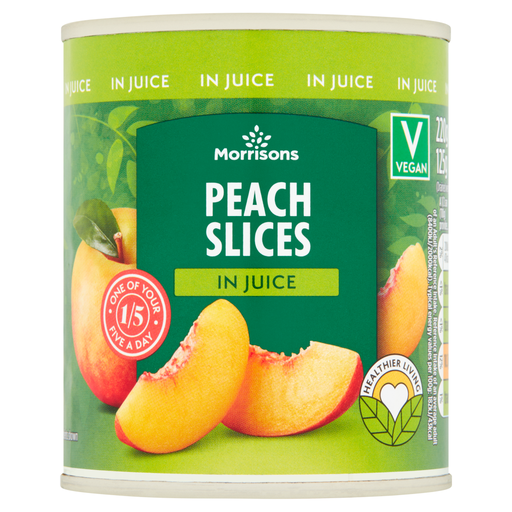 Image unavailable
The 220g tin is worth considering if familiar peach slices and a smaller pack matter more than fruit variety. Check the pieces before serving and use the current label to plan portions and leftovers.
 Image unavailable
Choose the sliced format if it is more familiar to the eater than chunks or mixed fruit. This 435g tin contains pineapple in juice; check how much you will serve and follow the label’s instructions for any remainder.
 Image unavailable
These peach halves offer one fruit rather than a cocktail when peaches are already familiar. The tin is 415g; consider how you will divide the halves into small servings and store what remains.
 Image unavailable
If pears are a familiar fruit, this avoids the variety of a mixed cocktail. The juice-packed pear halves come in a 415g tin; check the pack for serving and post-opening storage directions.
Start with a familiar single fruit if unfamiliar colours, shapes or textures tend to lead to refusal. A mixed cocktail is an option when the child is willing to try several fruits; offer a small amount without pressure, in line with NHS guidance.
Yes. NHS guidance says 80g of fresh, tinned or frozen fruit and vegetables counts as one 5 A Day portion, and advises choosing tinned fruit in natural juice or water with no added sugar or salt. A child’s small introductory serving need not be treated as a portion they must finish.
Follow the instructions on that tin. The Del Monte fruit cocktail listed by Tesco Groceries says to transfer unused contents to a suitable non-metallic container, cover, refrigerate and use within 3–4 days; ASDA Groceries gives a four-day period for its peach slices. Other products can have different instructions.
No. NHS advice for fussy eating is to offer small portions without forcing a rejected food and to try it again another time. That makes a plan for storing the rest of the tin more useful than serving a large amount at once.