Hosts checking gluten suitability
You are serving someone who needs gluten-free food and want to check the fruit, every topping and any baked accompaniment before putting the dessert together.


For coffee with a guest who needs gluten-free food, choose a tin or portion format that suits the group, then check gluten suitability on the exact current pack before serving. Fruit in juice offers one dessert option, while syrup or jelly may suit a different presentation; none of these formats establishes gluten-free status by itself. Check cakes, biscuits and other accompaniments separately.
You are serving someone who needs gluten-free food and want to check the fruit, every topping and any baked accompaniment before putting the dessert together.
You want fruit that is quick to portion when friends arrive. A shared tin and separate servings call for different amounts of draining, plating and storage.
You want to choose between juice, syrup and jelly using the exact ingredient list and nutrition panel, rather than assuming all tinned fruit has the same recipe.
For a gluten-free coffee-time dessert, check suitability for the guest before settling on the fruit, serving format and accompaniments.
| Concern | What to check | Who this matters to |
|---|---|---|
| Gluten suitability | Check the current pack for a gluten-free claim, then read its ingredients and precautionary wording. Check dessert additions separately. | If my guest needs strict gluten avoidance, I want clear assurance about the fruit before serving it; about 33% of consumers put gluten suitability first. |
| Fruit and packing liquid | Compare the exact ingredients and nutrition figures on the same basis, such as per 100 g or per serving. | When choosing fruit to serve with other dessert ingredients, I care which liquid and ingredients are in the tin; about 27% of consumers put the formulation first. |
| Serving ease | Check portions, drained weight where stated, and instructions for storing leftovers. | If friends will serve themselves, I may prefer a shared tin; for separate desserts, I want easier portioning. About 20% of consumers make serving ease their main concern. |
| Amount for the group | Compare usable fruit and expected servings, rather than treating the total weight of tins and pots as equivalent. | I want enough fruit for everyone without opening more than we will use; for about 20% of consumers, the amount needed is the primary concern. |
An ingredient list helps identify declared gluten-containing cereals, but it does not establish that the product meets a gluten-free claim. Formulations and labels can also change.
For a guest who needs strict gluten avoidance, check the current pack’s gluten-free wording, full ingredients and any precautionary statement.
Cake, biscuits, cereal toppings or sauces need their own suitability checks, even when the fruit has been checked.
Check each component and use clean utensils and serving dishes where avoiding gluten cross-contact matters for your guest.
A tin’s total weight includes its packing liquid, so it may not tell you how much fruit you can put on plates.
Check drained weight where stated, expected servings and whether you want one shared dish or separate portions.
These formats can have different ingredients, serving sizes and nutrition figures. A figure per serving cannot be compared directly with one per 100 g.
Choose the format for the dessert you plan to make, compare like-for-like nutrition information and check gluten suitability for that exact product.
These brands and retailer ranges provide points of reference for fruit formats; check the exact product rather than assuming a brand-wide gluten-free status.
Own-label tinned fruit includes Tesco Peach Slices in Juice 410 g.
Own-label fruit includes a 213 g peach-slices-in-juice can intended as one serving.
Princes Peach Slices with Juice is listed in 220 g and 410 g sizes.
UK retailer listings include Del Monte fruit formats such as peach slices and fruit cocktail in juice.
M&S lists tinned fruit and has a separate Made Without range.
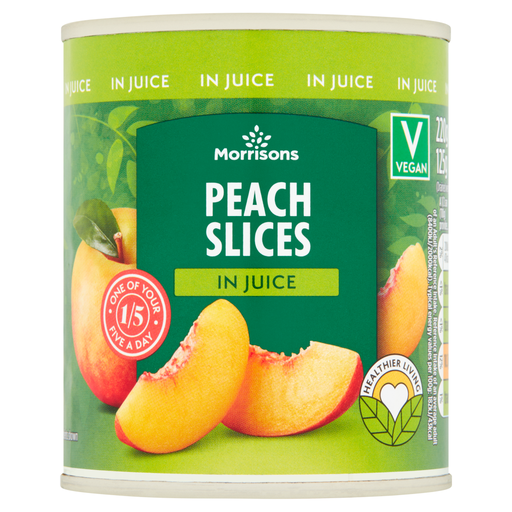
This peach-slices-in-juice tin is a fruit option for a coffee-time dessert. Its listing describes it as gluten-free, but check the current pack and any accompaniments before serving a guest who needs strict gluten avoidance.
 No image available
Consider this 220 g tin if you want sliced peaches in juice to portion into a coffee-time dessert. The listing names peaches, clarified grape juice and citric acid, and describes the product as gluten-free; confirm that wording and any precautionary information on the current pack. Its description advises transferring leftovers to a non-metallic container, refrigerating them and using them within 2 days. It also warns that stone fragments may occasionally remain.
No. An ingredient list without a declared gluten-containing cereal is useful to read, but it is not an explicit gluten-free claim. Coeliac UK explains that UK food labelled gluten-free must contain no more than 20 mg/kg of gluten; check the current product’s wording when you need that assurance.
Check the fruit’s current pack for a gluten-free claim where that assurance is needed, then read its ingredients and precautionary information. Coeliac UK advises checking food labels for cereals containing gluten; apply the same care to every dessert accompaniment and avoid cross-contact during preparation.
No. The fruit’s suitability does not establish the suitability of cake, biscuits, crumble toppings or other additions. Check each product separately and use clean utensils and dishes when preparing the dessert.
Follow the instructions on the exact pack. Tesco Groceries advises transferring unused Tesco Peach Slices in Juice to a non-metallic container, covering and refrigerating them, and consuming them within 2 days. Sainsbury's gives a 1-day refrigerated use period for its 213 g Peach Slices in Fruit Juice can, so do not apply one product’s timing to another.