Breakfast planners checking added sugar
If you add fruit to yoghurt, cereal or porridge regularly, the packing liquid, ingredients and sugars per 100g help you distinguish products that look similar on the front of the pack.


For regular weekday breakfasts, the NHS advises choosing tinned fruit in natural juice or water with no added sugar or salt; check the ingredients and compare sugars per 100g, since fruit in juice can still contain sugars. Choose pots when you are unlikely to finish a tin promptly, or a larger tin when you can store and use the remainder according to its label. If you prefer fruit in syrup, check the exact ingredients rather than treating “light syrup” as sugar-free.
If you add fruit to yoghurt, cereal or porridge regularly, the packing liquid, ingredients and sugars per 100g help you distinguish products that look similar on the front of the pack.
If mornings leave little time for preparation, a ready-to-eat portion may be easier to use than opening a tin and storing the remainder.
If you will use fruit across multiple breakfasts, compare the amount of fruit after draining and check how soon an opened pack must be finished.
Start with the packing liquid and ingredients, then choose a pack format you can use within its post-opening instructions.
| Concern | What to check | Who this matters to |
|---|---|---|
| Packing liquid and ingredients | Check for added sugar in the ingredients; compare sugars per 100g on the nutrition labels. | If fruit is a regular breakfast topping, I want to distinguish juice or water from syrup without assuming juice contains no sugars. About 30% of consumers would put ingredients and nutrition-label comparison first. |
| Portion format | Compare a standard tin with individual pots or a multipack, and check the quantity in each portion. | On a rushed morning, I may need one ready-to-eat portion without leaving an opened tin to store. For about 40% of consumers, ease of portioning would be the primary concern. |
| Usable fruit and leftovers | Compare drained weight where shown, then check the best-before date and post-opening storage instructions. | When several breakfasts are planned, I need enough usable fruit without throwing away what remains after opening. That would be the main priority for about 30% of consumers. |
Princes lists sugar among the ingredients of its peach slices in light syrup. Its peach slices with juice have a different ingredient list.
Check the exact variant’s ingredients and compare sugars per 100g rather than relying on the wording on the front.
Net weight includes the fruit and its packing liquid, so it does not tell you how much fruit remains after draining.
Use drained weight where it is shown when comparing tins for several breakfasts.
An unopened storecupboard tin and its leftovers have different storage needs. For M&S grapefruit segments, the pack instructions specify transfer to a non-metallic container, refrigeration and use within two days.
Choose a size you can finish, and follow the storage and open-life directions on the particular pack.
A listing is no substitute for the label on the pack you are buying when ingredients or storage directions affect your choice.
Check its current ingredients, nutrition panel, drained weight, date and storage instructions.
Princes offers peach slices in both juice and light syrup, making the exact variant important when shopping for breakfast.
Del Monte has fruit-in-juice options, including pineapple slices, peach halves and pear halves represented in the selections below.
Tesco Groceries lists tinned fruit alongside portioned fruit formats, offering two pack types to compare for breakfast use.
M&S lists grapefruit segments as a storecupboard fruit option.
These fruit-in-juice options include standard tins for planned servings and a four-pot pack for individual breakfasts. Check each pack’s ingredients, usable quantity and storage directions against how you intend to use it.
 No image available
Consider these pineapple slices when you want a juice-packed fruit topping from a standard tin. The stated pack size is 435g; check its drained weight and directions for storing any remainder when comparing servings.
 No image available
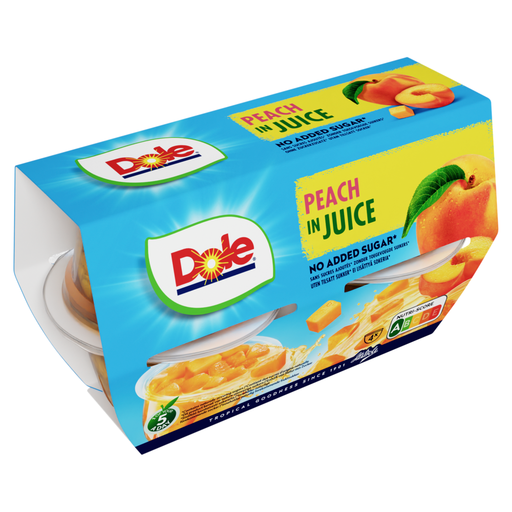
The four separate 113g pots suit breakfasts where opening one portion at a time matters more than using a standard tin. Check the ingredients and nutrition panel if the type of juice or sweetening matters to you.
 No image available
Choose this 432g tin if pineapple chunks in juice fit breakfasts you have already planned. Check the drained weight when comparing the amount of fruit with other tins, and follow the pack’s instructions for leftovers.
 No image available
These peach halves offer a juice-packed alternative to pineapple for a planned breakfast serving. The tin is labelled 415g; compare its drained weight with other packs and check how to store any fruit left after opening.
 No image available
Consider this 415g tin if you prefer pear halves in juice for breakfast. If usable fruit quantity will decide between tins, check the drained weight on the current pack rather than comparing net weights alone.
Yes. The NHS says 80g of canned fruit counts as one portion of 5 A Day and advises choosing fruit canned in natural juice or water with no added sugar or salt.
No. Princes lists sugar in its light-syrup peach slices, while its peach slices with juice list peaches, grape juice, water, citric acid and ascorbic acid. Check the exact product’s ingredients rather than assuming “light syrup” means sugar-free.
Follow the particular pack’s post-opening directions. M&S instructs buyers of its grapefruit segments to transfer leftovers to a non-metallic container, refrigerate them and eat them within two days; that period should not be assumed for every tinned fruit product.
No. GOV.UK notes that how long canned food remains acceptable after its best-before date depends on the product, storage conditions and brand. Check the date and storage directions for unopened packs, then follow the separate instructions that apply after opening.