Households planning regular toddler dinners
If tinned fruit is a regular meal component, compare the amount of drained fruit and choose a tin size your household is likely to use.


For a toddler dinner, start by comparing fruit packed in juice rather than assuming a light-syrup tin is interchangeable. Check the ingredients, the amount of drained fruit and whether the tin size suits your household; whichever fruit you choose, adapt the pieces to the child’s chewing ability and supervise eating.
If tinned fruit is a regular meal component, compare the amount of drained fruit and choose a tin size your household is likely to use.
If you want to distinguish juice-packed fruit from syrup, read the exact variant name, ingredients and nutrition panel rather than relying on the front of the tin.
If you serve slices, chunks or halves to a toddler, consider the child’s chewing ability. NHS guidance advises preparing food in manageable pieces and supervising young children while they eat.
For consumers choosing tinned fruit as part of a toddler dinner, the packing liquid, usable fruit and serving format each affect the choice.
| Concern | What to check | Who this matters to |
|---|---|---|
| Packing liquid and ingredients | Check whether the fruit is packed in juice or syrup, then read the ingredients and sugars on the nutrition panel. | If I want to avoid choosing a syrup recipe by mistake, I need to check the exact tin rather than assume that all peach slices are alike. About 33% of consumers put the packing liquid and label first. |
| Amount of drained fruit | Compare drained weight where stated, alongside the tin size. | For fruit served regularly at dinner, I want to know how much fruit remains once the liquid is drained. That usable quantity is the primary concern for about 27% of consumers. |
| Portions and fruit shape | Look at the number and size of tins, and whether the fruit comes as slices, chunks or halves. | When I open fruit only occasionally, a smaller tin may fit how much the household will use; the shape also affects preparation. About 20% of consumers put portion and texture practicality first. |
| Serving preparation | Inspect the fruit for hard pieces and cut it to suit the child’s chewing ability; supervise eating. | Before serving a toddler, I need to make sure each piece is manageable for that child. Safe preparation is the leading concern for about 20% of consumers. |
A tin contains both fruit and packing liquid, so its total weight does not tell you how much fruit you will serve.
Check the drained weight where it appears on the pack or listing, and consider whether your household will use the fruit after opening.
A tin that is too large for the household can leave fruit unused.
The Princes light-syrup peach listing names sugar in its ingredients; its juice-packed peach product has a different ingredient list. Fruit packed in juice is not necessarily sugar-free.
Check the exact variant and compare its ingredients and nutrition panel before choosing it for a toddler dinner.
Halves, slices and chunks may still be too large for an individual child. NHS guidance identifies food as a choking hazard for young children.
Inspect the fruit, remove any stones or hard pieces, cut it into manageable pieces for the child and stay with them while they eat.
Tesco Groceries lists several juice-packed tinned fruits, including peach pieces, pears and pineapple.
Sainsbury’s lists own-label fruit in juice, including peach slices, apricots, mandarins and pear halves.
ASDA lists own-label peach slices in fruit juice in a 411g tin.
Princes offers peach slices with juice as well as a separate light-syrup variant.
Tesco Groceries lists Del Monte peach slices in both juice-packed and light-syrup formats.
M&S lists tinned fruit among its food-cupboard products, including grapefruit segments and canned rhubarb.
These juice-packed peach and pineapple products offer smaller tins, slices, halves and chunks to consider for a toddler-dinner fruit component. Check each pack’s usable quantity and adapt the pieces before serving.
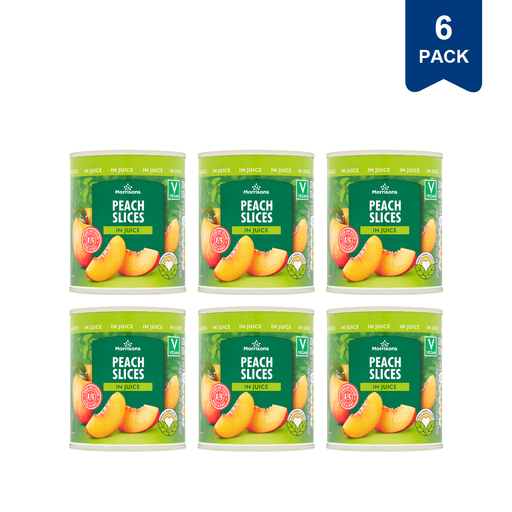 No image available
Consider the separate 220g tins if you usually open a smaller amount at a time. Check how you will use any fruit left after opening, and cut the slices to suit the child’s chewing ability.
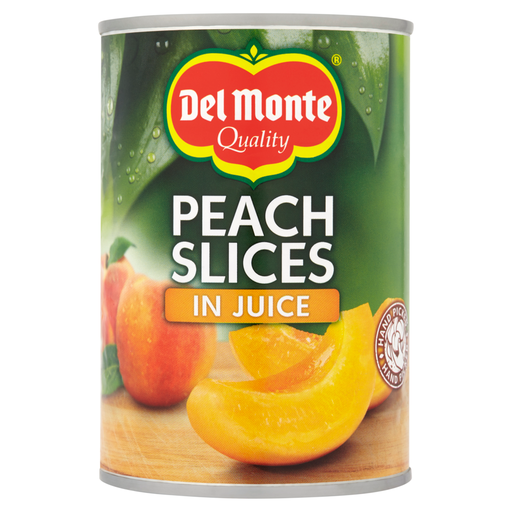 No image available
This branded peach option comes as slices in a 415g tin. Check the pack’s drained quantity when comparing usable fruit, and cut the slices further if needed for the child.
 No image available
Choose this format if the household wants pineapple slices rather than peaches. Inspect and cut the slices into pieces appropriate for the child, and check the drained quantity for portion planning.
 No image available
Peach halves suit households willing to prepare the fruit before serving. Cut each half into manageable pieces for the child and use the pack’s drained quantity when planning portions.
 No image available
This 432g tin offers pineapple in chunks rather than slices. Do not assume the chunks are ready to serve to a toddler: inspect them and cut them further where needed.
Start with the ingredients of the exact tins you are comparing. The Princes light-syrup peach listing includes sugar, while Princes lists a different ingredient composition for its peaches with juice; fruit in juice is not necessarily sugar-free, so check the nutrition panel too.
No. Check the drained quantity and consider how much fruit your household will use after opening. A smaller tin may be more convenient for occasional dinners, while a larger tin may suit a household that can use the remainder.
Inspect it for stones or hard pieces, cut it into pieces appropriate to the child’s chewing ability and stay with them while they eat. NHS guidance advises preparing food safely for babies and young children.
Follow the instructions on the exact product. For its Peach Slices with Juice, Princes advises transferring leftovers to a sealed container, refrigerating them and using them within three days.