Dessert planners watching portions
If a tin needs to cover dinner and another serving, compare its drained weight with its total weight. The liquid counts towards the latter, but not towards the amount of fruit on the plate.


For a student dinner, choose tinned fruit in juice when you want a straightforward dessert topping; choose light syrup when its sweet liquid has a role in a crumble or custard dessert. Compare drained weights to see how much fruit each tin supplies, then check the ingredients and instructions for storing any leftovers.
If a tin needs to cover dinner and another serving, compare its drained weight with its total weight. The liquid counts towards the latter, but not towards the amount of fruit on the plate.
If you want fruit for dessert, breakfast or yoghurt without choosing a syrup-packed product, start with the ingredients list. The NHS advises choosing tinned fruit in natural juice or water with no added sugar or salt.
If you are making crumble or serving fruit with custard, the fruit format and packing liquid can be part of the recipe. Marks & Spencer describes its rhubarb chunks in light syrup as suitable for pies, crumbles or custard.
For a student dinner, decide how you will serve the fruit before choosing its packing liquid and tin size.
Choose when: You want fruit to serve as it is or add to yoghurt.
Consider: If the liquid needs to sweeten a crumble or custard dessert, check whether juice suits that recipe.
Choose when: You intend to use the sweet liquid in the dessert.
Consider: Light syrup can contain added sugar, so read the exact product’s ingredients.
| Concern | What to check | Who this matters to |
|---|---|---|
| Usable fruit | Compare drained weights, then consider whether the fruit shape suits the dessert. | If I need one tin to cover dinner and another serving, I want to know how much fruit it contains rather than count its liquid. About 29% of consumers would put usable fruit quantity first. |
| Packing liquid | Read the ingredients and nutrition panel for the exact juice, water or syrup product. | For fruit I can also put on breakfast or yoghurt, I would choose the packing liquid deliberately rather than assume all tins are alike. Packing liquid would be the primary concern for about 29% of consumers. |
| Dessert use | Match halves, slices or chunks and their liquid to the dish you plan to make. | When dinner needs a simple pudding, I want fruit that works with my chosen topping, crumble or custard. About 24% of consumers would chiefly focus on that dessert use. |
| Leftovers | Check the opened-tin storage instructions and plan another use if the tin is more than you need. | Cooking for one, I need to know whether I can use the remaining fruit within the time stated on its label. Avoiding leftovers going to waste would come first for about 18% of consumers. |
Total weight includes the packing liquid. Tesco Groceries lists the Del Monte Peach Halves in Juice tin as 415g overall, with 235g drained fruit.
Compare drained weights when planning how much fruit you can serve.
The Princes Peach Slices in Light Syrup listing on Joybuy includes sugar in the ingredients. A label such as “light syrup” does not tell you everything about the contents.
Choose syrup when you want its sweet liquid in the recipe; otherwise, check the ingredients for fruit packed in juice or water.
Opened-storage instructions differ by product. The Del Monte peach listing gives 3–4 days after opening, while the Marks & Spencer rhubarb and grapefruit instructions give two days.
Follow the label for your tin and plan another serving, such as fruit with yoghurt or porridge, before opening it.
Peach halves, peach slices and rhubarb chunks serve different recipes. Marks & Spencer suggests rhubarb chunks for crumbles and custard; that does not make every rhubarb tin suitable for every dessert.
Decide whether the dish needs a visible fruit topping, pieces for a crumble or a sweet packing liquid, then check the exact tin.
Tesco Groceries lists Del Monte fruit in several formats, including peaches, fruit cocktail and mandarins in juice, as well as mango slices in syrup.
Tesco Groceries lists Princes peach slices in juice, while Joybuy lists peach slices in light syrup.
Tesco Groceries lists own-brand peach slices in light syrup and a pear-and-peach pieces format alongside branded tinned fruit.
Marks & Spencer describes rhubarb chunks in light syrup for pies, crumbles and custard, and grapefruit segments packed in grapefruit juice.
This editorial sequence brings together product details from Tesco Groceries, Joybuy and Marks & Spencer. It moves from juice-packed peaches to syrup-packed peaches and rhubarb for particular desserts; it is not an independent product test or a third-party ranking.
| Position | Product | Main specifications | Why consider it | Platform |
|---|---|---|---|---|
| 1 | Princes Peach Slices With Juice 410g | Peach slices in juice; 410g tin. | Tesco Groceries lists this as a juice-packed sliced-peach option for a dessert topping. Check its drained weight when deciding how many servings it provides. | Tesco |
| 2 | Del Monte Peach Halves in Juice 415g | Peach halves in juice; 415g net and 235g drained weight. | Tesco Groceries provides the drained weight, making this a useful option when whole peach halves suit the presentation. | Tesco |
| 3 | Princes Peach Slices in Light Syrup 410g | Peach slices in light syrup; 410g tin. Sugar is listed in the ingredients. | Joybuy’s product information identifies a syrup-packed option for a recipe that calls for a sweet packing liquid. | Joybuy |
| 4 | M&S Rhubarb Chunks 560g | Rhubarb chunks in light syrup; 560g tin. | Marks & Spencer suggests using the chunks in pies or crumbles, or heating them to serve with custard. | M&S |
These tins offer juice-packed fruit for straightforward toppings and a light-syrup mango option for a sweeter dessert. Choose by fruit format, drained quantity where stated, and how you will use any leftovers.
 Image unavailable
Choose peach halves when you want visible fruit pieces for dessert. The 415g tin contains 235g drained fruit packed in clarified pineapple juice from concentrate; follow its instructions to refrigerate leftovers and use them within 3–4 days.
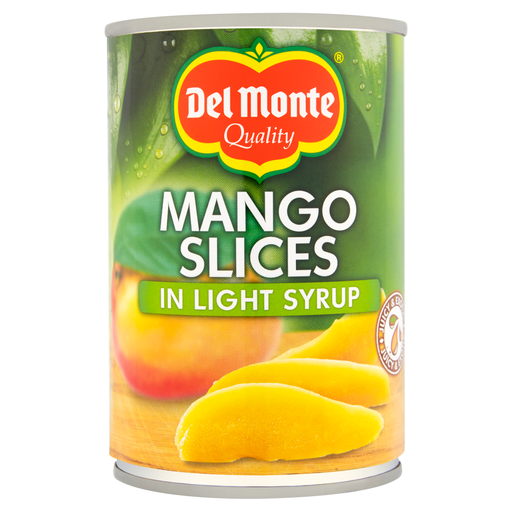 Image unavailable
Consider mango slices when the syrup will be part of a sweeter dessert. The 425g tin has a stated drained weight of 230g; sugar is listed among its ingredients. Refrigerate leftovers and use them within the stated 3–4 days.
 Image unavailable
The 220g tin offers peach slices for a smaller dessert or breakfast serving. Its described drained quantity is approximately 125–130g rather than an exact stated weight; use refrigerated leftovers within the listed two days.
 Image unavailable
Use this fruit cocktail when you want several kinds of fruit in a quick dessert. The 415g tin lists peaches, pears, pineapple, grapes and cherries in juice; check the pack’s drained weight if the amount of fruit matters for serving plans.
 Image unavailable
Choose pineapple chunks for a ready-to-eat dessert or yoghurt topping. The 432g pack is described as two 216g servings, including juice; check the drained weight when planning fruit portions and use refrigerated leftovers within two days.
No. Fruit in juice works for a straightforward topping, while light syrup can suit a recipe that uses the sweet liquid, such as fruit served with custard. The NHS advises choosing tinned fruit in natural juice or water with no added sugar or salt; whichever format you choose, read the exact ingredients.
Drained weight tells you how much fruit remains without the packing liquid. Tesco Groceries lists a Del Monte Peach Halves in Juice tin at 415g overall but 235g drained, so the two figures answer different questions when you plan servings.
Follow the instructions on the exact product. Del Monte’s peach instructions say to transfer unused contents to a suitable non-metallic container, cover and refrigerate them, then use them within 3–4 days; the Marks & Spencer rhubarb and grapefruit instructions give two days.
No. GOV.UK explains that a best-before date concerns quality rather than serving as an opened-product storage instruction. Once you open a tin, follow that product’s directions for storing and using the remaining fruit.