Added-sugar minimisers
You want cupboard fruit without added sugar from syrup or other sweetening ingredients. The NHS advises choosing canned fruit in natural juice or water with no added sugar.


For a lower-added-sugar choice, start with tinned fruit in water or natural juice with no added sugar, as the NHS advises, rather than assuming a light-syrup or reduced-sugar label means the same thing. Fruit and juice can still contain naturally occurring sugars, so compare the exact product’s nutrition panel per 100g and choose a drained portion and pack size that work for you.
You want cupboard fruit without added sugar from syrup or other sweetening ingredients. The NHS advises choosing canned fruit in natural juice or water with no added sugar.
You want to compare sugars and energy on the label, then serve an amount of drained fruit that fits your eating pattern.
You want a practical tin or pot size and need to distinguish its total contents from the amount of fruit left after draining.
Check the packing liquid first, then compare the nutrition panel and the amount of fruit you expect to serve. A fruit-in-juice pot and a light-syrup tin may look similar on the shelf but answer different needs.
| Concern | What to check | Who this matters to |
|---|---|---|
| Added sugar | Read the packing description and ingredients; distinguish natural juice or water with no added sugar from light syrup. | If I want convenient fruit without added sweetening, the liquid matters as much as the fruit itself. About 46% of consumers put avoiding added sugar first. |
| Sugars and portion | Compare sugars and energy per 100g, then use the drained weight to plan what you will serve. | When I serve fruit from a larger tin, I want to know both what the label says and how much fruit is on my plate. Managing total sugars and the portion is the primary need for about 36% of consumers. |
| Pack format | Compare the stated drained quantity and choose a tin or pot size you can use according to its storage instructions. | If I keep fruit in the cupboard, a pack I can finish without leaving unwanted fruit matters to me. Around 18% of consumers put practical pack format first. |
Fruit, including fruit packed in juice, can contain naturally occurring sugars. A claim about added sugar does not describe the total sugars in a serving.
Use the claim to assess added sweetening, then compare sugars and energy per 100g on the exact product.
Sainsbury’s and Tesco listings include fruit packed in juice as well as syrup variants. The same kind of fruit can therefore come with a different packing liquid.
Read the full product name and ingredients before choosing a tin or pot.
A pack’s stated weight can include liquid, while the drained weight describes the fruit available after draining.
Check drained weight where stated and consider whether you will use the remaining fruit after opening.
Storage instructions are product-specific. Marks & Spencer instructs buyers of its grapefruit segments to transfer leftovers to a non-metallic container, refrigerate them and eat them within two days.
Check your own pack before opening and choose a size you can use within its stated period.
These ranges offer useful examples of packing formats; check the exact product rather than assuming every fruit sold under a brand has the same ingredients.
Sainsbury’s lists Del Monte fruit-in-juice products alongside a light-syrup variant.
Princes offers canned pineapple in juice, while Tesco also lists Princes fruit in syrup.
Tesco lists own-label fruit-in-juice tins and portioned fruit formats.
Sainsbury’s lists own-label tinned fruit in juice alongside light-syrup products.
M&S lists grapefruit segments packed in grapefruit juice.
These juice-packed pineapple, peach and mixed-fruit options include tins and portioned pots. Compare their exact labels if avoiding added sugar or planning a drained portion is your priority.
 No image available
Consider this tin if you want pineapple chunks packed with juice and prefer to portion fruit from a can. The stated pack size is 432g; check the can’s drained weight when comparing how much fruit you will serve. Fruit in juice is not sugar-free.
 No image available
Choose this format if pineapple slices are more useful to you than chunks. The tin is labelled 435g and packed in juice; use the drained-weight and nutrition information on the exact pack to plan a portion rather than treating the full tin as one serving.
 No image available
This 415g tin offers peach halves in juice if you prefer to decide the serving size yourself. Check its per-100g nutrition and drained weight on the can, and follow its instructions for any fruit left after opening.
 No image available
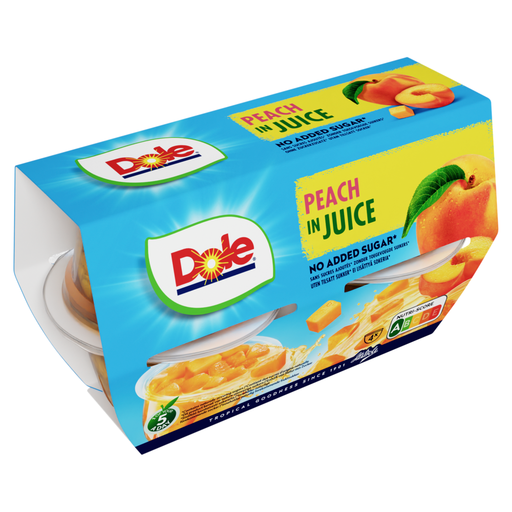
The four individual pots may suit you if opening one portion at a time is more practical than opening a tin. The product information pairs a no-added-sugar claim with an ingredient list that includes steviol glycosides; check that list if you want to avoid sweeteners as well as added sugar. The 113g figure is the pot size, not a stated drained-fruit weight.
 No image available
This 415g tin is an option if you want mixed fruit packed in juice rather than a single fruit. Check the exact can’s sugars per 100g and drained weight before deciding how much to serve; juice packing alone does not establish that the fruit is sugar-free.
No. Fruit can contain naturally occurring sugars, including when it is packed in juice. Compare the sugars figure on the exact product’s nutrition panel rather than reading a no-added-sugar claim as a sugar-free claim.
If avoiding added sugar is your main concern, the NHS advises choosing canned fruit in natural juice or water with no added sugar. You still need to check the exact product’s ingredients, sugars and energy per 100g, and the portion you intend to eat.
Follow that product’s pack instructions. For its grapefruit segments, Marks & Spencer specifies transferring leftovers to a non-metallic container, refrigerating them and eating them within two days; do not assume the same period applies to another tin.
Yes. The NHS says 80g of canned fruit counts as one portion for 5 A Day and advises choosing fruit in natural juice or water with no added sugar.